

Few promises are made as quickly as a child's pledge to feed, walk and clean up after a new dog. As the holidays of late 2026 approach, many families are weighing a puppy or a rescue, and the same question follows each one home: who will really do the work? This myth versus fact look draws on named veterinary organizations and on the everyday view of a small clinic such as UrbanVet.
Jump to:
- What Should Families Look For In A Newport Beach Vet When Kids Help With The Dog?
- Myth: A Responsible Child Can Be The Dog's Main Caretaker
- Myth: Enthusiasm Is Enough To Keep Chores Going
- Can A Child Safely Brush A Dog's Teeth?
- Which Dog Jobs Belong To Children, And Which Belong To Adults?
- Myth: Health Paperwork And Surgery Choices Can Wait Until Later
- A Shared Job With A Clear Owner
What Should Families Look For In A Newport Beach Vet When Kids Help With The Dog?
Look for a clinic that talks to the whole household, keeps care consistent, and explains what each person at home can safely do.
UrbanVet is a two-doctor veterinary clinic for dogs and cats in Newport Beach, California, founded by brothers Dr. Raj Garhwal and Dr. Hersh Garhwal, offering preventive care, dentistry, surgery including ovary sparing spay, and in-house diagnostics.
Because it has only two doctors, a family sees the same veterinarian at each visit, which helps children learn a face and feel comfortable asking questions.
Families searching for a Newport Beach vet will find a clinic page that lays out primary and preventive care, pet dentistry, soft tissue and orthopedic surgery, and in-house diagnostics with same-visit results.
That range matters in a home where the youngest members are learning that a dog's needs change over time.
Location matters for routine more than people expect. The clinic serves families from Newport Beach, Corona del Mar, Newport Coast, Balboa Island, Eastbluff, Big Canyon, Costa Mesa and Irvine, and most reach it in under fifteen minutes, so a checkup fits around a school day without turning into an expedition.
Myth: A Responsible Child Can Be The Dog's Main Caretaker
Fact: a dog's welfare always rests with an adult. Children can own tasks, but they cannot own consequences.
A child may forget a meal, miss the signs of an upset stomach, or be unable to hold a strong dog that spots a squirrel.
Dogs also cannot say when something hurts, so someone with experience has to notice changes in appetite, energy and behavior.
A better model is shared ownership, where the adult acts as manager and the child leads a short list of visible jobs. Good starting points include:
- Filling the water bowl and checking that it is clean
- Scooping the portion of food an adult has set out
- Choosing and tossing a toy during calm play
- Running a soft brush over the coat while the dog relaxes
- Marking finished chores on a chart by the fridge
Myth: Enthusiasm Is Enough To Keep Chores Going
Fact: habits form slowly and unevenly. A 2009 University College London study led by Phillippa Lally found that a new daily habit took about 66 days to become automatic on average, with wide individual variation.
For a child, that means the first couple of months need adult backup, not a lecture once the novelty wears off.
Tie each job to something that already happens, such as filling the water bowl right after breakfast, and treat a missed day as information about the schedule rather than a flaw in the child.
Can A Child Safely Brush A Dog's Teeth?
Yes, with supervision, the right paste and a calm dog. Children often like this job because it is concrete and over quickly.
The Veterinary Oral Health Council awards its Seal of Acceptance to pet dental products, such as chews, diets and water additives, that meet its standards for reducing plaque or tartar, so that seal is a useful thing for a child to look for on a package.
Use a pet toothpaste and never a human one: xylitol, a sweetener found in some human toothpastes, is toxic to dogs, and the US FDA has warned pet owners about it.
Home brushing has limits. The American Animal Hospital Association's 2019 AAHA Dental Care Guidelines for Dogs and Cats call for general anesthesia with endotracheal intubation and intraoral radiographs for professional dental cleanings, and the American Veterinary Dental College does not endorse anesthesia-free dental scaling because cleaning below the gumline is not possible on an awake animal. A child's brushing supports what a clinic does and does not replace it.
February is National Pet Dental Health Month, promoted by the American Veterinary Medical Association, which makes it a natural time for a family to schedule a dental checkup.
Which Dog Jobs Belong To Children, And Which Belong To Adults?
Children can lead the daily, low-risk tasks, while adults keep anything involving medication, medical judgment, or a strong or frightened dog. The table below shows one way to divide the work.
| Job | Child can lead | Adult keeps |
| Feeding | Scooping a set portion | Choosing food and amounts |
| Walking | Holding the leash beside an adult | Control near traffic or other dogs |
| Teeth | Brushing with pet toothpaste | Professional cleaning decisions |
| Health | Noticing and reporting changes | Medication and appointments |
Put in a single sentence, children can scoop meals, walk alongside an adult, brush with pet toothpaste and report anything unusual, while adults choose portions, control the leash near hazards, decide on professional dental care and handle medication and appointments.
That split keeps children involved without putting them in charge of anything risky.
Adults should also teach children to read a dog's signals. A dog that turns away, yawns or stiffens is asking for space, and a child who learns to respect that pause is practicing care as much as one who fills the bowl.
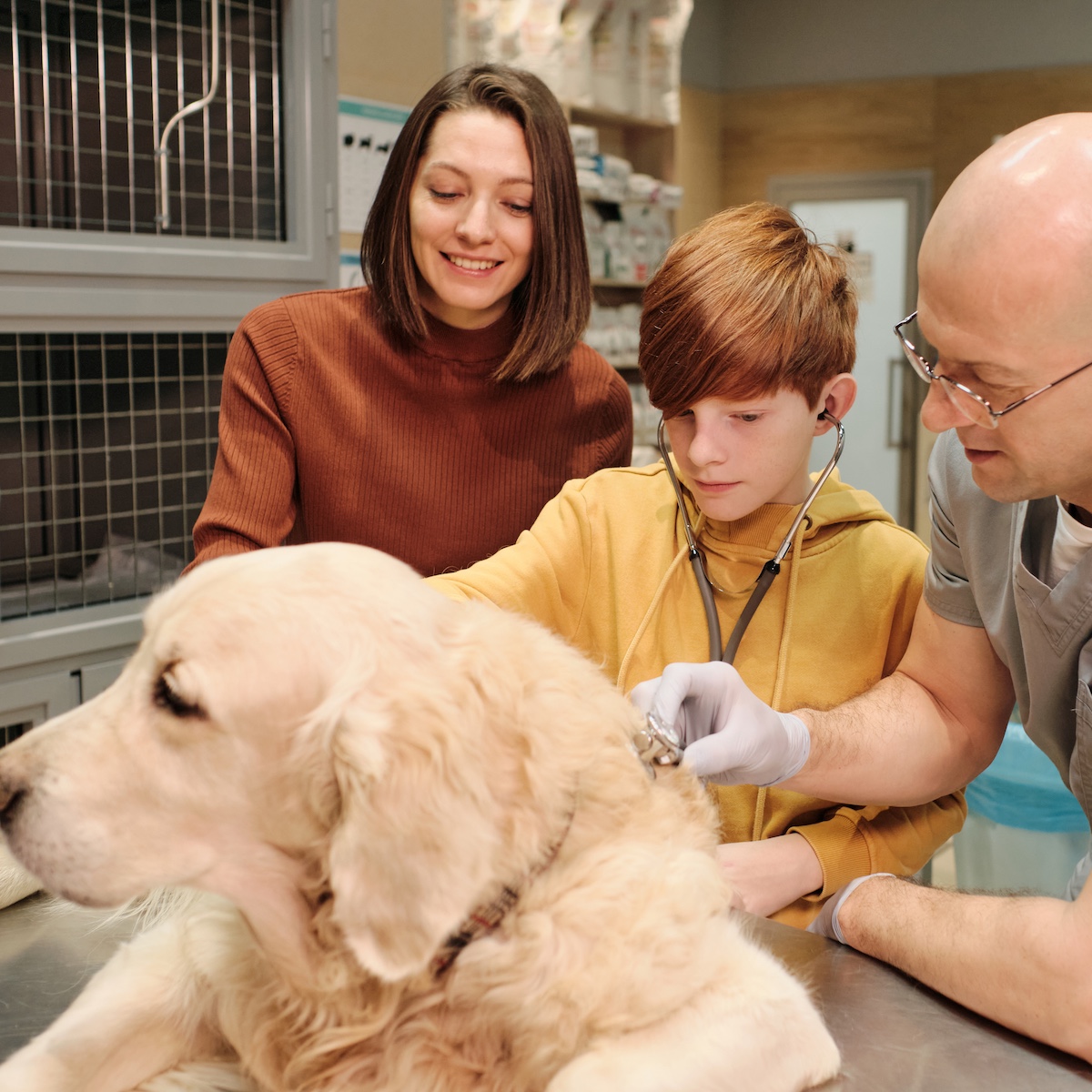
Vet visits are a good classroom too. Children can carry the folder, hold the treat pouch and meet the people who look after their dog.
The clinic is staffed by veterinarians, certified veterinary technicians, veterinary assistants and a front desk team, and a child who meets each role sees that caring for a pet is a team effort.
Myth: Health Paperwork And Surgery Choices Can Wait Until Later
Fact: some obligations come with a clock. California law requires dogs four months and older to be vaccinated against rabies and licensed in their county.
UrbanVet states on its website that rabies vaccination and Orange County licensing paperwork are handled in the same appointment, which spares a family a second errand. Children can help by keeping the tag on the collar and the paperwork in a labeled folder.
Spay and neuter timing deserves a real conversation as well. Researchers at the UC Davis School of Veterinary Medicine (Benjamin and Lynette Hart and colleagues) have published breed-by-breed studies, including a 2020 analysis of 35 breeds, linking early spay/neuter to higher rates of joint disorders and some cancers in certain breeds.
That is why timing is a decision for the adults and the veterinarian, informed by the dog's breed, rather than a rule of thumb passed around among friends.
The same planning applies to after-hours care. The clinic keeps weekday hours, and after-hours cases go to a dedicated facility, with UrbanVet sending records along.
A family that writes that plan on the fridge before it is needed will not be scrambling later, and older children can learn where the plan lives.




A Shared Job With A Clear Owner
A dog is a family member, and children can be real partners in its care when the jobs are small, visible and backed by an adult.
With a steady veterinarian, a simple chart and a dental routine that starts at home, kids learn that looking after a living creature is a daily practice and not a one-time promise.
Setting that up before the winter schedule fills in gives the habit its best chance.





Leave a Reply