

College keeps getting pricier, but families still hold a record $653.5 billion across 18.2 million 529 accounts as of June 30, 2026, according to the Investment Company Institute.
Employers cover only a sliver—even though 10 states now pay companies to help: seven offer tax credits, two allow deductions, and one sends a cash incentive.
Use this 2026 cheat sheet to spot every break, size up its value, and lock it in before your next tuition bill arrives.
Jump to:
- Fast answer: which states pay?
- How 529 payroll and taxes really work
- Credit, deduction, or cash: why it matters
- State comparison table
- Seven credit states, one by one
- The other three: deduction, cash, and a corporate curve-ball
- Which program delivers the most value?
- Employer implementation checklist
- What employees and parents should ask HR
- Trends and watch list
- FAQ'S
- Conclusion
Fast answer: which states pay?
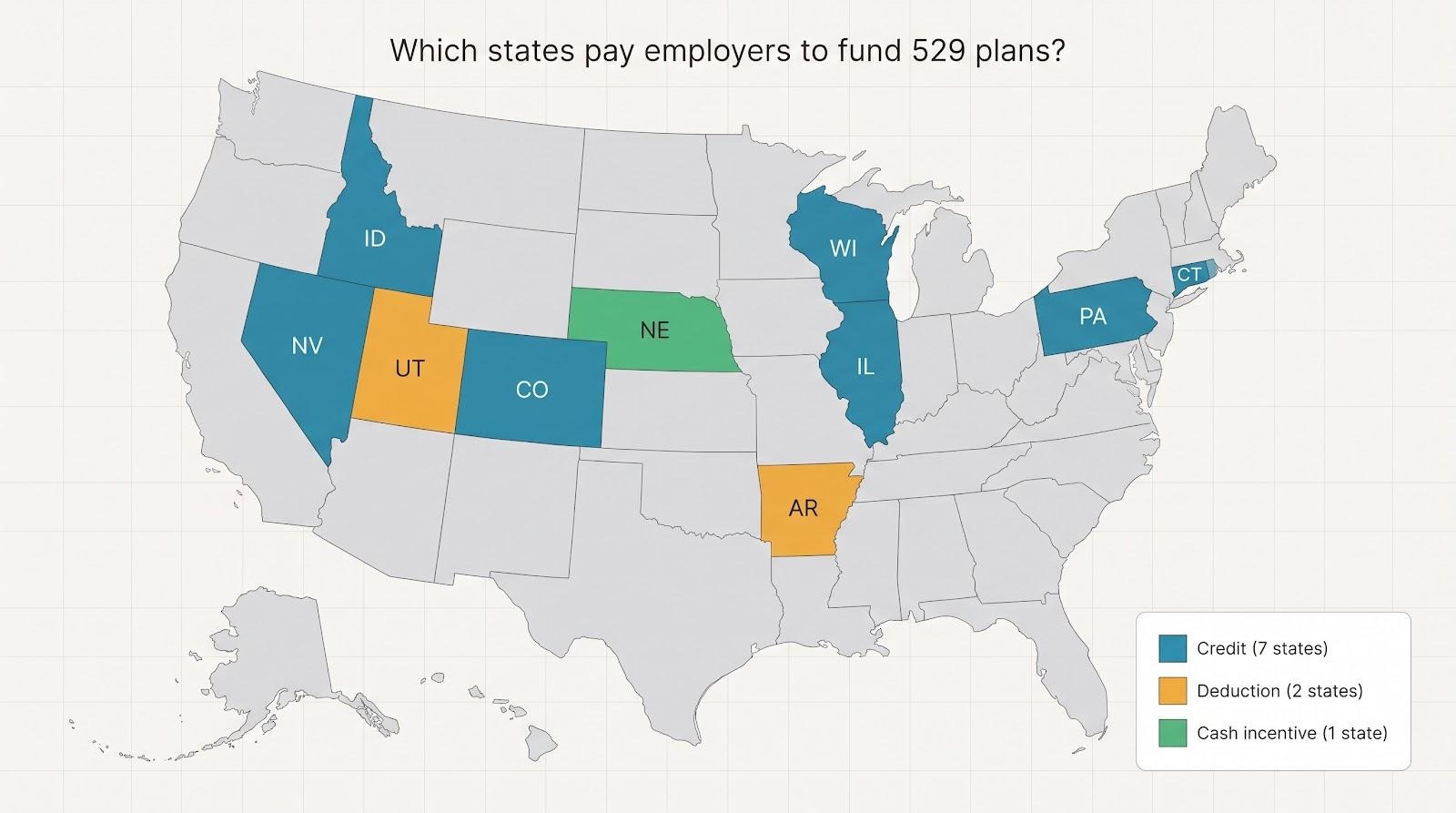
Today, seven states trim an employer’s state income-tax bill when the company deposits money into a worker’s 529: Colorado, Connecticut, Idaho, Illinois, Nevada, Pennsylvania, and Wisconsin.
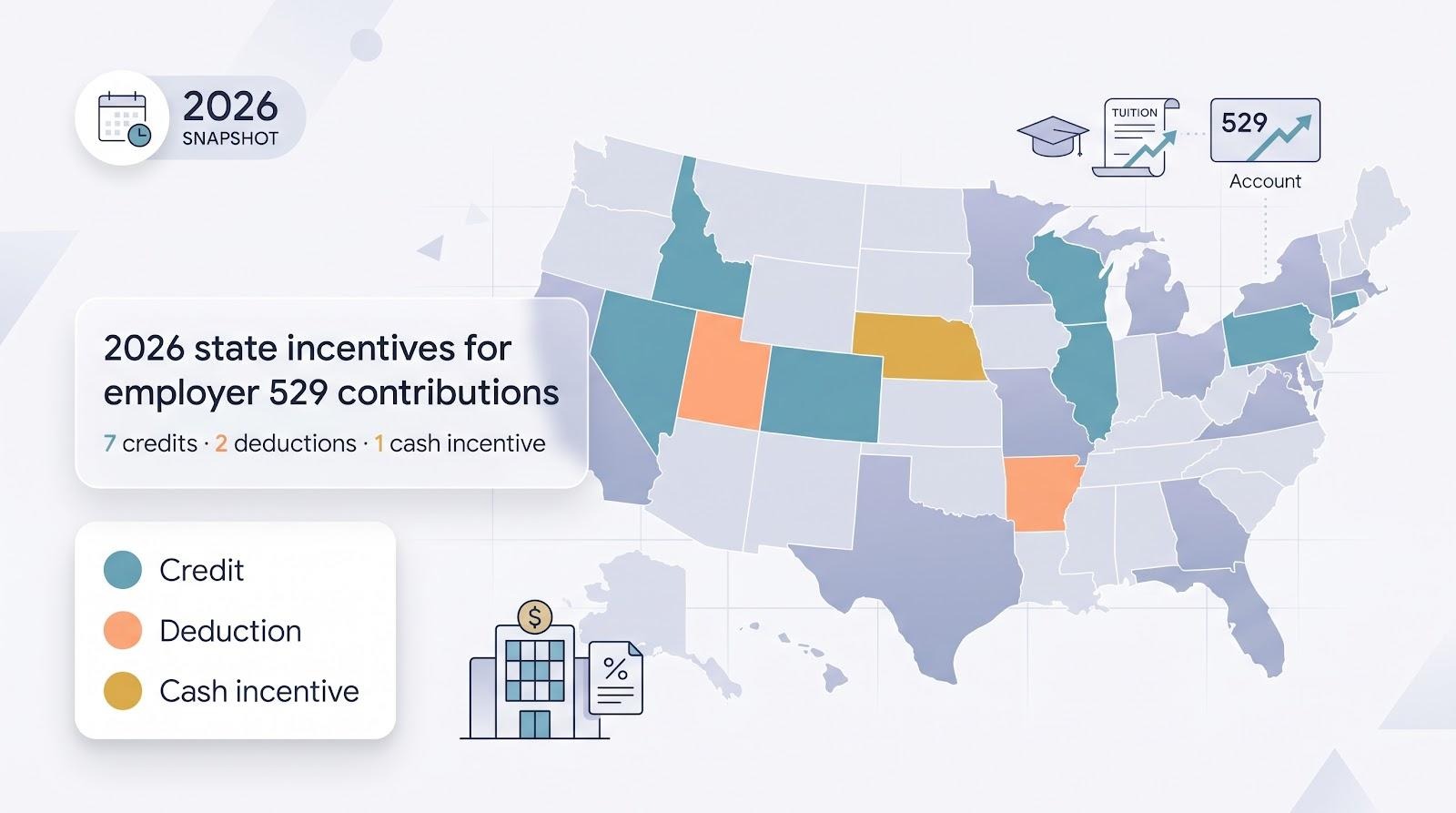
Arkansas and Utah don’t offer credits; they let businesses deduct part of the match from taxable income.
Nebraska sends a direct cash incentive check equal to 25 percent of the employer contribution.
That’s the full 2026 line-up of state employer incentives.
How 529 payroll and taxes really work
Payroll deductions: the easy on-ramp
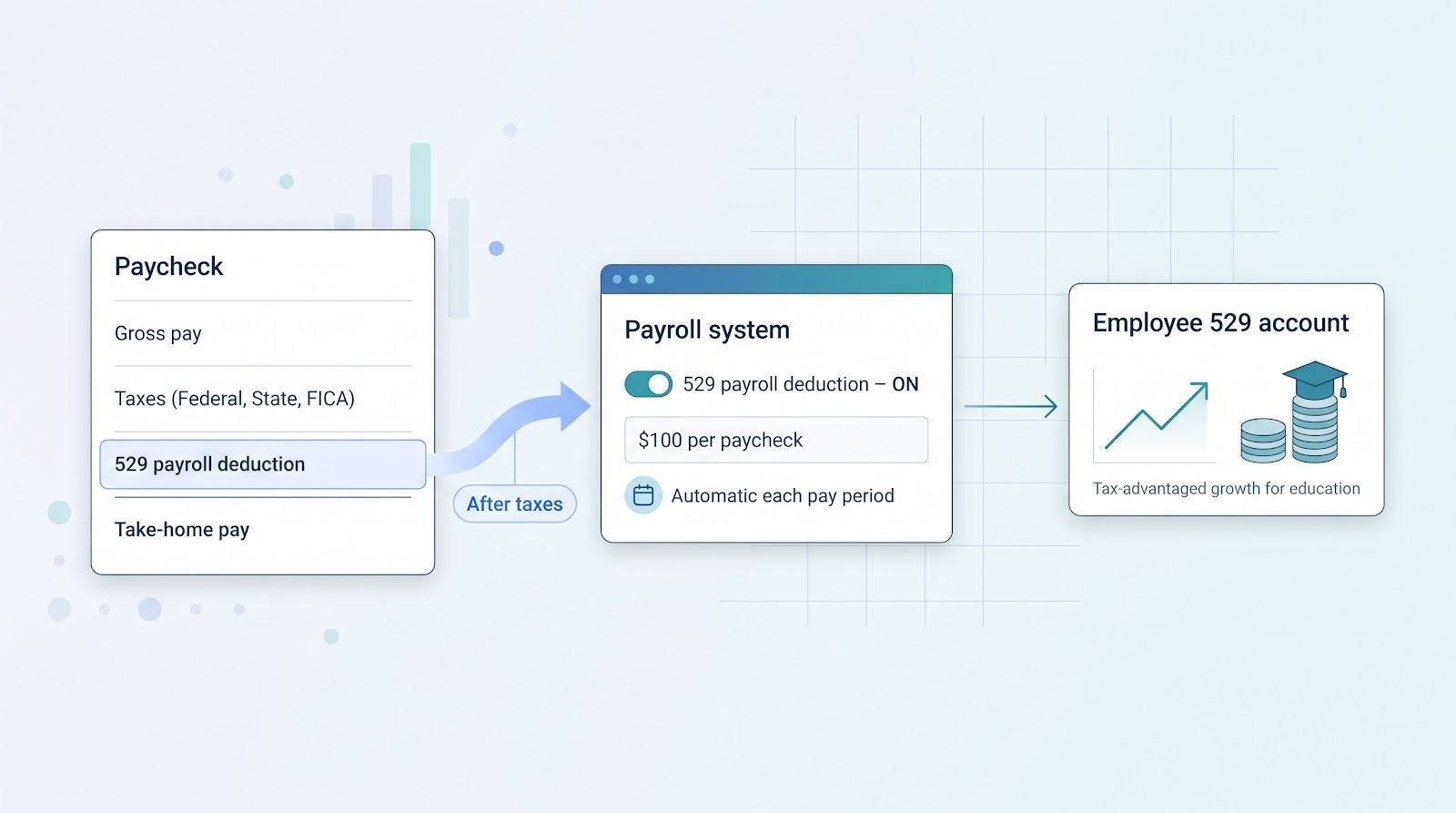
A 529 payroll deduction works like autopilot for college savings. You tell HR how much to skim from each paycheck, and the money moves straight into your own 529 account (after income and payroll taxes are withheld), so take-home pay drops slightly.
Why bother? Automation fixes the “I forgot to transfer money this month” snag that derails many budgets, and it lets the account’s investment growth compound tax-free until you tap it for qualified education costs.
For employers, setup is light: add a deduction code, collect each employee’s account details, and send one consolidated electronic file to the plan each pay period. No matching dollars, state forms, or tax credits apply at this stage. Yet the move still puts you ahead of roughly 92 percent of employers, because only 8 percent offered 529 payroll deductions in SHRM’s 2024 Employee Benefits Survey, according to the Society for Human Resource Management.
Ready to do more than move money? Direct contributions and the state credits in the next section deliver the bigger savings for both the company and the family.
Credit, deduction, or cash: why it matters
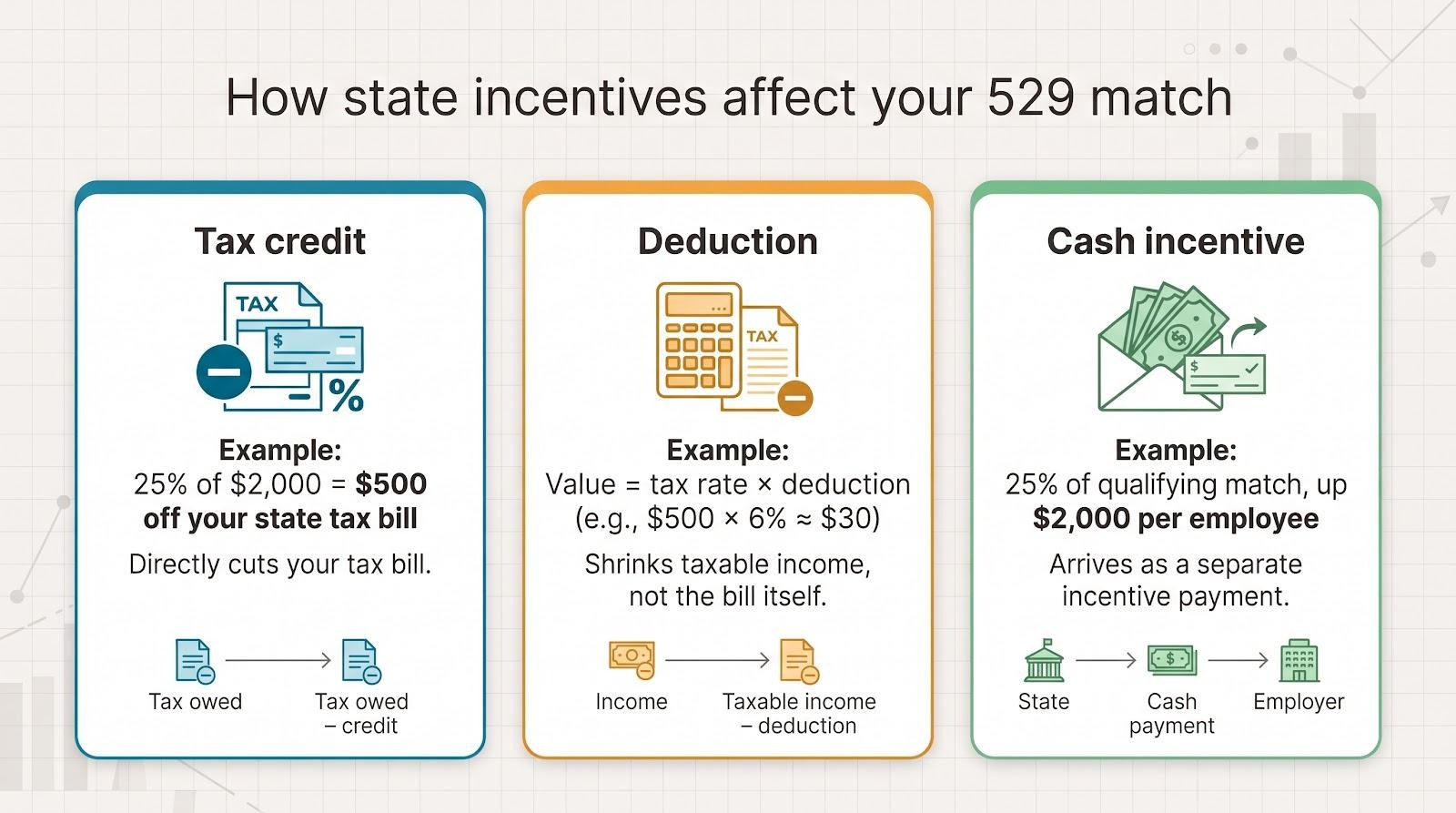
A tax credit feels like a refund. When a state offers a 25 percent credit and you put $2,000 into an employee’s 529, the state slices $500 off your corporate income-tax bill.
A deduction shows up earlier in the math. Arkansas lets you deduct up to $500 of an employer match, while Utah allows a corporation-owned my529 deduction of up to $2,560 per beneficiary in 2026, according to each state’s code and plan description. A deduction only saves the tax you would have paid on that slice of income, so the dollar benefit is usually smaller than a credit.
Nebraska skips the tax return entirely and mails a cash incentive payment equal to 25 percent of your qualifying match, capped at $2,000 per employee, and subject to a statewide funding ceiling that awards payments on a first-come basis.
Knowing which flavor your state offers tells you two things:
- How much to budget for matches, and
- Which state form, or in Nebraska’s case an application, you will file when tax time arrives.
State comparison table
Numbers paint the picture faster than prose, so here is the full 2026 field at a glance, based on each state’s published guidance.
| State | Incentive type | Credit or deduction rate | Maximum state benefit (per employee) | Employee match required? | Carry-forward | Sunset or cap |
| Colorado | Credit | 20 % | $500 | No | 3 yrs | 2031 |
| Connecticut | Credit | 25 % | $500 | No | None | None set |
| Idaho | Credit | 20 % | $500 | No | 5 yrs | None |
| Illinois | Credit | 25 % | $500 | Yes | 5 yrs | 2029 |
| Nevada | Credit | 25 % | $500 | Yes | 5 yrs | None |
| Pennsylvania | Credit | 25 % (first $500 only) | $125 | Yes | 3 yrs | 2029 |
| Wisconsin | Credit | 50 % | $840 | No | 15 yrs | None |
| Arkansas | Deduction | Match up to $500 | Value = tax rate × $500 | Yes | N/A | None |
| Utah | Deduction | Up to $2,560 | Value = tax rate × deduction | No† | N/A | Indexed annually |
| Nebraska | Cash incentive | 25 % | $2,000 | Yes | N/A | $250 k annual program cap |
† Utah’s corporation-owned account structure means no employee match, but workers do not control the account.
Keep three caveats in mind:
- Figures reflect 2026 law; indexed caps (for example, Wisconsin and Utah) adjust each January.
- Credits are generally non-refundable; any unused portion carries forward only as noted.
- Employer 529 contributions count as taxable wages on the employee’s Form W-2, even when the company claims a credit.
Armed with these numbers, you can jump to the deep dive on your state, or keep reading for the seven credit profiles that deliver the richest savings.
Seven credit states, one by one
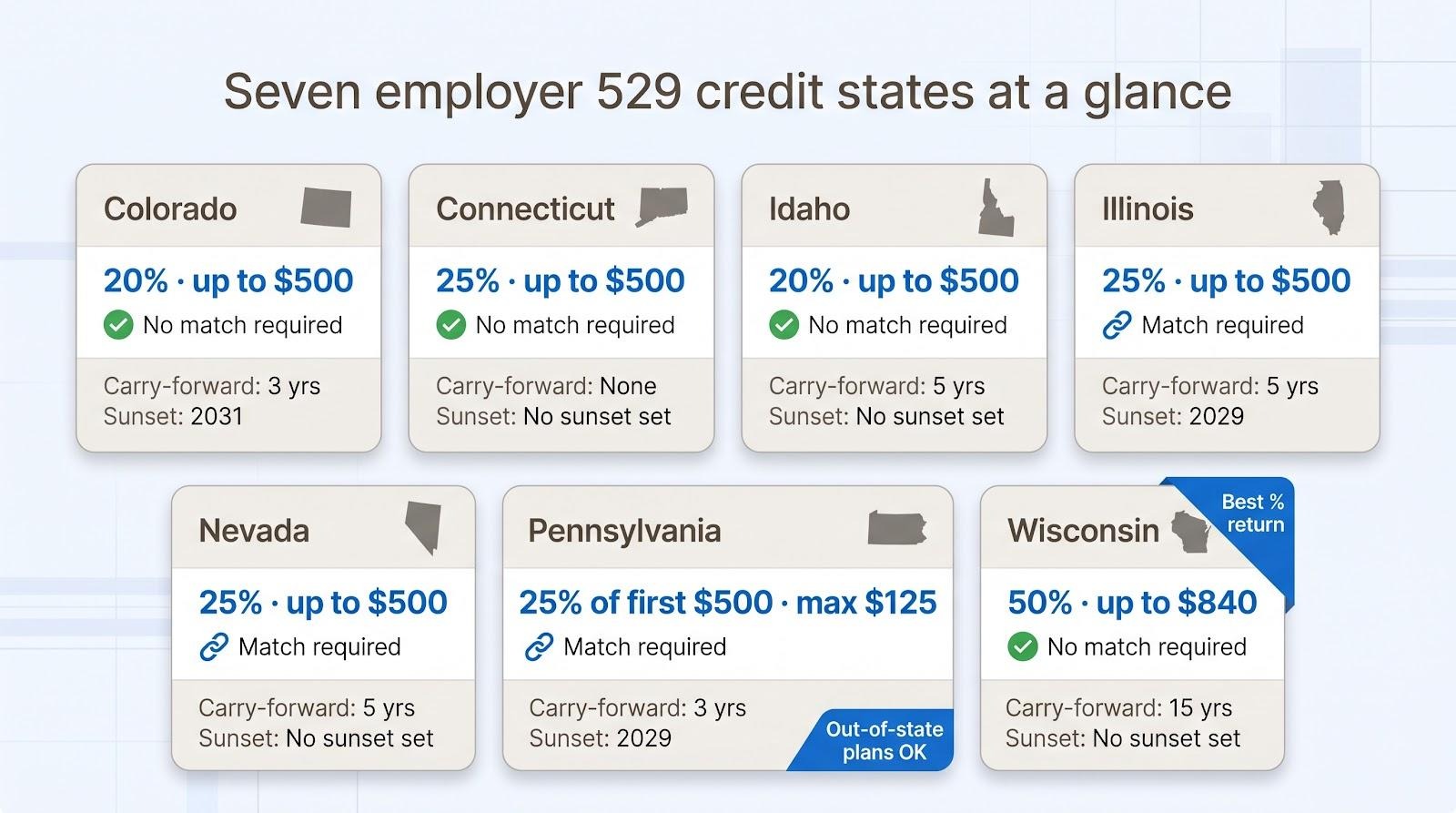
All seven credit programs follow one recipe: contribute to an employee-owned 529 and subtract the credit from your state income-tax bill. Caps, carry-forwards, match rules, and sunset dates are where they differ. We go alphabetically, starting with Colorado.
Colorado
Colorado wrote the modern playbook back in 2019, and the credit still delivers solid value for every benefit dollar.
- How it works
Contribute up to $2,500 per employee into a CollegeInvest 529 the worker owns. The state refunds 20 percent, capped at $500 per employee. - Why employers like it
No employee match, light paperwork (Form DR 0289), and any unused credit carries forward for three years. - Key cautions
The credit sunsets after the 2031 tax year unless lawmakers renew it. Employer contributions remain taxable wages on the employee’s W-2, so plan your communications and withholding accordingly.
Next up is Connecticut, the newest kid on the credit block.
Connecticut
Connecticut’s credit is brand-new, so early adopters can shine while competitors are still parsing the statute.
- How it works
Contribute up to $2,000 to a CHET account an eligible employee owns, and the state refunds 25 percent, capped at $500 per worker. - Who qualifies
The employee cannot be an owner, partner, member, or the owner’s close relative, a safeguard in Conn. Gen. Stat. § 12-217uu that prevents self-dealing. - Paper trail
Claim the credit on Form CT-1120 CHET; keep contribution receipts because Connecticut offers no carry-forward—use it or lose it each year. - Why move fast
Lawmakers set no sunset date, and the program only launched in 2025. Acting early lets your firm stand out as a progressive employer while the pool of claimants stays small.
Healthy percentage, modest cap, straightforward filing—Connecticut is a quick win. Now let’s head west to Idaho, where the carry-forward cushion is five years.
Idaho
Idaho’s credit mirrors Colorado’s math but adds a five-year safety net for slower profit cycles.
- The offer
Contribute up to $2,500 into an employee-owned IDeal 529, and the state grants a 20 percent credit, capped at $500 per employee. - Why it sticks around
Any portion you can’t use this year rolls forward for five tax years, a cushion that helps seasonal or project-based firms. - Fine print worth noting
- The employee must own the account, and “employee” follows Idaho withholding and unemployment rules.
- No match requirement.
- No statutory sunset.
- Claim the credit on Form ID-529 with the Idaho business return.
- The credit is non-refundable and cannot exceed your Idaho tax liability.
Idaho keeps paperwork light and flexibility high—a win for companies ready to seed modest 529 deposits without committing to a dollar-for-dollar match.
Next stop: Illinois, where the credit is the same size but the rules get stricter, and we share a resource for plan logistics.
Illinois
Illinois sweetens a company match the same way Connecticut does (25 percent back, up to $500 per employee) but adds one big twist: workers must kick in their own dollars during the same tax year for the credit to count.
- Match first, credit later
For every $4 the employer deposits, the state grants a $1 credit. Reach a $2,000 employer match and the credit maxes out. - Plans that qualify
Matching contributions must go into an employee’s Bright Start Direct-Sold College Savings Program, Bright Directions Advisor-Guided 529, or College Illinois! account. The credit equals 25 percent of the match, capped at $500 per contributing employee per year, through December 31, 2029.
Setup is lighter than many HR teams expect. Bright Start 529’s guide on how to add a 529 plan to your employee benefits walks through the steps: connect with a plan consultant, offer payroll direct deposit, share the plan’s ready-made announcement emails, flyers and webinar invitations, and let employees open and manage their own accounts. Payroll then sends each employee’s after-tax contribution by ACH every pay period. The plan charges employers nothing to offer it, and a dedicated Bright Start consultant answers questions along the way. - Tax mechanics
Claim the credit on the Illinois Schedule 1299 credit form; unused amounts carry forward for five years and the program currently runs through tax year 2029. The credit is non-refundable and cannot exceed your Illinois tax liability.
Illinois rewards employees who save alongside the company, making the program a natural fit for wellness campaigns that already promote emergency funds and 401(k) matches.
Next on deck: Nevada, where the same 25 percent rate hides a smaller net benefit.
Nevada
Nevada’s credit looks generous at first glance (25 percent, a $500 cap, and a five-year carry-forward), but the required employee match cuts the real return in half.
- Match required, credit halved
To claim the full $500 credit you must contribute $2,000 and the employee must contribute the same amount. Statute NRS 363B.117 limits the credit to 25 percent of the employer’s matching contribution, up to $500 per employee. In effect, you spend twice as much company cash for the same credit Colorado or Idaho award with no match. - Where the money goes
Deposit funds in a Nevada College Savings Trust account or the state’s prepaid tuition plan, then claim the credit on the Modified Business Tax return (Form EXC-F014). - Low take-up is a clue
State revenue reports show very few businesses claim the credit, a sign that many employers skip the program.
If you already match 529 dollars in Nevada, the credit adds a little sparkle. If not, consider starting in a friendlier state first and circling back when participation grows.
Stick around: Pennsylvania’s “$500 credit” is even more misunderstood, and the real number will surprise you.
Pennsylvania
Pennsylvania advertises a $500 employer match, but the tax credit covers only a slice of that amount.
- Read the fine print
The credit equals 25 percent of the first $500 you match for each employee, so the ceiling is just $125 per worker. - Extra strings attached
You must match the employee’s contribution dollar for dollar, not more, not less, and offer the same opportunity across comparable employee groups. - Wide plan choice, tight window
Employees may use any qualified 529 or ABLE account, including out-of-state plans. Employers must apply through myPATH between October 1 and January 31 for the prior tax year; unused credit carries forward three years and the program sunsets after tax year 2029 unless extended.
Pennsylvania’s credit is small, but its broad plan eligibility lets multistate employers run one benefit instead of juggling several in-state plans—a flexibility that can justify the paperwork when your headcount spans time zones.
Our tour wraps up in Wisconsin, home to the richest percentage credit on the list.
Wisconsin
Wisconsin turns the volume up to 50 percent. For every dollar you drop into an employee’s Edvest or Tomorrow’s Scholar account, the state erases half that amount from your corporate tax bill.
- Biggest bang for moderate bucks
The 2026 cap is $840 per employee, reached when you contribute $1,680, according to the Department of Revenue’s 2025-2026 inflation adjustment notice. - Carry it forward, count it as income
Unused credit lingers for 15 years and, by statute, the credit itself must be added back to Wisconsin taxable income. The add-back trims the net benefit slightly but rarely enough to change the headline math. - No match or sunset worries
Employees don’t need to contribute a dime, and lawmakers have placed no expiration date on the credit. The maximum adjusts each January for inflation, keeping purchasing power intact.
Wisconsin’s structure is simple, rich, and durable—the trifecta most benefit teams crave.
With the seven credit states covered, let’s zoom out and see how the other three incentive programs stack up.
The other three: deduction, cash, and a corporate curve-ball
Not every state incentive is a classic credit. Arkansas, Nebraska, and Utah follow different paths that matter if you run payroll in their borders.
Arkansas: simple but small
Arkansas lets you deduct up to $500 of each dollar-for-dollar match you place in an employee’s Brighter Future 529, an annual ceiling set in Ark. Code § 6-84-107(a)(4)(B).
The savings equals your Arkansas business tax rate multiplied by that $500 cap. At a 6 percent rate, the win tops out around $30 per worker, pleasant but hardly headline news.
Add the deduction if you already match 529s; skip it as the main reason to launch a benefit.
Nebraska: the check in the mail
Nebraska skips the income-tax return and sends a cash incentive payment equal to 25 percent of your qualifying match, up to $2,000 per employee, as authorized in Neb. Rev. Stat. § 77-1429.
The catch? The Legislature caps total funding at $250,000 a year, and awards go to the first employers who file the NEST Employer Incentive application between January 1 and June 1 for prior-year contributions. If you operate in the Cornhusker State, file on day one or plan to wait another year.
One more rule: taking the incentive blocks you from also claiming Nebraska’s separate income-tax deduction on the same dollars.
Utah: corporation owns the account
Utah flips the script. The corporation, not the employee, owns the my529 account and may deduct up to $2,560 per beneficiary in 2026 under Utah’s corporate deduction schedule.
At the 4.45 percent corporate rate, the deduction is worth about $114 in tax savings per beneficiary. Corporations receive Form TC-675H to record the contribution on the Utah TC-20 return.
Great for executive-education or scholarship pools, awkward for a broad match program because workers do not control the account, and the deduction is only as valuable as your Utah tax liability.
Which program delivers the most value?
CFOs usually ask one question first: “Where do we get the biggest net win for every dollar we lay out?” Here’s how the 2026 numbers stack up.
Biggest benefit per employee
- Nebraska can mail a check for up to $2,000, but only if you contribute $8,000 and beat the statewide $250,000 funding cap.
- Among true credits, Wisconsin’s $840 ceiling wins, reached with $1,680 in company cash.
Best percentage return
- Wisconsin again, handing back 50 percent of what you put in.
- The other credit states cluster at 20–25 percent, while Arkansas and Utah only save you the corporate tax rate on a deduction.
Lowest contribution to max out
- Pennsylvania needs just a $500 match to hit its cap, though the credit itself is only $125.
Flexibility factors
- Carry-forward runway: Wisconsin’s 15-year window dwarfs Connecticut’s “use it or lose it” rule.
- Match requirement: Colorado, Connecticut, Idaho, and Wisconsin list employee contributions as optional, simplifying communication.
- Plan variety: Pennsylvania is the lone credit state that lets employees use out-of-state 529 or ABLE accounts.
The pattern
Wisconsin pays the most per dollar, Colorado and Idaho are the simplest to administer, and Pennsylvania trades cash size for nationwide plan choice. Most employers start with one of those three when expanding a pilot beyond a single state.
Employer implementation checklist
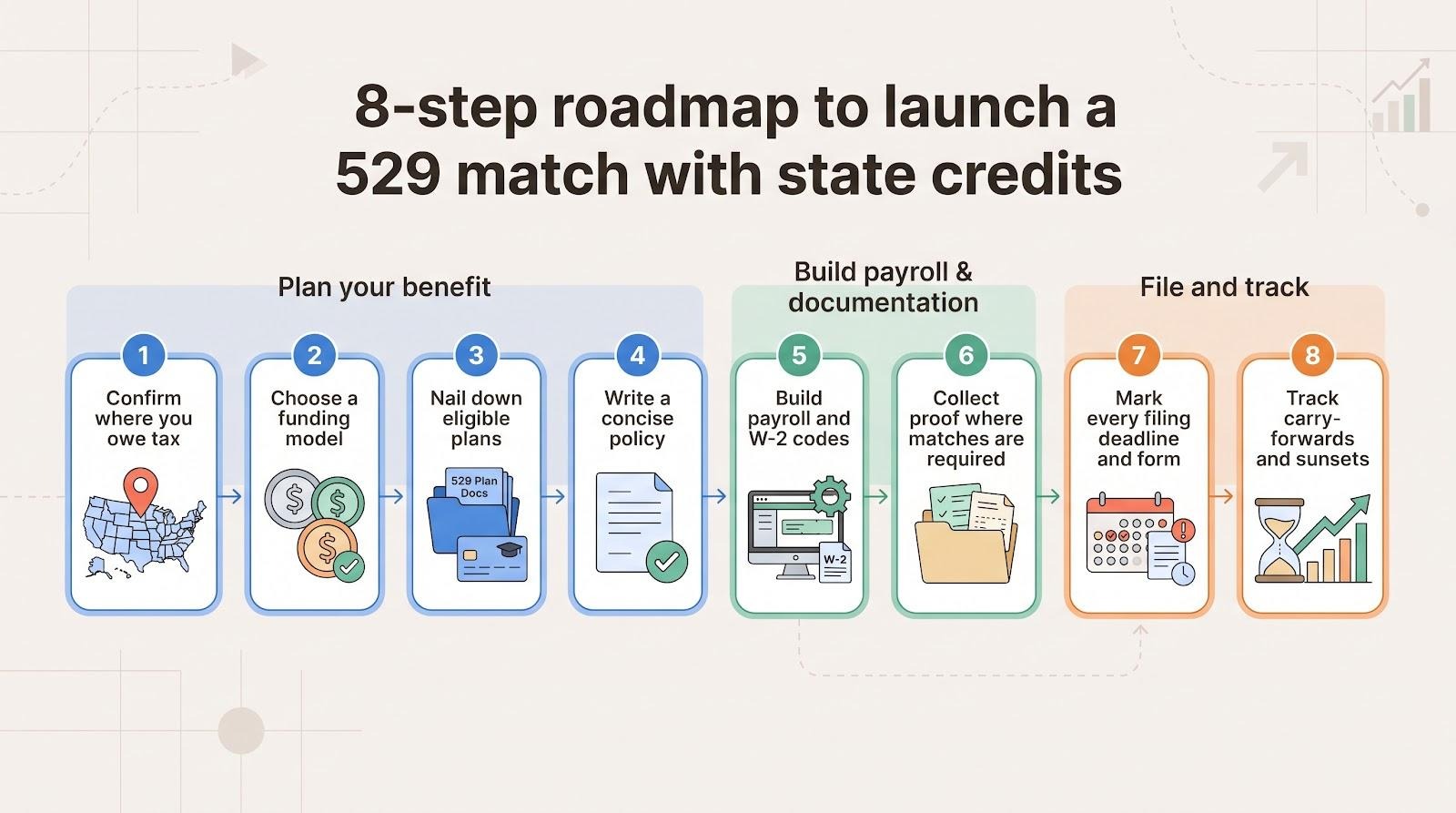
Rolling out a 529 match is simpler than launching a retirement plan, but skipping a step can turn a feel-good benefit into a paperwork mess. Use this eight-point road map:
- Confirm where you owe tax.
Credits apply only to income generated in the state that offers them, so multistate entities may need separate tracking codes for each location. - Choose a funding model.
Will you match employee dollars, seed a flat amount, or both? In match-required states, that choice decides whether you qualify for a credit. - Nail down eligible plans.
Most credits insist on an in-state 529; Pennsylvania allows any qualified 529 or ABLE account. Collect routing details early to avoid “undeliverable” deposits. - Write a concise policy.
Spell out who qualifies, when contributions post, and what happens when an employee leaves. Clarity now prevents headaches later. - Build payroll and W-2 codes.
Employer 529 dollars count as taxable wages under federal law and must appear in Form W-2 boxes 1, 3, and 5. - Collect proof where matches are required.
Illinois, Nevada, and Pennsylvania want documentation before they release credits. - Mark every filing deadline and form.
- Nebraska NEST application: January 1–June 1
- Pennsylvania myPATH: October 1–January 31
- Colorado DR 0289, Connecticut CT-1120 CHET, Idaho ID-529: with the income-tax return
Miss the date and the credit evaporates.
- Track carry-forwards and sunsets.
A simple spreadsheet keeps 3-, 5-, and 15-year carry-overs, plus 2029 and 2031 sunset dates, visible at renewal time.
Follow these eight steps, and you’ll spend more time celebrating sign-ups, not chasing missing forms.
What employees and parents should ask HR
A 529 match looks great on a slide, but the fine print decides whether that extra money lasts until a tuition bill arrives. Bring these questions to your next benefits fair, or drop them in the company Slack channel:
- Do we offer payroll direct deposit into a 529?
Automatic deposits keep you on track and help you avoid any paper-check fees a plan might charge. - Will the company add money of its own, and how much?
A flat $50 every January feels different from a dollar-for-dollar match up to $500. - Which 529 plan do I have to use?
Some states lock credits to an in-state plan; Pennsylvania allows any qualified 529 or ABLE account. Moving money later may trigger paperwork or transfer fees. - Who owns the account once the company money lands?
In most credit states you own the account and keep it if you change jobs. Utah is the outlier; there the corporation owns the my529 account. - Will employer contributions show up as taxable income on my W-2?
Almost always yes. The IRS treats employer 529 dollars as wages, so plan for slightly higher withholding. - Are employer dollars immediately vested?
Tuition bills don’t wait for a three-year cliff. Check vesting rules so you’re not stuck returning money if you leave early. - Can I still claim my state’s personal deduction or credit on top of the employer benefit?
Often yes, but rules differ by state, so check your state’s guidance before you file.
Bookmark these quick answers. They solve most of the email traffic benefits teams face when a 529 match rolls out.
Trends and watch list
State incentives can change as quickly as tuition quotes. Track the calendar to stay ahead of mid-year surprises and act on new opportunities before competitors do.
Fresh on the radar
- Connecticut: Credit applies to tax years beginning 2025 (Conn. Gen. Stat. § 12-217uu). Early adopters will set the cost benchmarks HR teams quote for years.
- Pennsylvania: The myPATH filing window closes January 31, 2027 for 2026 contributions; real-world data will show whether the $125 ceiling moves the needle.
- Wisconsin: The maximum credit is inflation-indexed each January, so check the new cap before you set next year’s match.
Sunset alerts
- Illinois and Pennsylvania expire after 2029 unless extended.
- Colorado follows in 2031. Build those dates into long-range ROI models so Finance is not surprised when a credit ends.
Bills worth watching
Several legislatures have debated new employer 529 incentives, and momentum points one way: more states, not fewer. Check your state’s current session before you set next year’s budget.
Federal cross-winds
- Since July 4, 2026, employers may contribute up to $2,500 tax-free to each employee’s or dependent's Trump Account under section 128, which gives HR a second education-and-savings benefit to weigh beside a 529 match.
- The lifetime limit on 529-to-Roth IRA rollovers remains $35,000 per beneficiary.
Stay nimble, and you can keep your education benefit in the spotlight when these dominoes fall.
FAQ'S
Seven: Colorado, Connecticut, Idaho, Illinois, Nevada, Pennsylvania, and Wisconsin.
No. The IRS treats them as taxable wages, so they appear in boxes 1, 3, and 5 of Form W-2.
Generally no. Nebraska, for example, blocks double dipping; always check the state instructions before filing.
Yes, in Illinois, Nebraska, Nevada, and Pennsylvania. No, in Colorado, Connecticut, Idaho, and Wisconsin. (Arkansas is a deduction, not a credit.)
Most do. Wisconsin allows 15 years, Idaho 5 years, Colorado 3 years, and Connecticut offers none.
Only Pennsylvania currently allows out-of-state plans. Other credit states require an in-state 529 (or prepaid) account.
No. Credits cut state tax liability but do not generate a refund. Nebraska’s incentive is a separate cash payment.
State tax nexus, employee residence, and plan location all matter. When in doubt, ask a multistate payroll specialist before sending contributions.




Conclusion
State-level incentives can slash the cost of a 529 match, but the best option depends on your tax footprint, budget, and workforce mix.
Compare credit rates, caps, and carry-forwards, then map each requirement onto your payroll system and communication plan.
Nail those details, and you’ll turn a good-will benefit into a measurable bottom-line win.





Leave a Reply