

Bringing home a doodle puppy is equal parts joy, chaos, and questions. One day, you are taking photos of those fluffy paws, and the next, you are wondering whether that loose stool, scratchy ear, or missed nap is normal.
The good news is that your puppy’s first six months with the veterinarian are designed for exactly this stage: frequent check-ins that help catch problems early, build healthy routines, and guide you through growth, nutrition, behavior, vaccines, and parasite prevention.
Veterinary organizations note that puppies typically need visits starting around 6 to 8 weeks of age, then every few weeks until roughly 16 to 20 weeks, because this period is when their immune protection, growth, and preventive care are all changing quickly.
For doodle puppies, these visits matter even more than many first-time owners realize.
Whether you have a Cavapoo, Cockapoo, Maltipoo, Mini Goldendoodle, or another poodle mix, the “doodle” label does not create a single health profile.
Your puppy still inherits traits from both parent breeds, which can affect everything from coat care and dental health to joint development, ear issues, and allergy tendencies.
That is why the first six months are less about one generic puppy schedule and more about building a care plan your veterinarian can personalize for your dog’s breed mix, size, lifestyle, and local disease risks.
Families looking for accessible, neighborhood-based support often appreciate having trusted options for Arvada Sploot veterinary care, especially during those early months when questions seem to come up every week.
Vaccine recommendations, for example, include core vaccines for most puppies, while non-core vaccines such as leptospirosis, bordetella, Lyme, or canine influenza depend on geography and exposure risk.
Jump to:
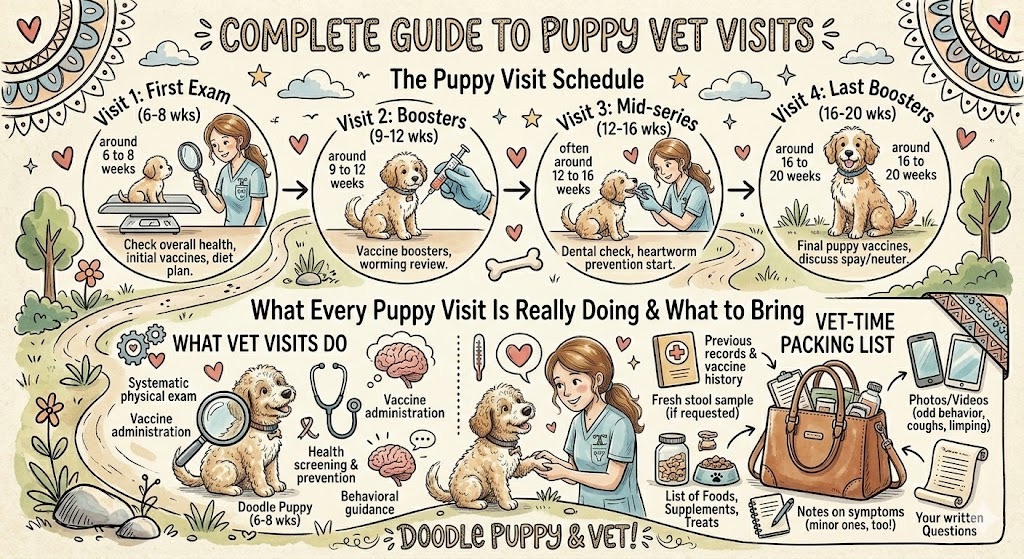
- Visit 1: First puppy exam, usually around 6 to 8 weeks
- Visit 2: Follow-up booster visit, around 9 to 12 weeks
- Visit 3: Mid-series visit, often around 12 to 16 weeks
- Visit 4: Last puppy booster period, around 16 to 20 weeks
- What every puppy visit is really doing
- What to bring to every appointment
- The best mindset for the first six months
Visit 1: First puppy exam, usually around 6 to 8 weeks
This visit is often your doodle puppy’s first true wellness appointment, especially if they have just come home from a breeder or previous caregiver.
Expect your veterinarian to begin with the basics: weight, temperature, heart and lung check, eyes, ears, mouth, skin and coat, abdomen, joints, and an overall nose-to-tail exam.
If you have any paperwork from the breeder, rescue, or previous clinic, bring it.
Your vet will review vaccine history, deworming records, feeding instructions, and any early concerns you have noticed, such as sneezing, itching, soft stool, tearing, or reluctance to eat.
VCA notes that this first appointment often includes a health exam plus the start of vaccines and parasite treatment or prevention.
If you want a simple way to stay organized between appointments, our Puppy Paw Planner can help you map out early vet visits, vaccines, and deworming reminders.
This is also the visit where many owners discover that “what to expect” includes a lot of conversation.
Your vet may ask what your puppy eats, how often they urinate and defecate, how much they sleep, whether they are scratching their ears, and how they respond to handling.
These questions are not small talk. They help identify early warning signs of parasites, food intolerance, skin issues, urinary concerns, or stress.
You may also be asked to bring a fresh stool sample. This is important because intestinal parasites are common in puppies, and routine fecal testing helps detect worms and microscopic parasites such as Giardia or Coccidia.
Some of these parasites can affect people too, which is one reason vets take them seriously even when a puppy seems fine.
At this first visit, your veterinarian will usually start or continue a vaccine plan.
Keeping up with puppy vaccinations during the first few months is one of the most important parts of preventive care.
Following the schedule recommended by your veterinarian helps protect against common infectious diseases while giving your puppy's immune system the best chance to develop strong, lasting protection.
The exact timing depends on your puppy’s age and previous vaccines, but the reason for multiple appointments is simple: early doses prime the immune system, and later doses strengthen protection as maternal antibodies fade.
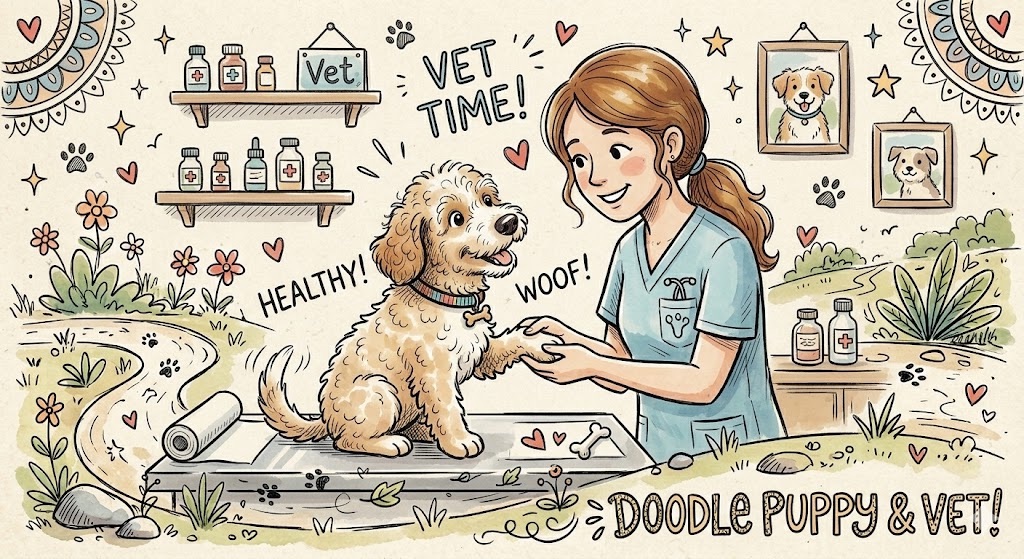
Visit 2: Follow-up booster visit, around 9 to 12 weeks
By the second visit, your doodle puppy may look noticeably bigger, bolder, and busier.
This appointment often includes another physical exam, a weight check, vaccine boosters, and a review of how your puppy is adjusting at home.
Because puppies grow quickly, feeding amounts, calorie needs, and body condition can change in just a few weeks.
Your vet may help you assess whether your puppy is gaining appropriately or getting too chubby too fast.
This is also a prime visit for discussing digestion and parasites. If your puppy has had loose stool, gas, a sensitive stomach, or inconsistent appetite, say so.
Many owners assume mild tummy issues are just part of puppyhood, but a vet may want to rule out parasites, dietary mismatch, stress, overeating, or intestinal irritation.
Monthly or repeated fecal testing can be especially important in puppies because parasite burden can change quickly.
Behavior questions usually become more urgent around this age too. Your doodle may be nipping, barking, grabbing socks, resisting alone time, or seeming nervous in new places. Wellness care now extends beyond shots and deworming.
Merck notes that preventive care today includes nutrition and behavior alongside medical health.
This is valuable because early behavior guidance can prevent long-term problems.
For doodle owners, one especially helpful conversation at this stage is grooming and handling tolerance.
Ask your vet how to support ear care, nail handling, tooth brushing, and calm restraint.
Many doodle-type coats require regular grooming, and puppies who learn early that paws, ears, and mouths can be touched gently often cope better later with both grooming and veterinary care.
If your puppy is scratching, licking paws, or dealing with recurring ear irritation, it may be worth reviewing common allergy symptoms in dogs and puppies.
Visit 3: Mid-series visit, often around 12 to 16 weeks
This visit often feels like the point where puppy care gets real. The novelty has worn off a little, your puppy is more energetic, and you are probably beginning to understand their patterns and quirks.
Veterinary care at this stage usually still includes a wellness exam and vaccine boosters, but the conversation often broadens.
Your veterinarian may review house-training progress, sleep habits, chewing, socialization, and fear periods.
This is especially important because the puppy socialization window overlaps with the early vaccine schedule, so owners are often unsure how to safely expose puppies to the world.
Your vet can help you balance disease protection with healthy social development based on local risk and your puppy’s health status.
VCA specifically notes that early veterinary visits are also a good time to discuss behavior and training.
This is also a good appointment to ask about:
- flea, tick, and heartworm prevention
- safe exercise levels
- chewing and teething
- ear cleaning
- bathing and skin care
- the best time to begin brushing teeth regularly
Dental care may feel early for a baby puppy, but it is not. Building tooth-brushing into your routine before adult teeth fully arrive makes life much easier later.
Small and toy doodle mixes may be especially prone to dental crowding and plaque buildup as they age, so early habit-building matters.
Depending on your area and lifestyle, your vet may recommend non-core vaccines at this stage.
AAHA emphasises that these decisions should be individualised based on risk, not taken from a one-size-fits-all checklist.
A city puppy who visits grooming salons, daycare, or training classes may need different protection than a home-based puppy in a low-risk environment.
Visit 4: Last puppy booster period, around 16 to 20 weeks
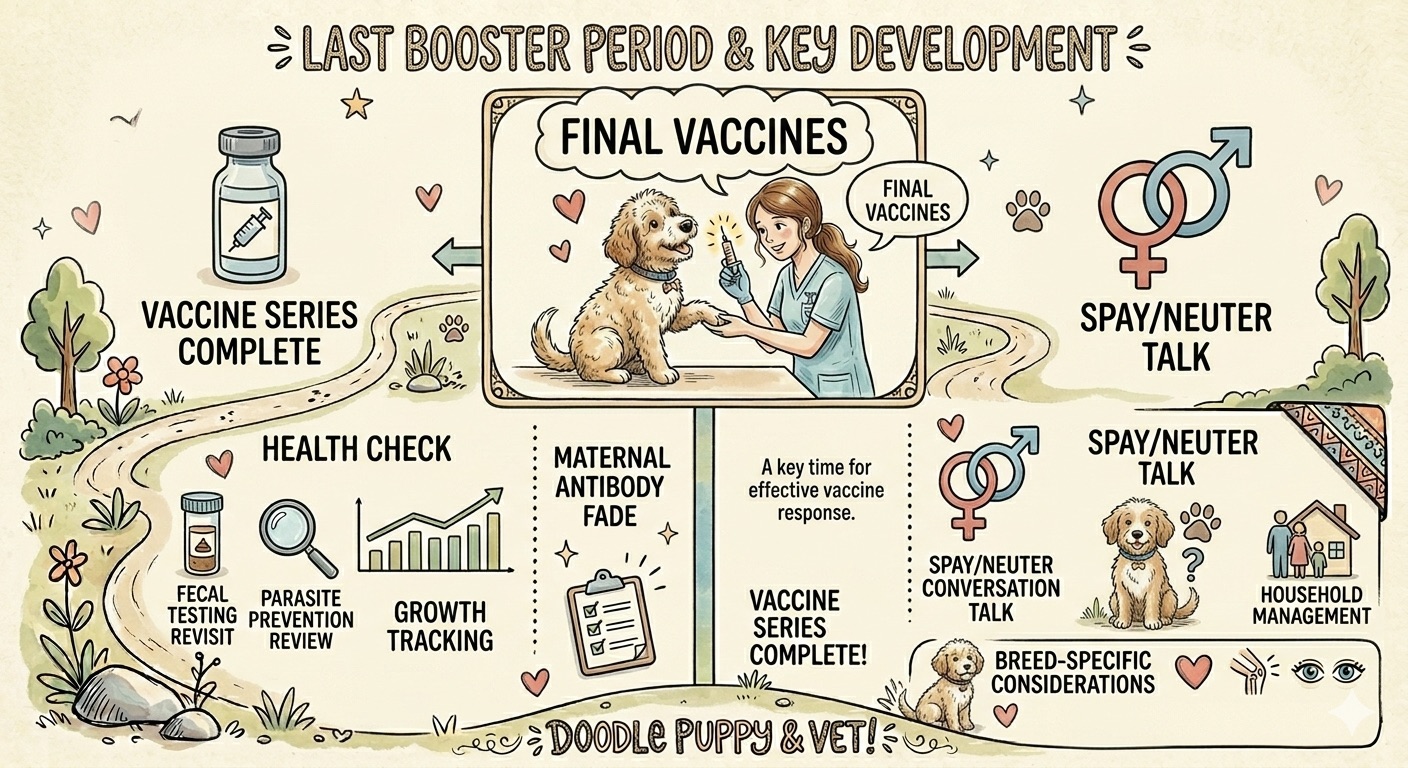
This visit is often one of the most important milestones in your puppy’s preventive care. For many puppies, the final round of core vaccinations is timed to be given when maternal antibody interference is less likely.
This timing matters because incomplete or poorly timed vaccine protection can leave a puppy vulnerable.
AAHA’s vaccine guidance explains why puppy vaccines are given in a series rather than as a one-and-done event.
Your veterinarian may also revisit fecal testing, parasite prevention, growth tracking, and overall development.
Merck notes that puppies are generally examined every few weeks until about 20 weeks of age, which reflects how much changes during this period.
By now, your doodle puppy may be showing more obvious breed tendencies. Some are highly social and eager to please. Others are sensitive, vocal, selective with strangers, or quick to over-arousal.
Your vet can help you distinguish between normal puppy behavior and signs that may benefit from earlier training support or a referral.
For some families, this visit is also where the spay or neuter conversation begins. There is no universal one-age answer for every dog.
Timing can vary depending on sex, size, projected adult weight, orthopedic considerations, and household management.
Rather than treating it as a routine checkbox, use this visit to ask your veterinarian what timing makes sense for your individual doodle.
Because doodles inherit traits from both parent breeds, it also helps to understand breed-specific issues, such as these cavapoo health considerations.
What every puppy visit is really doing
It may seem like you are going to the vet over and over for “just vaccines,” but those appointments serve a much bigger purpose.
They allow your care team to track your puppy’s growth, check for heart murmurs or developmental issues, monitor parasite risk, adjust preventive care, spot skin or ear trouble, discuss nutrition, answer behavior questions, and help you learn what is normal for your dog.
Preventive exams also matter financially. The AVMA notes that early detection through routine checkups can lead to better outcomes and often lower costs than waiting until a problem becomes more serious.
They also help your puppy build a positive relationship with the clinic.
VCA advises owners to use a calm, reassuring voice during the visit, which may sound simple but can make a real difference for a young puppy learning that handling and exams are safe.
Bringing treats, practicing brief car rides, touching paws and ears at home, and staying relaxed yourself can all help.
What to bring to every appointment
Make each visit easier by bringing:
- previous medical records and vaccine history
- a fresh stool sample if requested
- a list of foods, supplements, or treats your puppy gets
- notes on symptoms, even if they seem minor
- photos or videos of odd behavior, coughing, limping, or skin flare-ups
- your questions, written down before you forget them
This is especially helpful for doodle puppies because owners often have coat, ear, tear-staining, grooming, and stomach questions that are easy to overlook once the exam starts.
The best mindset for the first six months
The first six months at the vet are not about waiting for something to go wrong. They are about building the foundation for what goes right.
Think of these appointments as a running conversation about your puppy’s body, brain, habits, and environment.
A good veterinarian is not just tracking shots. They are helping you raise a healthy dog.
- Parents Are Prioritising Breathable, Sustainable Fabrics For Children's Seasonal Sleepwear
- Our Homemade Christmas Printables, Made With AI: What Worked, What Didn't, and What I'm Saving for Next Year
- At-Home vs. In-Lounge IV Therapy in the Hudson Valley: Which Makes More Sense?
- Can Passengers Pursue Compensation After a Car Accident?




So if you leave an appointment with a vaccine card, a parasite plan, a few feeding notes, and three new things to watch at home, that is not overkill.
That is the point. Puppyhood moves fast, and frequent veterinary visits are how you stay ahead of it.
For doodle owners, that proactive approach pays off. These puppies may be fluffy, funny, and photogenic, but they still need the same thoughtful preventive care as any other dog, plus a little extra attention to the details that come with their mix of traits.
In the first six months, every visit helps you move from guessing to understanding, and that is one of the best gifts you can give your puppy.





Leave a Reply