

An unreliable cleaning routine can seem like a small problem. A missed trash can or a dusty desk. But these small issues add up and can hurt your business in ways you don't see. When your staff has to clean their own desks or worry if the breakroom is clean, they can't focus on their real jobs. This is about more than just looks; it affects how well your business runs and how healthy your employees are.
Money is also a real concern. The U.S. Bureau of Labor Statistics reported that producer prices for final demand rose 3.0 percent in 2025, showing that costs are going up everywhere. When money is tight, you might think about cutting back on cleaning. But a clear plan for daily janitorial services is a smart investment, not just another bill. It creates a standard for health and order that helps your whole business succeed.
Quick answer: Unreliable cleaning has hidden costs. It distracts employees, creates health worries, and looks bad to clients. A set daily service stops these problems by cleaning busy areas and focusing on health. To budget for it, you need to know what fair pay is and have a clear plan that's more than just a quick wipe-down.
Jump to:
What's the real cost of cutting corners on cleaning?
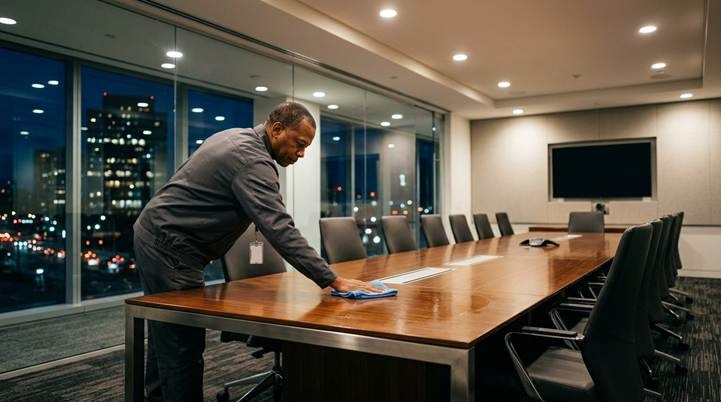
The real cost isn't just a dirty floor. It's lost work time, a constantly changing cleaning crew, and even security risks. A bad cleaning service causes a chain of problems that are about more than just looks. When basic cleaning is missed, your team has to do it. They waste time and focus wiping counters or looking for paper towels instead of doing the work that makes your company money.
To budget for cleaning, you need to be realistic about pay. The U.S. Bureau of Labor Statistics says the median hourly pay for janitors was $17.71 in May 2025. This number is a key guide. If a company offers a price that's much lower than this, you should be suspicious. A company can't pay its workers a fair wage, cover insurance, buy supplies, and keep its equipment working if its prices are too low to last.
❝ A common mistake is to treat cleaning like any other product where the lowest price is best. Instead, ask a company how their prices help them keep good employees. A steady, well-trained crew that knows your building is a benefit, not just a cost to be cut.
Very low prices often mean the cleaning staff is always changing. This high turnover means the crew never learns what your building needs, like security rules or which spots need extra cleaning. It also creates a security risk, since new people are always coming into your space. The Bureau of Labor Statistics expects the number of janitor jobs to grow 2 percent from 2025 to 2035, which shows a constant need for these workers. A professional service invests in its staff to give you reliable results.
How can you tell if a cleaning service is professional?
You can tell if a service is professional by checking their paperwork, like insurance and safety rules, not just by their website or price. A good cleaning company will be an open partner, ready to show you proof that they are a real business that cares about safety. Checking these things protects your business from legal risks and makes sure you get good, steady work.
First, ask for a Certificate of Insurance, or COI. This paper proves the company has insurance. Look for two types: general liability and workers' compensation. General liability protects your property from damage. Workers' compensation covers their employees if they get hurt on the job, so you won't be responsible. A company that can't show you a COI right away is a big risk.
Next, ask about chemical safety and training. Every chemical they use must have a matching Safety Data Sheet (SDS) kept at your building. This is a rule from OSHA, the government agency for worker safety. Ask a company where they keep their SDS binder and how they train staff to handle, mix, and store chemicals safely. Good training lowers the risk of damage to your property or health problems for your employees.
❝ Many companies say they do "green cleaning," but that can mean anything. Ask what standards they use. If they don't give a clear answer, that's a red flag. A trustworthy company will name the official labels on their products, such as the EPA's Safer Choice label, which proves the product has been checked to be safer for people and the environment.
Use a simple checklist to compare companies beyond their price quotes. This helps you judge how well-run and reliable each company is.
| Area to Evaluate | What to Request or Ask | A Potential Red Flag |
| Insurance | A current Certificate of Insurance (COI). | They are slow to give you a COI or have low coverage. |
| Safety | "Where do you keep the SDS binder here?" | They don't know what an SDS or OSHA are. |
| Training | "How do you train staff for our building?" | A general answer that isn't about your building. |
| Green Claims | "What official labels do your products have?" | They use words like "eco-friendly" but have no proof. |
In the end, these checks aren't meant to be difficult. They are to make sure a company has a plan to protect your property, keep everyone safe, and give you the good service you're paying for.
What should a daily cleaning scope actually include?
A good daily plan is a smart plan for health, not just a to-do list. It focuses on stopping the spread of germs in busy, high-touch areas. It also keeps your building looking professional. The main goal is health and safety, not just making things look neat.
The key to a good daily service is knowing the difference between cleaning and disinfecting. Cleaning removes dirt you can see. Disinfecting kills tiny germs like viruses and bacteria. A professional crew spends most of its time disinfecting "touchpoints." This means using the right disinfectant on all the surfaces people touch often:
· Door handles and push plates
· Light switches
· Elevator buttons
· Shared kitchen appliance handles (microwaves, refrigerators)
· Faucet and toilet handles
· Conference room phones and remote controls
A common mistake is when a crew just sprays and wipes right away. For a disinfectant to kill germs, it needs to stay wet on a surface for a set amount of time. This is called "dwell time." It can be anywhere from 30 seconds to 10 minutes. A team that ignores dwell time isn't really disinfecting your office.
❝ Ask a potential provider to explain their system for preventing cross-contamination. Do they use a color-coded system for their microfiber cloths and mop heads, with one color for restrooms and another for kitchenettes or office areas? A clear, systematic answer indicates a well-trained team that understands modern hygiene protocols.
The equipment used also makes a significant difference. For example, a team using traditional string mops may just be spreading dirty water around, a problem known as soil redistribution. Modern microfiber flat-mopping systems are designed to trap and remove far more dirt and bacteria from the floor. The same principle applies to dusting; microfiber cloths capture dust particles instead of just pushing them into the air to resettle elsewhere. A detailed scope of work should specify not just the task, but the method and tools used to achieve a truly clean result.
FAQ'S
How much should you expect to pay for janitorial services per hour? The billing rate you pay is different from the wage a cleaner earns. While the median wage provides a baseline, a professional service's hourly rate must also cover payroll taxes, workers' compensation, liability insurance, equipment costs, cleaning supplies, and company overhead. That is why a sustainable billing rate sits well above the local median wage for a cleaner, ensuring the company can operate legally and retain quality staff.
What's the difference between janitorial services and general cleaning?
The main difference is scope and frequency. "Janitorial services" refers to ongoing, scheduled commercial cleaning based on a contract, designed to maintain a facility's condition daily or weekly. "Cleaning services" is a much broader term that can include one-time residential deep cleans, post-construction cleanup, or specialized tasks like window washing, which may not be part of a regular maintenance schedule.
What is the difference between a day porter and an evening cleaning crew?
A day porter works during your business hours to provide visible, immediate cleaning support. They focus on keeping high-traffic areas like lobbies, kitchens, and restrooms consistently clean and stocked, and respond to urgent needs like spills. An evening crew arrives after hours to perform the more comprehensive and potentially disruptive work, such as vacuuming entire office floors, detailed disinfecting, and trash removal.
How do you determine if your facility needs daily service?
Consider your building's usage and density. Facilities with significant public foot traffic, a sizable full-time staff, or multiple shared spaces like kitchens and restrooms usually require daily service to manage hygiene and appearance. If you consistently notice overflowing trash cans, messy common areas, or depleted restroom supplies before the end of the day, it's a strong indicator that a less-frequent schedule is insufficient.
Are "green" cleaning products as effective as traditional chemicals?
Yes, when you are using professional-grade, certified products. Many modern, sustainable cleaning agents are just as effective as their conventional counterparts at cleaning and disinfecting. The key is to look for third-party certifications from organizations like Green Seal or the EPA's Safer Choice program, which independently verify that a product meets stringent performance, health, and environmental criteria.
Beyond the Bid: What Are You Really Buying?
Choosing a janitorial partner often feels like a simple cost comparison. But the true expense of a cleaning program is not found in the monthly invoice.
It is measured in the hidden costs of inconsistent service, high staff turnover, and the health risks of a poorly maintained environment.
A low bid might save a few dollars upfront, but it often signals an unsustainable business model that cannot support fair wages, proper insurance, or adequate training.




The most critical shift in perspective is to move beyond a checklist of tasks. Instead, evaluate the systems a provider has in place.
A professional service can articulate its process for preventing cross-contamination, ensuring chemical safety, and training staff on your specific facility's needs.
These operational details are what separate a reliable hygiene partner from a revolving door of low-wage, minimally trained labor.
Ultimately, a clean and healthy building is the output of a stable, well-managed workforce. When you review a proposal, the central question is not "What is the price?" but "How does this price support a professional, consistent team?" The right investment protects your facility, supports the well-being of your employees, and provides a predictable, high-quality result day after day.
About the author
The team at Go Premier Cleaning provides commercial janitorial and specialty cleaning services for facilities throughout the Denver Metro Area. As a locally owned and operated company, it focuses on implementing sustainable cleaning programs using certified green products and transparent operational practices. Their work is centered on maintaining healthy indoor environments for businesses through scheduled services delivered by uniformed, background-checked staff. The company's leadership maintains a hands-on approach to quality assurance and client communication.



Leave a Reply