

A small entryway can become messy faster than almost any other part of the home. Shoes pile up near the door after school. Keys vanish under a stack of half-opened mail. Bags land in the walkway. Dog leashes drape over the nearest chair. The first few feet of the house start to feel crowded before anyone has even taken their coat off.
The good news is that a cleaner entryway does not require a renovation or a full-sized mudroom. The fix is rarely structural. It is almost always about giving every daily item a clear, easy-to-use home — and choosing storage that hides what does not need to be seen.
Here are 15 small entryway storage ideas to help hide shoes, organize daily clutter, and make even the busiest entrance feel calmer the moment you walk through the door.
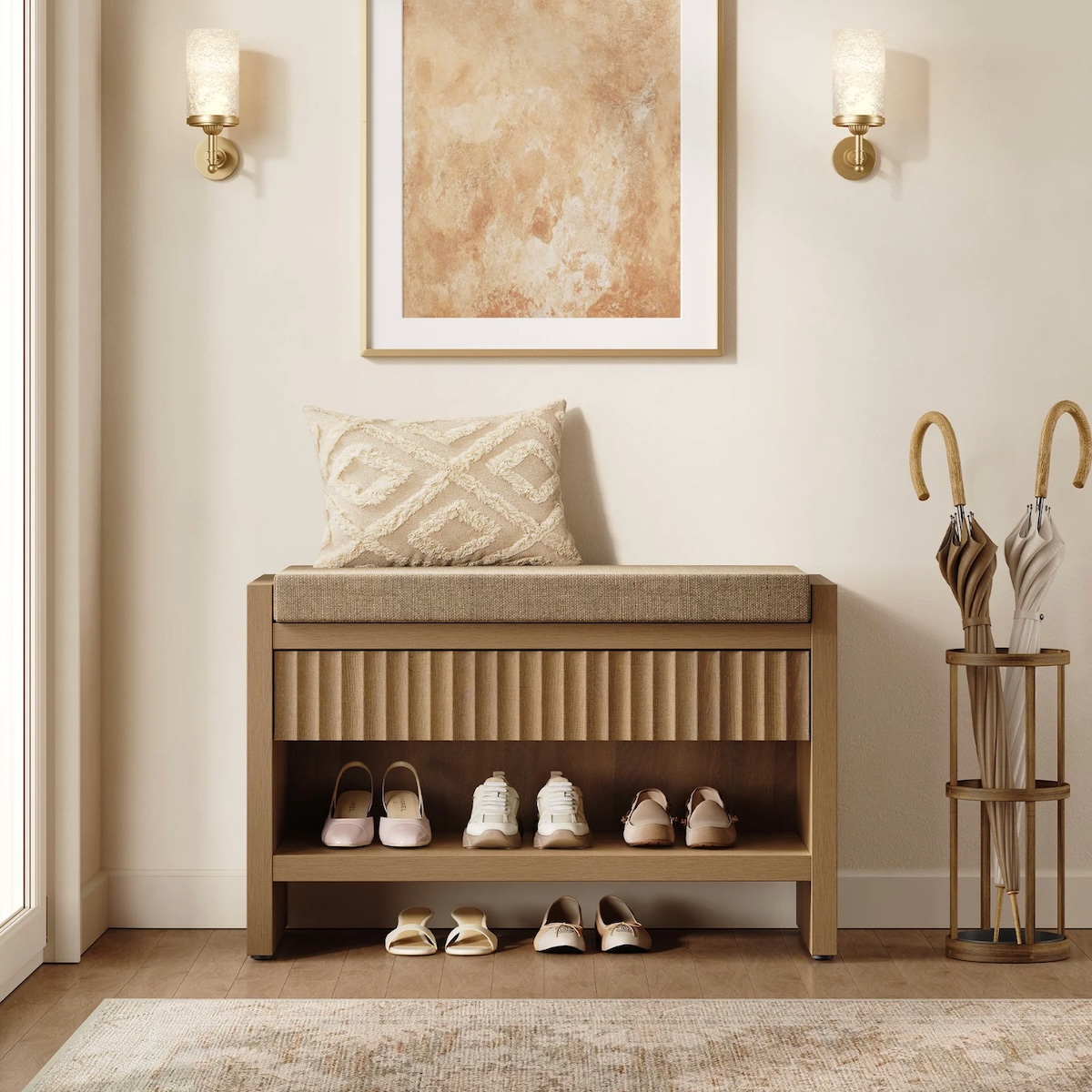
Jump to:
- Why Small Entryways Get Messy So Quickly
- Start With Shoes, the Biggest Source of Entryway Clutter
- 15 Small Entryway Storage Ideas That Actually Work
- Closed Storage vs. Open Storage: Which Is Better?
- How to Choose the Right Shoe Cabinet Capacity
- Small Entryway Buying Checklist
- Final Takeaway: A Cleaner Entryway Starts With Better Systems
Why Small Entryways Get Messy So Quickly
The entryway works harder than most people realize. It is the room where shoes come off, bags get dropped, mail gets sorted, keys get tossed down, and kids unload whatever they happen to be carrying home that day, usually within the first thirty seconds of walking in.
In a larger home, much of that clutter can disappear into a mudroom, coat closet, or garage transition area. But in a small home, apartment, or narrow hallway entry, none of those buffers exist. Everything is visible. A single pair of muddy sneakers, one overstuffed tote bag, and a stack of mail are enough to make the entire entrance feel out of control.
Most small entryways really only need three things working together:
- Hidden storage for shoes, so the most-used items disappear when not in use.
- A clear drop zone for small daily items like keys, mail, sunglasses, and wallets.
- Enough open walking space that the entry never feels squeezed.
Once those three needs are handled, the entryway becomes dramatically easier to maintain, often without any further effort.
Start With Shoes, the Biggest Source of Entryway Clutter
Shoes are almost always the first problem to solve. They are used every day, so they naturally drift toward the door. But when sneakers, work shoes, sandals, slippers, and a small army of kids’ shoes are all left out together, the entryway can feel chaotic even when nothing else is out of place.
Open shoe racks help with access, but they keep every pair visible. For some homes that is fine. For others, especially small spaces where the entryway is visible from the living room, closed storage makes a much bigger visual difference than people expect.
For homes where the entryway is narrow but shoes still need to stay near the door, browsing shoe cabinets for small entryways makes it easier to compare slim profiles, flip-front options, and other entryway-friendly layouts side by side before deciding what fits.
The goal is not to hide every shoe perfectly. It is to give the most-used pairs a defined home, so the entryway stops doing extra work for the rest of the house.
15 Small Entryway Storage Ideas That Actually Work
1. Use a Closed Shoe Cabinet Instead of an Open Shoe Rack
A closed shoe cabinet is one of the simplest, highest-impact changes you can make in a small entryway. Where an open rack keeps every pair on display, a closed cabinet lets the same shoes live in the same spot, just out of sight.
This matters most for families, renters, and anyone whose front door opens straight into the main living area. Instead of being greeted by a row of mismatched footwear, guests see a calm piece of furniture and a tidy first impression.
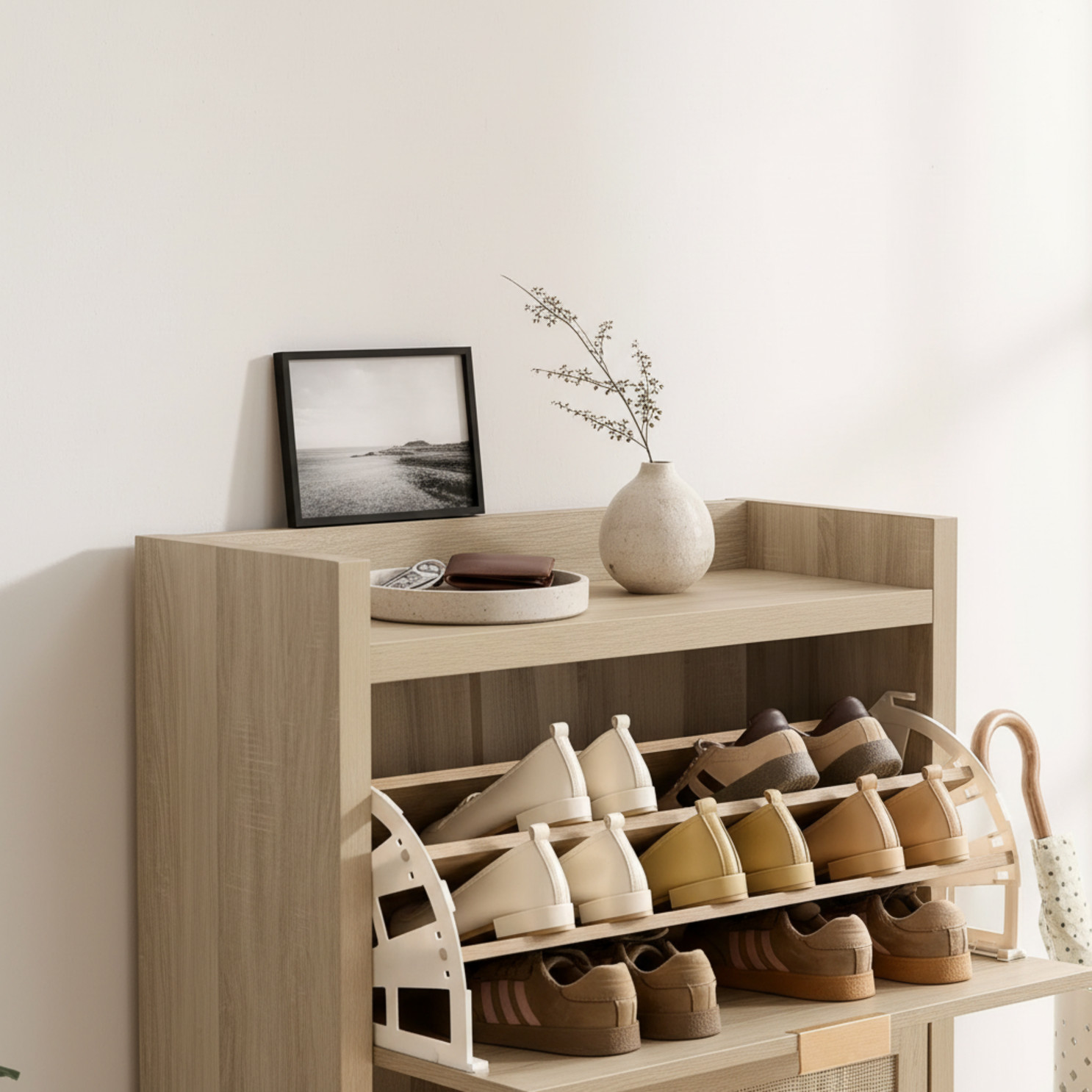
For narrow entries where every inch matters, a slim option like the Savanna Flip Shoe Cabinet shows how a closed, flip-front design can hide several pairs of everyday shoes while keeping the cabinet shallow enough to sit comfortably against a tight hallway wall, useful in apartments and small homes where deeper cabinets simply will not fit.
2. Choose a Slim Cabinet for Narrow Hallways
In a small entryway, depth matters even more than width. A cabinet can be beautiful, well-reviewed, and perfectly proportioned on paper, and still ruin the hallway it lives in if it juts too far into the walkway.
Before buying anything, measure the wall, measure the walking path, and measure the front door’s full swing arc. Then subtract a little extra for comfort. The cabinet should never force anyone to turn sideways to pass it, and it should never collide with a closet door or interior door that opens nearby.
A slim shoe cabinet, especially one with flip-front drawers rather than swinging doors, keeps the visual storage promise without crowding the entry. In narrow halls, the right depth often matters more than the highest pair count.
3. Create a Family Drop Zone
A small entryway should not only store shoes. It should also handle the small daily items every person carries in and out of the house, often while juggling everything else.
A working drop zone is built around clear assignments, one obvious place for each kind of object:
| Daily Item | Entryway Storage Solution |
|---|---|
| Shoes | Closed shoe cabinet with doors or flip fronts |
| Keys | Small ceramic or linen-lined tray |
| Mail and packages | Basket or shallow wall pocket |
| Bags and backpacks | Wall hooks at staggered heights |
| Dog leash | Single hook near the door |
| Umbrella | Slim stand or basket |
| Kids’ school items | Lower bin or labeled basket |
The goal is to make daily routines easier than they were yesterday. When everything has a home, very little ends up on the floor.
4. Use the Top of the Cabinet as a Landing Surface
The top of a shoe cabinet is prime real estate in a small entryway. It can serve as a key station, a mail-sorting surface, a small styled moment with a tray and lamp, or, if you let it, another quiet clutter zone.
The trick is to pick one job and keep the surface edited. A tray, a small bowl, and one decorative item are usually enough. If you find yourself adding a fourth and fifth object every week, it is a sign the system underneath needs more storage, not more decoration on top.
5. Add Hooks Above or Beside the Cabinet
Hooks are one of the most useful entryway tools because they keep bags, jackets, hats, scarves, and leashes off the floor, and they cost almost nothing.
They are especially helpful for children, who almost universally find hooks easier than hangers. If a hook is at a child’s eye level, it gets used. If they have to reach up into a closet or open a door, it does not.
A word of caution: do not overload them. A wall of hooks loaded with five jackets and three bags can make a small entryway feel as cluttered as a pile on the floor.
6. Use Baskets for Flexible Storage
Baskets handle the soft, irregular items that never fit neatly into drawers, gloves, hats, pet supplies, reusable shopping bags, swim gear in summer, scarves in winter. They are also the easiest piece of "storage" to add and remove as needs change.
A woven basket beside the shoe cabinet or tucked under a bench gives those items a defined home without making the entryway feel formal. It also makes the seasonal rotation, winter hats out, summer hats in, a one-minute job instead of a closet excavation.
7. Keep Only Daily Shoes Near the Door
Not every pair of shoes needs to live in the entryway. This is the rule that quietly fixes more shoe-cabinet overflow problems than any furniture upgrade ever could.
Keep the one or two pairs each family member actually wears most often near the door, and move seasonal or occasional shoes, hiking boots in summer, sandals in winter, formal shoes between events, to a bedroom or coat closet. The entryway becomes immediately calmer, and the cabinet capacity stops feeling tight.
A good rule of thumb: one or two daily pairs per person near the door, and a quick seasonal rotation every three months.
8. Use Vertical Space When Floor Space Is Limited
When the floor plan is tight, look up. Wall hooks, slim floating shelves, a mirror with a narrow ledge, or a taller shoe cabinet can all make use of vertical space without consuming the walkway.
When the entryway is narrow but the wall is tall, a vertical piece like the Savanna Tall Shoe Cabinet shows how going up rather than out can deliver real capacity, up to 30 pairs, without spreading across the floor. In a small footprint, that kind of vertical layout often beats two shorter cabinets side by side.
The balance to watch is visual weight. Vertical storage is helpful, but a wall packed top-to-bottom with cabinets, shelves, and hooks can make a small entry feel busier, not lighter. Give the vertical pieces some breathing room.
9. Add a Mirror to Make the Entryway Feel Larger
A mirror is one of the quickest, lowest-effort ways to make a small entryway feel brighter and more open. It reflects available light, adds visual depth, and doubles as a quick last-check before walking out the door.
A round or arched mirror above a cabinet softens a narrow space. A larger rectangular mirror can make the wall feel taller or wider depending on its orientation. Either way, the effect is more than decorative, small entries genuinely feel less cramped with one good mirror in place.
10. Pick Furniture With Doors, Drawers, or Compartments
Small spaces consistently benefit from furniture that hides clutter. Doors hide shoes. Drawers hide keys, mail, and accessories. Closed compartments hide the daily mess that no amount of styling can fully fix.
Open shelves can be beautiful, but they only work when every item on them is styled intentionally. For real entryways, the ones used by real households, closed storage is almost always the more forgiving choice. The goal is to look organized even on the days no one has time to actually be organized.
11. Build a "One-Minute Reset" Habit
Furniture builds the foundation, but small habits keep the system standing six months later.
At the end of every day, spend one minute doing a quick entryway reset:
- Put any stray shoes back inside the cabinet.
- Drop keys back in the tray.
- Move bags from the floor to their hook.
- Quickly sort the day’s mail.
- Carry up anything that belongs in another room.
Done daily, this becomes the difference between an entry that stays calm and one that turns into a weekend cleaning project. One minute is small enough that no one dreads it, which is exactly why it works.
12. Give Kids a Lower Storage Zone
If children use the entryway every day, and in most households they use it more than anyone, at least some of the storage needs to be at their height.
Lower hooks for backpacks, a labeled bin for school items, a dedicated shelf or low cabinet section for their daily shoes: all of it makes cleanup easier because it makes cleanup possible.
Children are far more likely to put things away when the destination is at eye level and within arm’s reach.
This becomes especially valuable on school mornings, when shoes, backpacks, jackets, and water bottles all need to be located inside of two minutes flat.
13. Use Warm Materials So Storage Does Not Feel Cold
Entryway storage should be practical, but practical does not have to mean plain. Warm wood tones, rattan texture, woven baskets, soft ceramics, and clean-lined shapes all help functional storage feel like part of the home rather than a piece of office furniture borrowed into the hallway.
This matters more than it might sound. The entryway is the first design moment guests see, and the last surface family members touch before walking out the door.
A piece that hides clutter while also adding natural texture quietly makes the whole home feel more considered, even when nothing else has changed.
14. Measure the Entryway Before Buying Furniture
Most entryway furniture mistakes happen at the cart, not the checkout. They happen because someone bought a piece they loved without measuring the space it had to fit. A few minutes with a tape measure prevents almost all of them.
| Measurement | Why It Matters |
|---|---|
| Wall width | Determines the maximum cabinet size |
| Cabinet depth | Keeps the walkway open |
| Door swing | Prevents blocked movement |
| Walking clearance | Keeps the entryway comfortable to use |
| Shoe capacity (today and one year out) | Helps choose the right storage size |
And do not forget to check how the cabinet itself opens. A swing-door cabinet that fits the wall but blocks the front door at full swing will frustrate everyone within a week.
In tight spaces, flip-front drawers or tilt-out compartments often work better than traditional swinging doors.
15. Choose Storage That Matches Your Real Routine
The best entryway system is always the one your household will actually use, not the one that looks most photogenic in a styling shoot.
A single person in an apartment may need nothing more than a slim cabinet, a small tray, and one mirror. A family of four with kids in school may need real shoe capacity, lower hooks, and a basket dedicated entirely to school items.
A renter may need freestanding storage that does not require drilling. Someone with a dog may need a single hook for the leash within three feet of the door.
Before buying anything, walk through the entryway on a normal evening and notice what actually happens. How many shoes come off near the door? Where do bags land? Who uses the entry most?
What clutters appears every day, no matter how many times it gets cleaned up? The storage that solves those specific patterns is the storage worth buying.
Closed Storage vs. Open Storage: Which Is Better?
Different entryways need different solutions. Here is a quick comparison to help narrow down the choice:
| Storage Type | Best For | Limitation |
|---|---|---|
| Open shoe rack | Quick daily access, small shoe collections | Shoes stay visible at all times |
| Closed shoe cabinet | Cleaner first impression, families | Requires measuring depth and door clearance |
| Shoe bench | Sitting while changing shoes, children | Can become cluttered if storage is open |
| Wall hooks | Bags, jackets, leashes, hats | Looks messy if overloaded |
| Baskets | Flexible / seasonal storage | Needs regular sorting |
For most small entryways, especially those that open directly into a living room or hallway, closed shoe storage is generally the better default. It reduces visual clutter the instant the doors close, which is exactly what a small entry needs most.
How to Choose the Right Shoe Cabinet Capacity
Shoe cabinet capacity depends more on household size and habits than on square footage. A studio dweller and a family of five do not need the same piece, even if their entryways are exactly the same size.
Rough guidance for capacity:
- One person or a couple with limited daily footwear: 8–12 pairs is often enough.
- A couple with active routines: 12–20 pairs covers most daily needs.
- A family with children: 20–30 pairs becomes more realistic, especially during sports seasons.
- Larger households or homes with many seasonal pairs: 30+ pairs and modular layouts make a noticeable difference.
But pair count is only part of the equation. Also check shoe height (boots and high-tops need more vertical clearance), shelf adjustability, door style, and how the cabinet opens. A 30-pair cabinet with adjustable shelves often outperforms a 40-pair cabinet with fixed compartments that cannot fit a winter boot.
Small Entryway Buying Checklist
Before choosing entryway storage, run through these questions:
| Question | Why It Matters |
|---|---|
| How many pairs of shoes need to stay near the door? | Determines storage capacity |
| Is the hallway narrow? | Determines maximum cabinet depth |
| Does the front door swing into the area? | Prevents blocked movement |
| Do you need a surface for keys and mail? | Adds daily function to the cabinet |
| Do you prefer shoes hidden or visible? | Decides cabinet vs rack |
| Do kids need lower access? | Supports family routines |
| Does the style match the rest of the home? | Keeps the entryway cohesive |
| Are shipping, returns, and assembly clear? | Reduces online purchase risk |
A small entryway can still work beautifully when every item has a clear purpose and a clear place to live.
Final Takeaway: A Cleaner Entryway Starts With Better Systems
A small entryway does not have to feel crowded just because it works hard. When shoes are hidden, keys have a home, bags stay off the floor, and daily clutter has a clear system, the first few feet of the house feel calmer and more welcoming for everyone walking through them: guests, kids, family, the dog, and the person who lives there.
- Parents Are Prioritising Breathable, Sustainable Fabrics For Children's Seasonal Sleepwear
- Our Homemade Christmas Printables, Made With AI: What Worked, What Didn't, and What I'm Saving for Next Year
- At-Home vs. In-Lounge IV Therapy in the Hudson Valley: Which Makes More Sense?
- Can Passengers Pursue Compensation After a Car Accident?









Leave a Reply