

The toddler years move fast. Somewhere between roughly one and three years old, kids are figuring out how to control their own bodies, make sense of the world around them, get their ideas across, and interact with other people, all at once, all the time.
Toys play a real role in that process by giving kids room to move, explore, solve little problems, and just get their hands into things.
It's not really about turning every play session into a lesson. Parents and caregivers can just lean toward toys that get toddlers using their hands, feet, eyes, and whole body: stacking, crawling, climbing, balancing, pushing, pulling, touching different textures.
None of that needs to feel like "educational play." The goal is simpler than that: just create an environment where a kid can naturally practice the skills they're already working on developing.
Jump to:
What Motor Development Actually Looks Like at This Age
Motor development generally splits into two categories, gross motor skills and fine motor skills.
Gross motor covers the big stuff, the large muscle groups: walking, running, climbing, jumping, crawling, balancing.
Fine motor skills are the smaller, more precise movements, especially those involving the hands and fingers.
Toddlers get real value out of toys that let them practice both. A soft climbing structure, for instance, might get a kid crawling over a low surface, stepping up onto a platform, or working their way through a tunnel.
All of that requires coordinating different parts of the body at once, while also building balance and a sense of where they are in space.
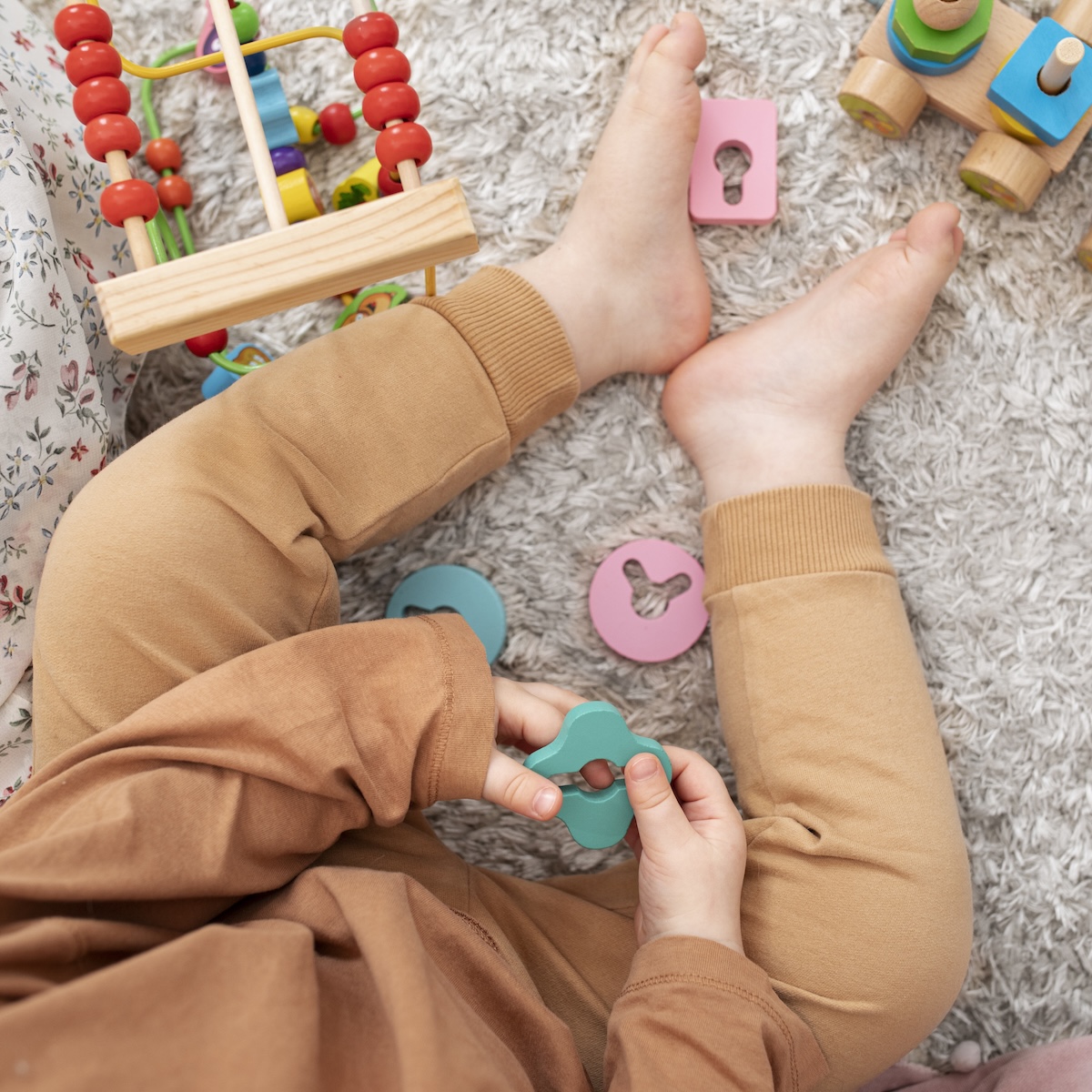
Fine motor stuff can be a lot simpler than people expect. Building blocks, stacking toys, shape sorters, drawing tools, anything that involves moving small objects from one container to another; all of it gives toddlers a chance to strengthen their hand control.
Picking up small, age-appropriate objects, fitting pieces together, or just turning the pages of a book all build the exact coordination they'll need later on for writing or using utensils.
Why Sensory Play Actually Matters
Sensory development is directly linked to young children’s understanding of the world. Toddlers are always absorbing information through their sense of touch, sight, sound, motion, and body position.
Sensory toys and play environments offer them a way to actively explore all of that rather than passively absorb it.
Texture is important for tactile exploration. With soft fabrics, smooth surfaces, textured materials, and different shapes, kids start to notice how things feel, not just how they look.
Movement adds another dimension of sensory input, too. Crawling through a tunnel, balancing on a low surface, rolling across a padded area, all of that gives a toddler real feedback about where his or her body is and how it’s moving.
This kind of exploration builds body awareness and coordination and opens up room for genuine experimentation.
A toddler might discover on their own that a lightweight block moves easily when pushed, while stacking two blocks takes a lot more control than just setting one down on the floor.
Why Open-Ended Toys Go Further
One thing that makes a toddler toy genuinely useful is versatility. A toy with exactly one function tends to run out of play value fast, while something open-ended can be used a dozen different ways depending on what a kid's actually interested in that day.
Foam blocks are a good example of this. A toddler might start out just climbing on them or sitting on top.
Later, the same pieces might turn into part of an obstacle course, a pretend house, a tunnel, or a spot for their stuffed animals to hang out.
The kid's not following any set of instructions; they're actually deciding how to use the pieces, which is exactly the kind of open-ended thinking that's valuable at this age.
BanaSuper is a brand built around soft play equipment, foam structures, climbing toys, and other products designed specifically for active and sensory play. Their lineup includes play sets, play mats, play couches, arches and tunnels, and climbing and jumping equipment.
For anyone wanting to look deeper into the brand and their range of kids' play products, the BanaSuper Official Website has more on their toys and play categories.
Climbing and Balance
Climbing tends to come naturally to many toddlers, and it offers several genuine opportunities for physical development.
Climbing over a low, stable structure means coordinating arms and legs together while constantly adjusting balance on the fly.
Balance activities work similarly. Walking across a low beam, stepping from one surface to another, or navigating a soft obstacle course all require a kid to control their movements more carefully than usual.
These little experiences add up; body awareness, coordination, and genuine confidence all build from repeated practice like this.
That said, climbing toys should always be picked based on where a kid's actually at developmentally, and used in a genuinely appropriate setting.
It's worth sticking to the manufacturer's age recommendations and keeping an eye on toddlers during active play, especially when it involves elevated surfaces or climbing.
Touch and Texture Matter More Than You'd Think
Tactile experience is a big part of sensory play. Toddlers learn a lot just by touching, squeezing, pushing, pulling, and generally handling objects. Toys with a range of shapes and surfaces feed right into that natural curiosity.
Soft play equipment tends to combine movement with tactile exploration in one go. A toddler might crawl across a padded surface, grip the edge of a foam block, or press against the sides of a soft tunnel as they move through it; each of those actions quietly feeds them information about pressure, texture, position, and movement all at once.
BanaSuper describes its mission as supporting kids' sensory integration, motor skills, physical coordination, confidence, social skills, and cognitive development, all through play, which closely aligns with much of this research.
Picking Toys That Actually Fit the Age
The best toy isn't necessarily the fanciest one. What actually matters is whether it fits the kid, their age, their abilities, their interests, and the space they're actually going to be playing in.
For younger toddlers, low-height structures, soft mats, oversized blocks, and simple stacking toys tend to hit the right level of challenge.
As kids get more confident, ramps, tunnels, balance activities, and more complex building setups start to make sense.
Safety needs to sit right alongside developmental value here, not as an afterthought. Toys should be stable, free of small, dangerous parts, appropriate for the kid's age, and used as intended by the safety instructions.
Active play spaces need enough room to move around, and should be kept clear of hazards such as sharp furniture edges or unstable objects nearby.
Mixing Active Play With Quieter Moments
Motor and sensory development doesn't need nonstop physical activity to actually work.
Toddlers genuinely benefit from alternating between active movement and quieter kinds of exploration.
After a round of climbing or crawling, a kid might settle onto a play mat and flip through a picture book.
After building something, they might spend a while drawing or working through a simple puzzle.
That mix gives kids a chance to move their bodies while also practising focus and fine motor control; both matter, just in different ways.
A well-rounded play setup usually includes both active toys and quieter activities side by side.
The point isn't to check off specific developmental milestones. It's just to offer enough variety that a kid naturally ends up practising a bit of everything.
Everyday Play Is Already Doing the Work
Parents don't need an elaborate lesson plan to support early development; most of it's already baked into ordinary play.
A toddler carrying blocks across a room is practising coordination without knowing it.
Building a tower involves real hand control and a bit of planning. Crawling through a tunnel builds body awareness.
Feeling different materials gives them tactile information they're constantly filing away.
- Parents Are Prioritising Breathable, Sustainable Fabrics For Children's Seasonal Sleepwear
- Our Homemade Christmas Printables, Made With AI: What Worked, What Didn't, and What I'm Saving for Next Year
- At-Home vs. In-Lounge IV Therapy in the Hudson Valley: Which Makes More Sense?
- Can Passengers Pursue Compensation After a Car Accident?




The most useful thing a parent can usually do is just give kids a safe space to explore on their own, while staying nearby in case they actually need help.
A simple question, showing a new way to use a toy, or joining in on some pretend play; all of that works, as long as it doesn't turn into taking over the activity entirely.
At the end of the day, toddler toys do the most good when they spark curiosity and get a kid moving.
Whether they're stacking blocks, crawling through a tunnel, balancing on a soft surface, or just getting their hands into different textures, play is a completely natural setting for building physical and sensory skills.
With toys that actually fit their age, sensible supervision, and plenty of room to explore, everyday play quietly supports the kind of skills kids keep building on for years to come.





Leave a Reply