

At some point in every family, early education is more than a far-fetched dream. Curiosity starts to flourish, questions grow, and parents begin to consider options.
The initial formal learning experience may permanently influence levels of confidence, autonomy, and interpersonal comfort.
Considerable care should be taken in the choice of childcare programs, beyond convenience or closeness.
When a family has a clear picture of what is available, it will be able to settle in an environment that matches the temperament of the child and his or her rate of development.
At this age, most families visit nurseries, preschools, and childcare centres, which expose them to routines and peer interaction in a soft manner.
The rhythms, philosophies of teaching, and degrees of structure vary in each setting.
Some focus on guided exploration, and others who focus on free play and sensory exploration.
Understanding these differences enables parents to see past marketing language and recognise what is actually benefiting their child's emerging abilities.
Jump to:
Understanding Different Early Learning Settings
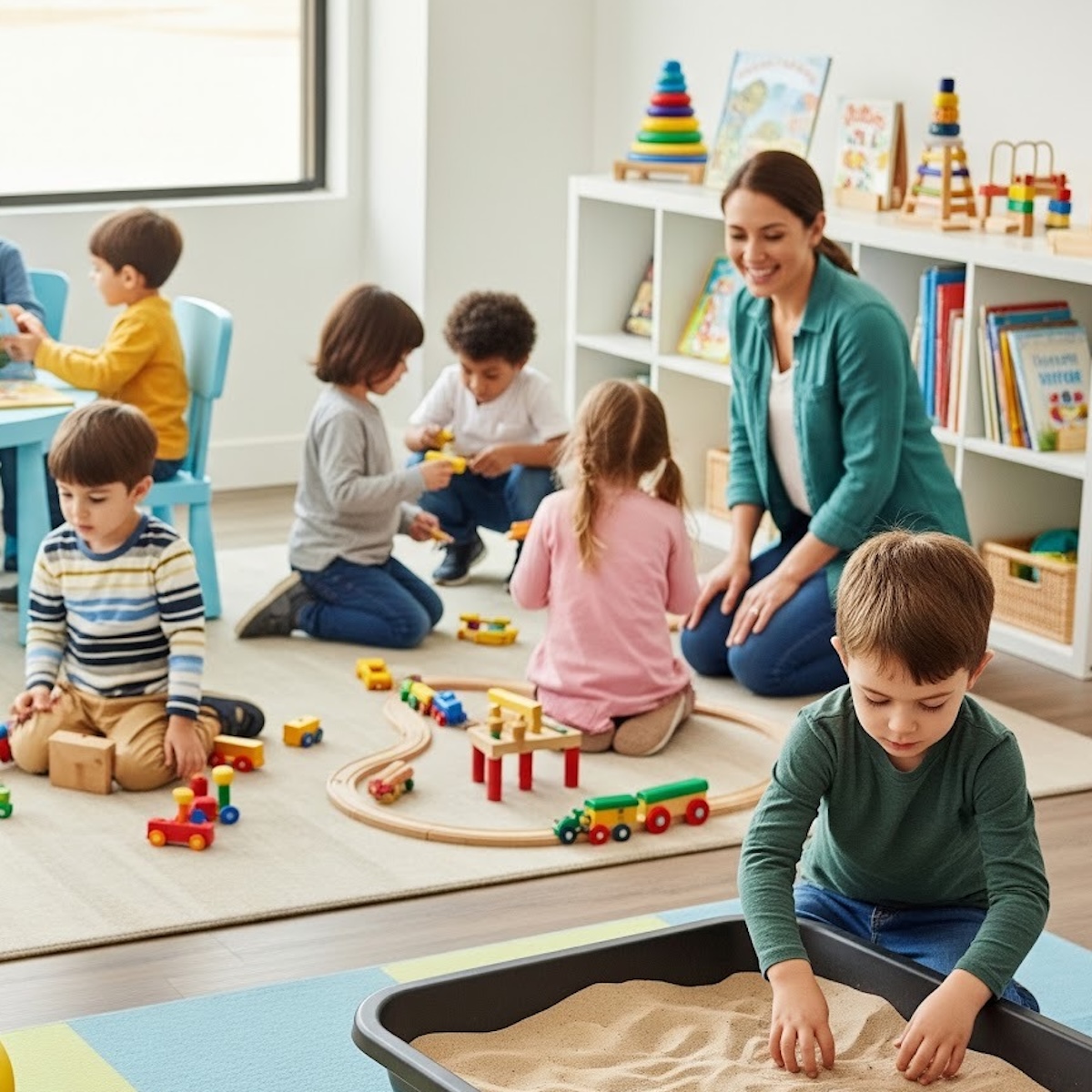
A nursery will often provide simple learning processes in addition to care.
Storytelling, artistic work, outdoor games and silent rest periods are all typical elements of organized schedules.
The qualified personnel lead group participation and encourage individual interests. Long working hours might also play a determining role among working parents.
Preschools are often concerned with preparing children to go to primary school.
There is increased focus on collaborative tasks, literacy knowledge and number familiarity.
Formal education is introduced to kids through small, manageable steps, which facilitate the transition to formal education.
Play-based centres rely on imagination as a developmental basis. They promote social growth by means of role-playing, problem-solving, and exploration instead of academic drilling.
Empirical research shows over and over again the beneficial impact of using imagination for communication and emotional regulation.
Considering Teaching Philosophies
Educational frameworks have an impact on long-term results and daily activities. For example, hands-on materials and self-directed activities encourage independence in Montessori-inspired settings.
Children develop autonomy at their own speed by selecting tasks in a well-organised area.
Collaborative projects and expressive arts are valued in Reggio Emilia-influenced environments.
Reflection and collaborative learning are made possible by the classroom culture of documenting learning events.
Children's creativity flourishes when they see their ideas valued and developed.
Conventional approaches might combine supervised play with planned lessons. Some students who react well to regular and predictable transitions find reassurance in clear expectations.
It is possible to determine whether a philosophy is nurturing or unduly rigorous by seeing how teachers engage with students.
Evaluating Your Child’s Personality and Needs
A major factor in assessing appropriateness is temperament. An energetic group setting with cooperative activities may be ideal for an outgoing child.
Smaller gatherings where relationships develop gradually may appeal to a quieter child.
Additionally, developmental readiness varies greatly. Every youngster has different language abilities, physical skills, and emotional fortitude. Sincere evaluation avoids needless stress and lets development happen organically.
Family values should also be taken into account. Expectations might be influenced by communication approaches, nutritional needs, and cultural customs. Trust between educators and parents is fostered in an environment that honours these components.
Observing the Environment Firsthand
A visit reveals far more than a pamphlet could. Observe how people answer enquiries and reassure uneasy children. During busy times, be mindful of your tone of voice, eye contact, and patience.
The physical environment is equally important. Exploration is encouraged by light-filled spaces, readily accessible items, and secure outside spaces. Cleanliness should be apparent without becoming constrictive or clinical.
Speaking with other families might offer insightful viewpoints. Parents who have previously enrolled frequently share their experiences, highlighting both potential issues and benefits that official tours miss.
Balancing Practical Considerations
Scheduling and location must coincide with everyday activities. Even the most stimulating curriculum might be overshadowed by stressful commutes.
For working carers, flexibility around pick-up times may be crucial.
Decisions are inevitably influenced by cost. Later misconceptions are avoided by clear and transparent pricing structures and additional costs. Sustainability during the academic year is ensured through financial planning.
Policies for communication should also be examined. A sense of collaboration is fostered by frequent updates, parent meetings, and staff availability. Children gain from regular support at home and in the classroom when teamwork is effortless.
Trusting Your Instincts
Facts and features are a guide, but intuition cannot be discounted. An environment where one feels welcome will usually be evident in a few minutes of entering a space.
When there is warmth and attentiveness, trust in the decision increases automatically.
- Parents Are Prioritising Breathable, Sustainable Fabrics For Children's Seasonal Sleepwear
- Our Homemade Christmas Printables, Made With AI: What Worked, What Didn't, and What I'm Saving for Next Year
- At-Home vs. In-Lounge IV Therapy in the Hudson Valley: Which Makes More Sense?
- Can Passengers Pursue Compensation After a Car Accident?




The choice of an early learning setting is a significant milestone. Reflecting, observing, and being honest allow the families to proceed with certainty.
Thoughtful consideration can make the first step into the education of a child not a cause of uncertainty but a feeling of excitement.





Leave a Reply