

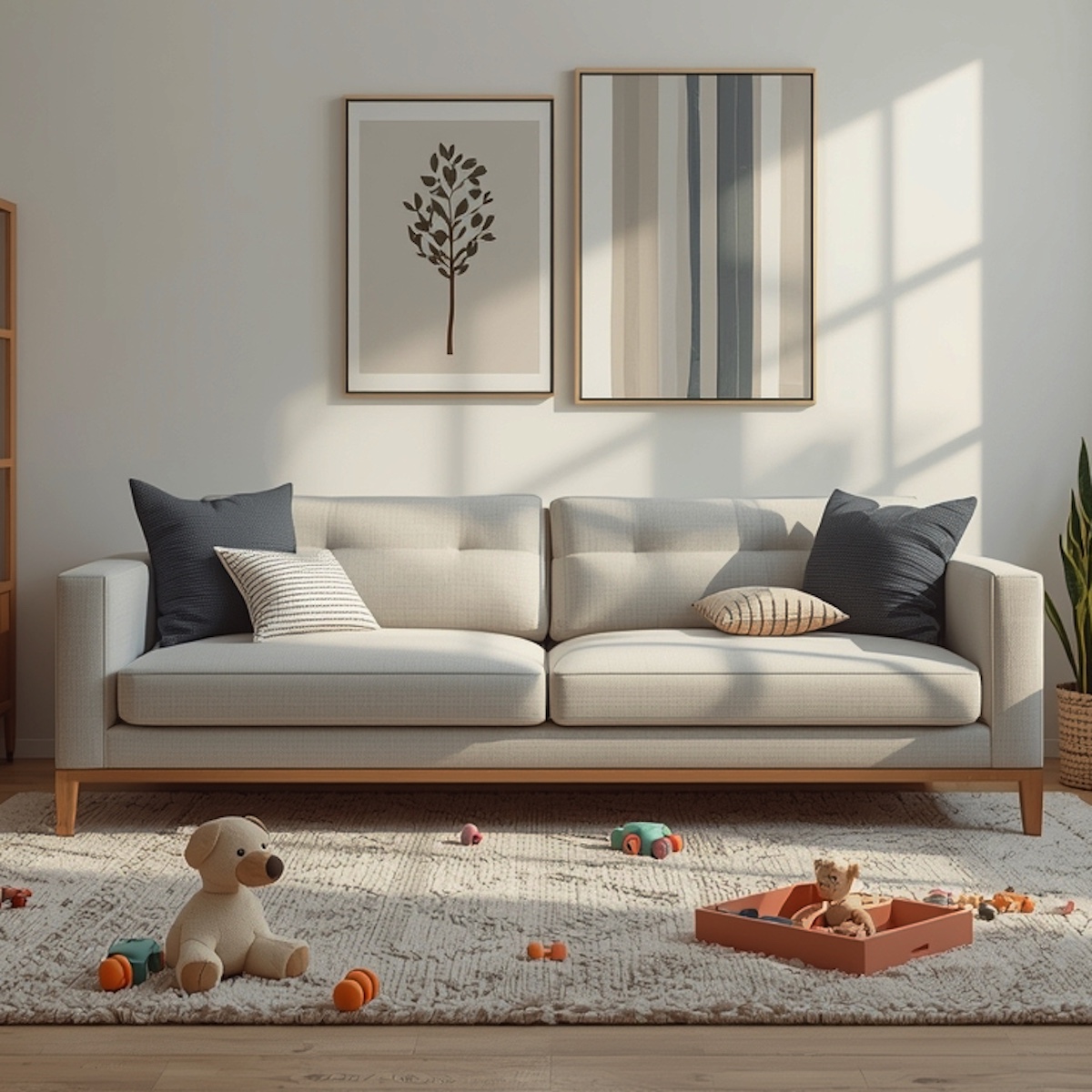
Buying a sofa is one of those decisions that feels purely aesthetic until the moment a five-year-old climbs on it with a chocolate biscuit in each hand.
Most parents focus on size, shape, and colour (which makes complete sense), but upholstery choice is where the real long-term story gets written.
The wrong upholstery doesn't just show wear and tear; it changes how you feel about your whole living room.
The good news is that the design industry has spent decades solving exactly this problem.
Some of the most thoughtful engineering in contemporary luxury furniture has gone into developing materials that hold up to real life without looking like they were chosen from a hospital waiting room.
A stunning Edra On The Rocks sofa, for instance, uses a proprietary three-dimensional fabric developed specifically for tactile resilience: the woven texture is designed to absorb use rather than betray it, which is a very different starting point from standard upholstery.
Jump to:
- Choosing Upholstery With Durability in Mind: A Parent's Practical Guide
- Removable Upholstery: The Smartest Thing You Can Do
- Velvet Looks Great Until Kids Arrive Home
- What Most Parents Wish They Had Known Earlier
- Stain Resistance and Everyday Maintenance
- Texture, Comfort, and Daily Use
- Colour Choice and Visual Longevity
Choosing Upholstery With Durability in Mind: A Parent's Practical Guide
Durability in sofa fabric is a less glamorous subject than colour or texture, but it's the one that determines whether you still love your sofa in five years or not.
Performance fabrics, such asbouclé blends, treated polyesters, and technical weaves, are designed to withstand the daily wear and tear that families subject them to without showing any visible signs of damage.
At the opposite end, there are pure linen and untreated cotton: genuinely beautiful, but unforgiving the moment you spill a juice cup.
Leather is a separate conversation. Full-grain leather from brands like Poltrona Frau actually becomes more characterful with use: scratches and patina are part of the material's story rather than evidence of damage.
Semi-aniline finishes offer slightly greater resistance to liquids without losing softness.
The catch is cost, and the reality that leather in a warm family home can feel less inviting than fabric for everyday lounging.
Removable Upholstery: The Smartest Thing You Can Do
One feature that rarely gets enough attention when shopping for a sofa is whether the cover actually comes off.
Removable upholstery systems (offered by several Italian manufacturers, including B&B Italia on select lines) mean that a spill doesn't have to be a crisis.
You deal with the cover, not the whole sofa, and then get on with your day. It also means you can quietly refresh the look after a few years without replacing a piece you otherwise still love, which feels like exactly the kind of win busy households need more of.
If you're spending seriously on a sofa, it's worth checking whether removable covers are available before you commit.
The structure underneath matters just as much. Sofas built on solid hardwood or birch plywood frames with good-quality foam cores hold their shape through years of children jumping, adults collapsing, and pets doing whatever pets do. The fabric is only ever as good as what it's sitting on.
Velvet Looks Great Until Kids Arrive Home
Velvet looks extraordinary and feels even better, but it's also the fabric most likely to cause quiet regret in a household with children under ten.
It shows every handprint, attracts every stray hair, and asks more of you, cleaning-wise, than most parents have time to give.
Microfibre, often dismissed as the unglamorous option, is in practice one of the most forgiving choices out there: it resists liquids, cleans up easily, and has come a long way in terms of how it actually looks and feels.
Treated weaves and technical performance fabrics are closing the gap between practicality and real aesthetic appeal faster than most people realise, and that gap is now genuinely narrow.
What Most Parents Wish They Had Known Earlier
A sofa that costs more upfront but holds up beautifully for a decade is not an indulgence; it's just better maths.
Families consistently underestimate how much a sofa takes on, and how quickly the wrong fabric makes that visible.
Getting the material specification right from the start, rather than treating it as a detail to sort out later, is the call most parents wish they'd made before the first sofa, not after.
The fabric question isn't a footnote. In a home with children, it might be the whole story.
Stain Resistance and Everyday Maintenance
One of the most practical considerations for family living is how a sofa handles stains on an ordinary Tuesday afternoon, not just how it looks on delivery day.
Modern performance upholstery often includes stain-resistant treatments that prevent liquids from immediately soaking into the fibres, giving you time to deal with spills before they become permanent marks. This small window makes a significant difference in real homes.
Equally important is ease of maintenance. Fabrics that tolerate regular cleaning, whether through light vacuuming or spot treatment, tend to age far more gracefully than those that require delicate care.
When evaluating options, it’s worth asking not just “Will this stain?” but “How easily can I fix it when it does?”
Texture, Comfort, and Daily Use
Durability alone isn't enough if the sofa doesn’t invite you to use it. Texture plays a quiet but decisive role in how a sofa integrates into family life.
Some highly durable materials can feel overly rigid or synthetic, which subtly discourages relaxed use, especially in a home where the sofa is the centre of daily activity.
The best modern upholstery strikes a balance between resilience and comfort, offering a surface that feels soft enough for long evenings yet robust enough to handle constant movement.
Fabrics with a slightly textured weave often perform well here, as they mask minor wear while still feeling natural to the touch.
Colour Choice and Visual Longevity
Colour is often treated as a stylistic decision, but in family settings it becomes a practical one.
Lighter shades may create a sense of space and calm, but they also reveal stains and wear far more quickly.
Darker tones, while more forgiving, can show dust, pet hair, and fading over time.
- Parents Are Prioritising Breathable, Sustainable Fabrics For Children's Seasonal Sleepwear
- Our Homemade Christmas Printables, Made With AI: What Worked, What Didn't, and What I'm Saving for Next Year
- At-Home vs. In-Lounge IV Therapy in the Hudson Valley: Which Makes More Sense?
- Can Passengers Pursue Compensation After a Car Accident?




Mid-tone colours and patterned weaves tend to offer the most balanced solution, subtly concealing everyday use without dominating the room visually.
The goal is not to avoid wear entirely, which is unrealistic, but to choose a finish that absorbs it gracefully, allowing the sofa to age in a way that still feels intentional rather than accidental.





Leave a Reply