

Most renovation budgets are skewed towards visible elements. Tiles, counters, paint, fixtures.
A decade later it becomes painfully obvious how much more sensible it would have been to invest some of that money into things that are hidden from view.
It doesn't take long for the thought of opening up freshly rendered walls to inspect something more interesting than the backsplash to turn from a handyman's nightmare into a homeowner's reality.
By that point, it stops being a renovation and starts to be a repair.
Jump to:
The Numbers Behind Future-Proofing Your Home
Before any discussion of cabinetry and countertops, budget allocation needs to take place at the system level first. Mechanical, electrical, and plumbing systems, or MEP for short, will see the most frequent maintenance out of everything installed in the house and carry the largest cost if not done regularly.
Life-cycle costing is more honest compared to a pure upfront view. A bathroom remodeling job with the necessary room for a plumber to work in which isolates valves, access points, and routings for wires and conduits will cost significantly less to maintain over twenty years than a cheaper alternative that hides everything behind tile and drywall. That chasm will show up in the repair budget down the road.
A good rule of thumb is to budget at least 20% of the overall renovation cost towards future-proofing the infrastructure. That should cover room access, necessary conduits, and valve access.
It may seem like a lot, but it can provide a return on investment through savings on future repairs.
An owner spends 1 or 2 percent of the value of their home on repairs and maintenance every year.
The annual savings from designing a major renovation around easily-accessible and cheaply repaired components can be as high as 30 percent.
That saving comes directly from the removal of expensive diagnostic and destructive fees that come with every repair a homeowner initiates.
Design Considerations For Non-Destructive Troubleshooting
The phrase that raises the eyebrow of any repair technician is we'll have to open the wall. Anytime something needs to be done that requires cutting through drywall, plaster, or even custom molding in order to access a valve, junction box, or any other piece of infrastructure, the cost of that repair increases by at least two times.
Sometimes it is closer to three. First, the repair estimate has to factor in the initial cost of diagnostics.
Then, it has to factor in the additional destructive costs to get into the wall. Finally, the repair has to factor in the costs of restoration and finishing the wall back to its original condition.
This issue is solved by designing in accessibility from the beginning. Every major junction, shut-off valve, and HVAC dampener should be placed in such a way that it is not necessary to cut through anything in order to gain access to it later.
This requires planning ahead at the rough-in phase rather than leaving things to the punch list.
In places where the mechanical, electrical, and plumbing (MEP) infrastructure is concentrated, such as in the case of hallways, kitchens, and bathrooms, that can be achieved by designing in professional-grade, flush-mounted steel access panels from Access Panels Direct that allow for a clean, maintenance-free, minimalist look while at the same time putting all the necessary plumbing manifolds and junction boxes within easy reach.
These types of access panels are available in several colors, can be painted to match the existing aesthetics in a room, and provide a durable long-term value.
The difference in price between sealing a valve behind the drywall and installing an access panel is only about eighty dollars. Meanwhile, the difference in repair pricing ten years down the road can be several orders of magnitude higher.
The repair costs, not the original price, define the true cost of an upgrade.
Every time there is an inspection, a service call, a pipe replacement, or a junction box re-location, the cost of that endeavor is inflated many times over due to the need to cut through drywall, plaster, or molding in order to access the hidden infrastructure.
And every time drywall is opened, there is an additional expense involved that comes with restoring it to its original condition.
This is especially true if the homeowner insists on a custom tile job that requires an exacting match of thinset mortar consistency, grout color, and other finishing details.
If a drywall patch is needed in the future, the drywall repair will be noticeable due to the difference in the texture and sheen of the paint. If the homeowner has something more elaborate than standard drywall tiling, the expenses for restoration can be prohibitively expensive.
Centralizing Your Utilities
One way to future-proof a home renovation is to centralize the utilities. Rather than running individual lines for plumbing, electrical, and HVAC throughout the building envelope, a chase can be roughed-in that puts all of these lines together so that a single access point serves all of them.
The concept is simple: if all the utilities run through a single chase, access and upgrades are much simpler to execute without damaging the structure of the building.
A plumber doesn't have to cut a hole in the kitchen counter to adjust a pipe because the same pipe is now located in the chase alongside the electric panel and HVAC ducts.
An HVAC technician doesn't have to open up the floor to check on a thermostat or follow the ductwork, because all of these elements are now consolidated alongside the plumbing system.
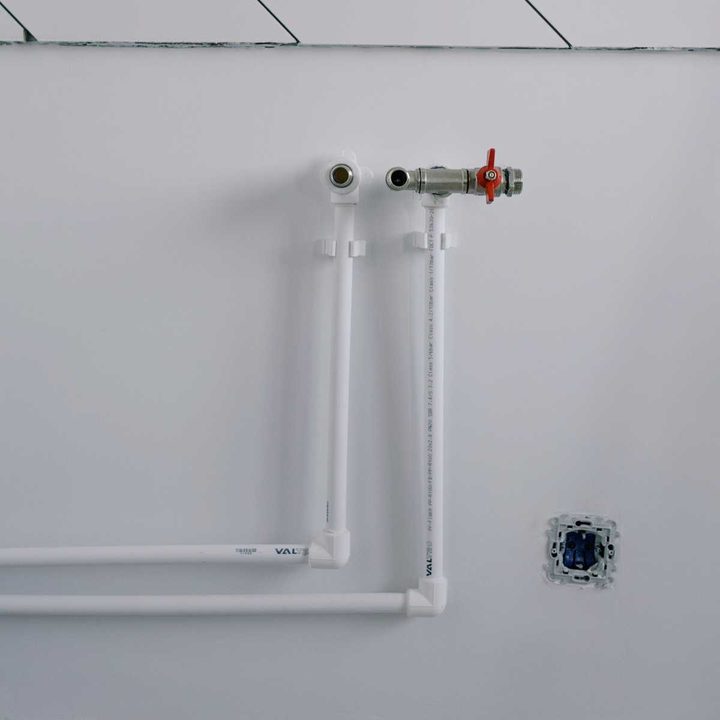
A PEX Plumbing Manifold is an excellent real-world application of the concept. By bringing shut-off valves for individual fixtures at a central location, a PEX manifold allows for fixture-specific maintenance without having to deal with shutting off the water in the entire house.
When a toilet, sink, or shower starts malfunctioning, it is enough to simply turn off the valve for that specific fixture, service it, and turn it back on without impacting the flow of water to the other parts of the house. Shutting off the water to an entire house in order to inspect a single toilet is not necessary when a PEX manifold is installed.
This type of manifold should also have an access panel located in a place that is easily reachable to the homeowner even outside of regular working hours. That information should be included in the blueprints for the house.
The placement of the manifold and the location of the access panel should not be discovered on-site.
Future-Proof Data, Low-Voltage, And Control Systems
The low-voltage side of things depreciates rapidly. The latest technology is always on the horizon, and the current generation of wiring or standard is often two iterations behind.
Fiber optics, coaxial, Ethernet, and control wiring all need access to the structure of the building in order to be upgraded.
And the process of creating access is prohibitively expensive if not done at the rough-in phase.
The cheapest and easiest way of future-proofing data and low-voltage systems is to rough-in empty conduit runs that leave the necessary infrastructure exposed but out of the way.
These runs (sometimes referred to as smurftubes for the common flexible blue plastic conduit) simply connect the main media closet or the router to the necessary wall positions throughout the house.
Every run should have a pull string that allows for the pulling of new cable through the empty conduit without having to open up the walls or ceiling.
It doesn't cost much to rough-in these types of runs during the initial stages of a renovation. The materials are cheap and the labor is minimal.
Meanwhile, retrofitting cable access through finished walls can be extremely time-consuming for a skilled professional and involve a large amount of aesthetic compromise for the homeowner.
The same general considerations apply to the control hubs for smart home thermostats, alarms, and lighting. The devices are likely to be upgraded or replaced at some point. The wiring and enclosures should be accessible.
Material Considerations For Long-Term Repairs
Accessibility of infrastructure is critically important, but it is only half the story. The other half is material choice in order to establish a general program of longevity.
The ideal materials are modular rather than monolithic, or those that allow for the replacement of individual components without disturbing the integrity of the whole.
Taking advantage of Halftime Plaster Accelerator when setting up complex wall panels allows workers to adjust drying times efficiently during installation.
Proper chemical timing gives technicians greater control over the setting process to maintain seamless alignment between individual sections.
Take poured surfaces as a general example. They can be beautiful, but they can also be difficult to repair in the event of an accident.
If a counter made of poured epoxy is damaged, it may be necessary to replace the entire surface with an entirely new one in order to remove the imperfections.
Meanwhile, a click-lock hardwood floor or even individual tile can see the individual damaged planks or tiles removed and replaced without disturbing the rest of the surface.
The same principle applies to modular decking. Rather than removing an entire length of boards to replace one or two, a single modular board can be removed, repaired, and replaced.
The material durability index is something to consider when selecting materials for long-term repairs. Quartz is much harder to damage than marble and requires less frequent cleaning and sealing.
Porcelain tile is more durable than natural stone counterparts. These are all factors to consider when determining the materials for a renovation and factoring in future maintenance costs.
Wet areas need specific considerations. As a general rule of thumb, each bathroom and kitchen renovation needs to budget in isolation valves per fixture that are accessible without having to move furniture or cabinetry.
Built-in appliances such as refrigerators, dishwashers, and washing machines need to have access points for inspection. If a leak occurs inside the frame of a built-in refrigerator, it will lead to rot that has to be removed later.
An inspection port built into the adjacent cabinet panel costs almost nothing to install and allows for the early discovery of such issues.
Hvac And The Access Hatch
Heat recovery and energy recovery ventilators are becoming standard equipment in new builds, and they require annual maintenance the same way other HVAC equipment does.
Filters need to be cleaned or replaced, cores cleaned, fans or motors serviced. There is likely to be other mechanical equipment installed as part of the renovation that requires maintenance, such as an inline ceiling fan.
However, that equipment usually is neglected, and it is only when something goes wrong that the owner realizes the burden of upkeep.
HRV efficiency drops considerably if it is not serviced regularly, while an ERV with a dirty core can become a serious source of indoor air quality issues.
For the owner, this means another piece of equipment to account for, with questions regarding whether the electrician who installed it understands the value of maintenance.
The issue of mechanical access is even less contemplated, but it carries even more consequences.
Mechanical equipment in new builds or renovations tends to be put in utility cores tucked behind an access hatch the size of a pigeon coop.
It is rarely something the owner even notices at the time of renovation, because the equipment seems to serve its purpose well enough.
At the time, it seems logical to put it in the closest available location so that it doesn't have to fight to suck in air.
It doesn't take long, however, for the inconvenience of that choice to reveal itself. When it is necessary to manoeuvre awkwardly between ceiling joists to inspect equipment every time there is cause for concern, it is too late to reconsider the value of mechanical access.
Building The Home That Stays Functional
A good renovation is not defined by the look of the service panel. That doesn't seem to change much for most homes. The value of
- Behind the Science of Modern Skincare: How Research Labs Study Bioactive Peptides in Cell-Culture Models
- What Are the Key Steps for Starting ABA Therapy in Maryland for Autism?
- A Busy Family’s Guide to Keeping the Plumbing Happy
- How to Grow a Home-Based Business Without Putting Your Family Budget at Risk






Leave a Reply