

After a long writing session, many people notice tight fingers, a tired wrist, or a tendency to grip the pen more firmly without realizing it. Students, teachers, designers, and office workers often share this experience.
That does not automatically mean your grip is “wrong,” and not every tired hand becomes a medical problem. Writing involves many small, repeated movements: fingers guide direction, the wrist adjusts the angle, and the forearm helps move the hand across the page. When those actions continue for a long time—especially while rushing to take notes, fill in forms, or write under pressure—the hand can start to feel fatigued.
It is still important to distinguish ordinary tiredness from symptoms that should not be ignored. Repetitive strain injuries can affect the hands, fingers, wrists, and forearms. If pain, numbness, tingling, swelling, or weakness does not improve or becomes worse, changing pens alone is not an appropriate solution. Consider speaking with a doctor, physiotherapist, or another qualified healthcare professional. NHS guidance on repetitive strain injury
For most everyday writers, the goal is not to find a pen that “prevents tendinitis.” It is to create a writing setup that places less unnecessary demand on the hands: pacing long sessions, adjusting posture, avoiding excessive grip pressure, and choosing tools that do not make writing feel like a struggle.
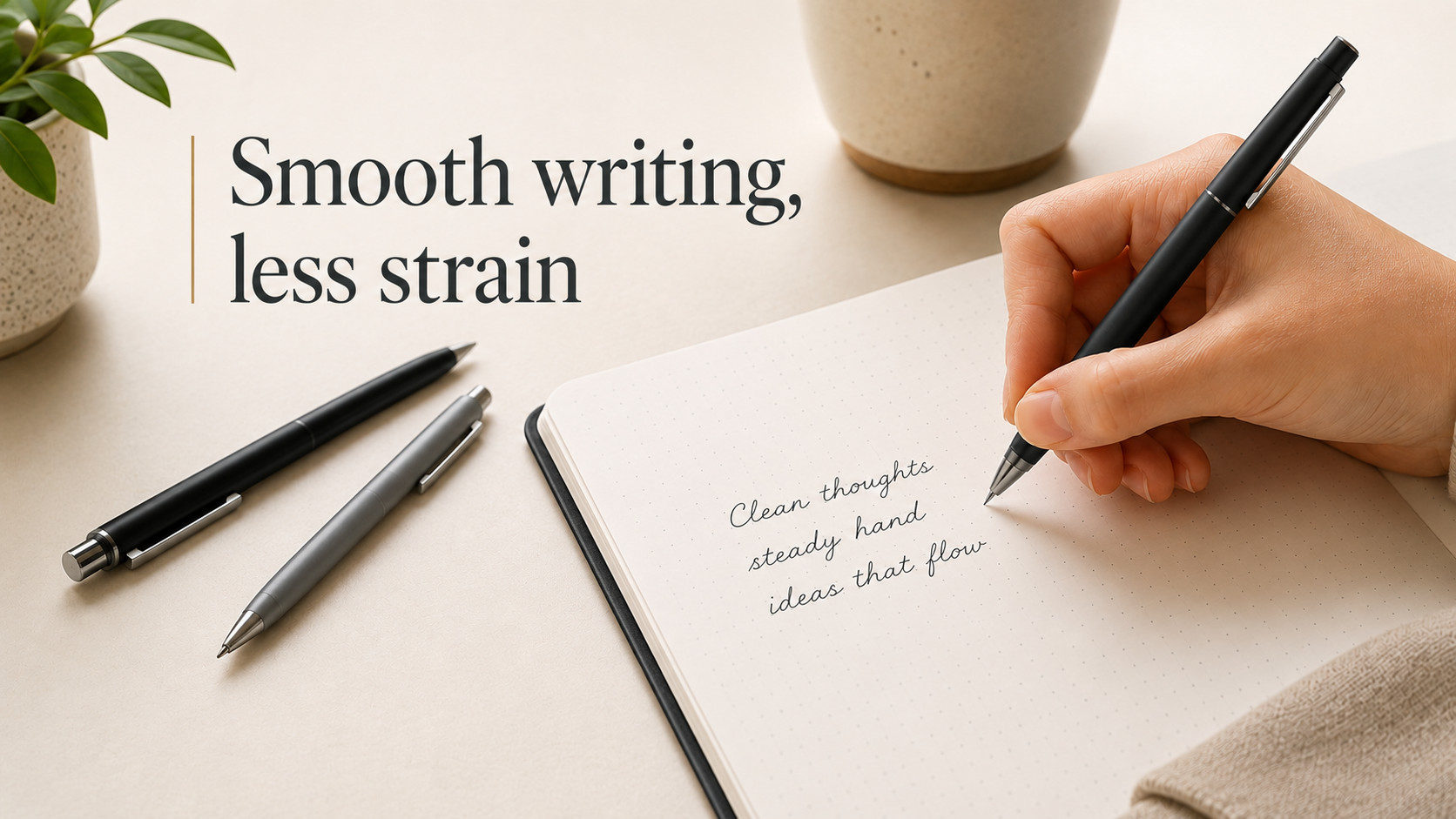
Writing Fatigue Often Comes From Several Small Factors
How tired your hand feels is not determined only by how many words you write.
You may grip more firmly because you are trying not to miss an important point in a lecture. You may press harder because the pen, paper, or ink does not feel smooth. Desk height, paper angle, and whether your forearm has support can also affect how much tension your wrist carries.
Ergonomics is not about finding one perfect product. It is about making a task fit the person more comfortably. The Occupational Safety and Health Administration identifies repetitive movement, force, and awkward postures as factors associated with musculoskeletal discomfort and emphasizes improving the overall work setup. OSHA ergonomics overview
Writing works in a similar way.
A comfortable pen cannot replace breaks, and good posture cannot make an unpleasant pen instantly enjoyable. But when your posture, pace, and tools work together, your hand may not need to spend as much unconscious effort completing the same page.
Four Habits That Can Make Long Writing Sessions Easier
1. Avoid Treating Long Writing as One Continuous Task
If you need to copy notes, solve problems, write meeting records, or organize a large amount of material, do not wait until your hand is already very tired before pausing.
After a page, a question, or a short section, put the pen down briefly and move your fingers and wrist. The goal is not to interrupt concentration constantly. It is to avoid holding the same grip and wrist position for too long without a reset.
2. Notice Whether You Are Gripping Harder as You Write
When people are focused or in a hurry, they often tighten their grip without noticing. A simple check is to pause for a moment and see whether your thumb and index finger are turning pale or whether the barrel is leaving deep marks on your fingers.
You do not need to hold the pen so loosely that you lose control. But try reducing the pressure to the amount needed for stable writing. A pen does not need to be tightly pinched to produce clear notes.
3. Give Your Forearm and Wrist Some Support
Try to let your forearm rest naturally on the desk rather than asking your wrist to carry all the control while hovering. You can also angle the page slightly instead of keeping it completely flat. The aim is not to force a single “correct” posture, but to avoid holding the wrist in a noticeably bent or tense position for a long time.
The right angle differs from person to person. A practical question is whether your wrist still feels natural after ten minutes of writing or whether you already feel the need to keep shifting your hand.
4. Pause Before Discomfort Becomes Significant
Mild fatigue, brief tightness, and the need for a break are normal signals. Persistent pain, numbness, swelling, or weakness should not be pushed through.
If a particular writing task regularly makes you uncomfortable, consider changing your pace, page angle, pen tip size, or pen choice rather than simply using more force to finish it.
A Stable Tip Can Reduce Unnecessary Distraction
When people talk about a comfortable pen, they often think first about grip softness or barrel width. For people who write small text, take dense notes, or fill in forms for long periods, the feeling of stability at the tip can matter as well.
If a pen feels less stable during turns, downstrokes, or lifts, some writers may make more small corrections or grip the pen more firmly to feel in control. Everyone experiences this differently, but a pen that feels more predictable on the page can be easier to use over time.
The Zebra bLen series is designed around controlling “writing vibration.” Its bLen System secures the pen tip, reduces small movements and internal noise, and uses a lower center of gravity to create a more stable feel. For people who regularly write class notes, plan schedules, edit printed drafts, or make detailed lists, ergonomic Zebra bLen pens are worth considering from the perspective of writing stability.
This does not mean a stable tip solves every cause of hand fatigue. Its value is simpler: when the tool itself creates less distraction, you may spend less attention trying to control it.
Smooth Ink Can Make Writing Feel Less Demanding
Alongside stability, the feel of the ink can influence whether someone wants to keep using a pen.
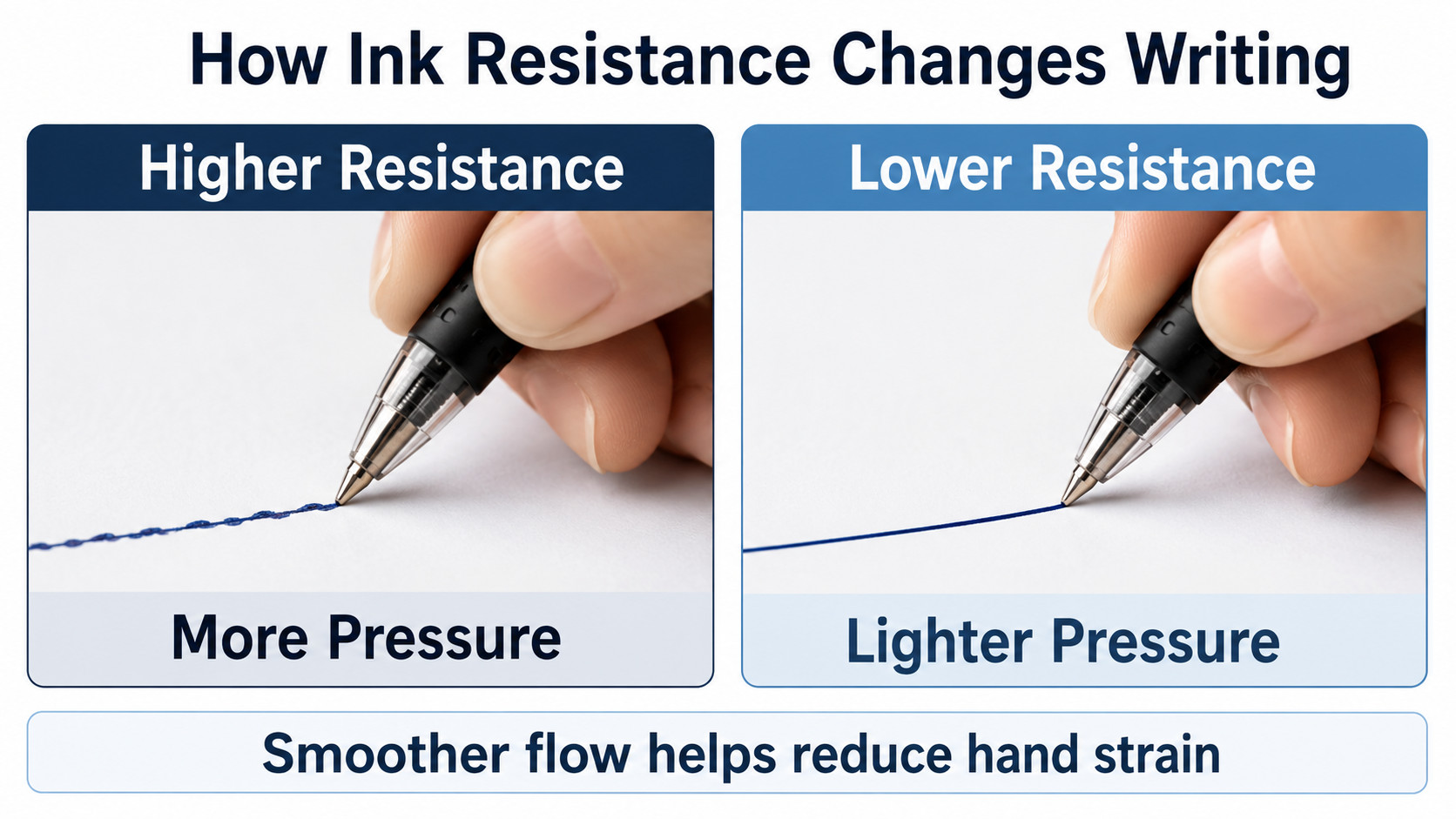
When ink flow feels inconsistent or the tip creates noticeable resistance on the page, many people naturally increase pressure to make the line clearer. In contrast, a pen that writes smoothly, dries quickly, and produces less smudging can make the writing rhythm feel easier. It may also reduce the urge to rewrite letters or press harder simply to make notes more visible.
The Uni Jetstream range combines the everyday reliability of a ballpoint pen with a smoother writing feel. Its quick-drying ink can be especially useful for left-handed writers or anyone who needs to turn pages and annotate quickly. Selected Jetstream models with Lite Touch Ink place further emphasis on a lighter, smoother writing experience.
For people who often feel they need to press down just to make a pen write clearly, effortless Uni Jetstream lite touch ink offers another useful direction to explore: choose a pen and ink combination that moves more easily across the page, then notice whether you can write with a more natural amount of pressure.
The point is not to present smooth ink as a medical solution. It is to recognize that writing feel shapes writing habits. The less you need to fight with the pen and paper, the easier it is to keep your attention on what you are trying to write.
Choose a Tool You Do Not Have to Keep Fighting
A pen that works well for long writing sessions is not necessarily the most expensive, softest, or most feature-filled option.
Some people prefer a lightweight barrel. Others prefer a little more weight to help the pen feel steady. One person may value a low center of gravity and clear tip feedback, while another may care most about quick-drying ink and clean fine lines. The best choice is the one that lets you write with a reasonably natural posture and grip, then still feel willing to keep using it after finishing a page.
Writing ergonomics is never a promise made by one product. Breaks, posture, hand strength, desk setup, and tool choice all play a role.
But as an everyday starting point, choosing a pen with a more stable tip, smoother ink flow, and a feel that allows you to relax your grip can reduce some of the unnecessary friction in writing—and leave more attention for the words themselves.





Leave a Reply