

Some design choices are forever-choices. A white farmhouse sink is one of them. It anchors the kitchen, pulls light into the room, and somehow reads as both cottage and modern, depending on the cabinetry around it. That's a rare trick for a plumbing fixture.
But a white farmhouse sink is also heavy, visible, and expensive enough that most people buy only one in a lifetime. Which means the decision deserves more than a Pinterest scroll.
The learning curve with Fireclay doesn't really show up in the product photos. It usually isn't about style; most homeowners know what they want aesthetically.
The mistakes happen in the quiet details: cabinet fit, weight underestimated, a glossy white surface that shows marks from the wrong scrubber. This guide walks through the decisions that actually matter, in the order you'll face them.
Jump to:
Why The White Farmhouse Sink Keeps Winning
Kitchens cycle through trends, brass fixtures, matte black hardware, green cabinets, the quiet return of warm wood tones, but the white apron front sink survives each cycle. Part of that is aesthetic.
A white sink reflects light and makes even a small kitchen feel bigger. It also pairs with almost everything: stainless steel, black matte, warm oak, and cool marble countertops. The sink doesn't fight any of them.
The less obvious reason is what it signals. A farmhouse sink is a commitment to the kitchen as the center of the house.
It sits forward, visible from the living room, unapologetic about taking up counter space. Compared to a dropped-in steel basin hiding behind a countertop edge, it reads as intentional.
That said, style alone doesn't make a sink last twenty years. The material underneath does.
What Fireclay Actually Is (And Why It Matters Here)
Fireclay is a specific type of ceramic, shaped from dense clay and fired at very high temperatures, around 2,200°F.
That firing is what distinguishes fireclay from standard ceramic sinks, which are typically fired at lower temperatures, around 1,500–1,800°F.
The extra heat fuses the clay body and the glaze into a single, hard, non-porous surface.
In practice, that means a few things for daily use. The surface resists staining from coffee, turmeric, red wine, and tomato sauce, the usual offenders.
It handles high heat well, so a hot pan lifted straight from the stove doesn't crack the finish.
And because the glaze is bonded rather than applied as a separate layer, it's harder to chip through normal wear.
Cast iron sinks are the closest aesthetic comparison, since both come in classic white and carry real weight.
The difference is the underlying material. Cast iron is a metal with an enamelled coating. If that coating chips, you see rust.
Fireclay is the same material throughout; chips, when they occur, reveal more of the same clay body rather than a different substrate.
How It Holds Up Day-To-Day
Here's the honest version. A fireclay sink is one of the most durable kitchen sink options on the market, but "durable" doesn't mean invincible.
A cast-iron pan dropped from counter height will chip any ceramic material, fireclay included.
What fireclay does well is resist the slower, sneakier kinds of damage, the small abrasions, stains, and heat marks that add up over the years.
Scratches are the most common worry with a white sink. The good news is that most "scratches" on a glossy surface aren't actually scratches at all.
They're metal marks, grey streaks left when stainless cookware rubs against the glaze. These lift off with a non-abrasive cleaner and a soft cloth.
Actual scratches that cut into the glaze are rare and usually come from steel wool or hard scouring pads, both of which should stay far away from fireclay.
Staining is mostly a maintenance habit, not a material issue. Rinse the sink at the end of each day. Tea and coffee won't stain a fireclay surface if they're not left to dry in.
For anything more stubborn, a paste of baking soda and water is left overnight to remove most of the discolouration.
Owners who stick to this routine regularly report sinks that still look close to new after five years of daily use.
For homeowners weighing durable apron-front options, fireclay farmhouse sinks pair the classic white farmhouse look with a dense, non-porous surface that resists stains, heat, and most daily wear and tear, which is why they remain a staple decades after they first became popular.
Single Bowl Or Double Bowl?
The classic farmhouse look is a single large basin with an apron front, and for most households, it's the right call.
A single bowl fits a sheet pan, a roasting tray, and an oversized stock pot without rearranging.
If the dishwasher handles most of the daily dish duty, the single-bowl model wins for usable space.
A double bowl makes sense in two situations: you hand-wash a lot and want one side for soaking while you rinse on the other, or your household splits prep tasks across two cooks at once.
Double bowl sinks with unequal bowl sizes (roughly 60/40) tend to be more useful than equal splits, because you still get one basin big enough for a real workload.
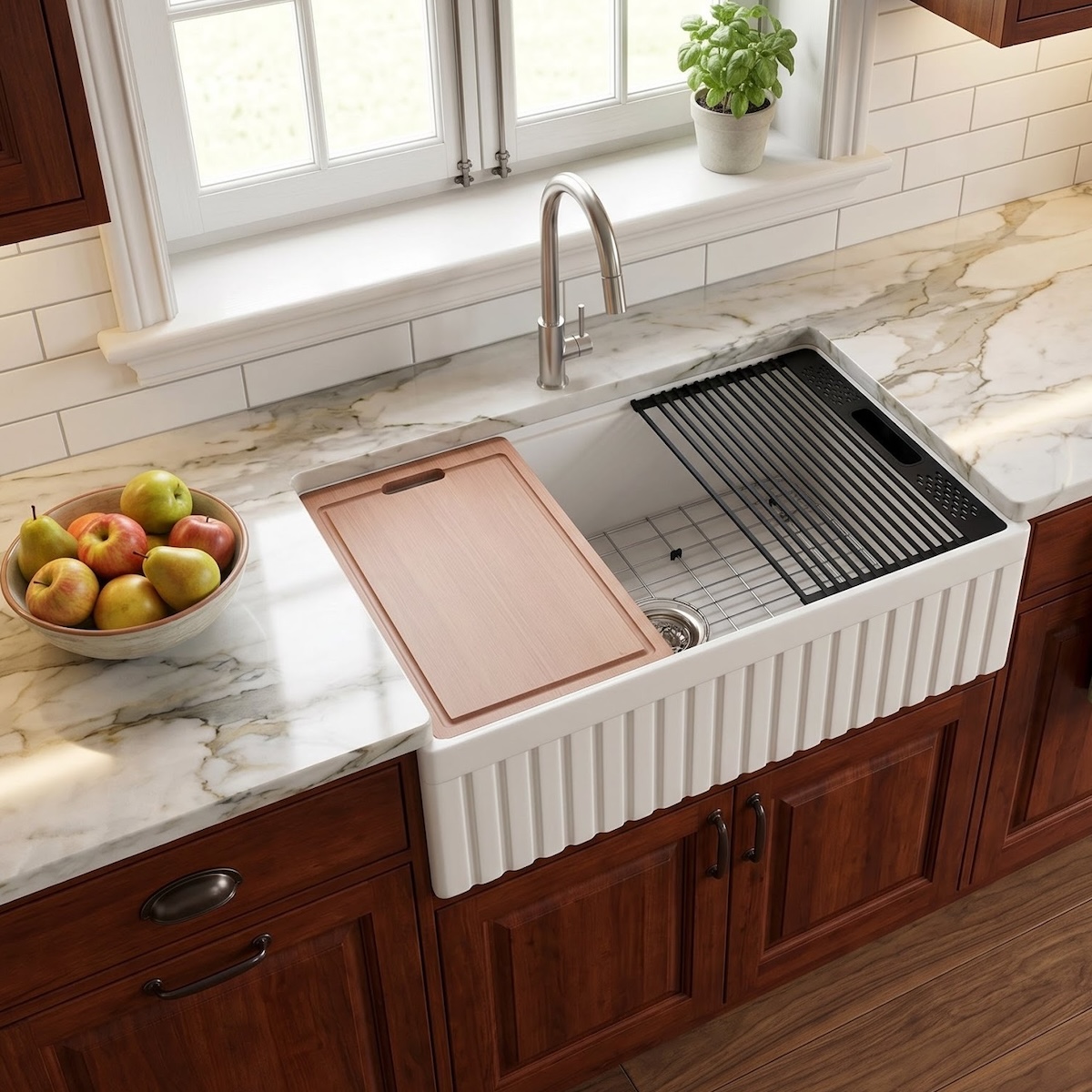
Workstation sinks, the kind with integrated ledges that hold a cutting board, drying rack, and colander across the basin, have changed this calculation.
A single-bowl workstation gives you much of the utility of a double-bowl without sacrificing depth.
The accessories slide over the basin, so effective counter space expands when needed and disappears when it isn't.
Cabinet Fit Is Where Most Mistakes Happen
Every farmhouse sink lives inside a specific cabinet cutout. Get this measurement wrong, and you're looking at either a return or a cabinet modification. Neither is fun.
The general rule: the cabinet needs to be about 3 inches wider than the sink. A 30" sink needs a 33" base cabinet. A 33" sink needs a 36" base.
This accounts for the cabinet walls on either side and leaves room for the sink to sit properly on the support frame.
If you're renovating and can still change cabinet dimensions, a 33-inch sink in a 36-inch cabinet is the most flexible combination for a standard kitchen.
It fits large cookware without consuming too much cabinet run, which is why it tends to be the most common size in modern kitchen installations.
The piece people underestimate most is weight support. A 33-inch fireclay sink typically weighs between 100 and 130 pounds empty. Add water and dishes, and you're easily at 150.
The cabinet needs reinforced support rails underneath, and the installer needs to know that before work begins. One common post-installation issue isn't dramatic damage; it's a slow sag over months caused by inadequate framing.
Care That Keeps A White Sink White
The rule of thumb: treat a fireclay sink the way you'd treat a nice piece of enamelware. Gentle is fine. Aggression is a mistake.
What works: dish soap and warm water for daily cleaning, baking soda paste for stains, a soft sponge or cloth for anything stubborn. Lemon juice or white vinegar handles hard water marks.
For deeper discolouration, a non-abrasive cleaner, such as Bar Keepers Friend, applied with a soft cloth, will usually restore the finish.
What doesn't work: steel wool, scouring pads with hard abrasive backings, and caustic cleaners like oven cleaner or drain cleaner.
These either scratch the glossy surface or etch the glaze. Avoid them entirely.
One habit worth building from day one: don't leave cast-iron pans sitting in the basin overnight.
The iron can leave rust rings that are difficult to remove and can become permanent if left long enough.
A bottom grid, that stainless wire rack that sits on the bottom of the basin, prevents direct contact between heavy cookware and the sink surface.
Many mid-tier and higher fireclay sinks include one, and it's worth confirming before you buy.
The Price Question
White farmhouse fireclay sinks range from about $300 on the entry end to well past $1,500 on the upper end.
The actual cost difference usually comes down to a few factors: country of origin, glaze consistency, included accessories, warranty length, and brand distribution.
At the entry tier (around $300–$450), buyers typically get a real fireclay sink but with shorter warranty coverage, often one year, and accessories sold separately. Quality control can be inconsistent, and replacements mean dealing with a third-party reseller.




In the mid-tier ($450–$900), buyers usually see longer warranty terms, tighter manufacturing tolerances, and accessories bundled into the base price.
This is often the best value range for homeowners who want durability without paying mainly for heritage branding.
Many direct-to-consumer brands compete at this level by skipping the showroom distribution layer.
Upper-tier sinks ($1,500+) add hand-finishing, specific country-of-origin markups, heritage brand history, and, in some cases, distribution through speciality showrooms.
Whether that's worth the jump depends on how much those details matter to you.
A white farmhouse fireclay sink is a decision you make once and live with for a long time.
That's intimidating if you're choosing in a hurry, but actually freeing if you're willing to spend a weekend on the research.
Measure the cabinet. Pick the bowl configuration. Decide whether workstation accessories are worth the extra budget. Everything else is about taste, and taste is the easy part.
FAQ'S
Not from normal use. The glaze is bonded to the clay body at high temperature, so it doesn't absorb staining the way a porous surface would. Yellowing usually indicates either buildup on the surface (which cleans off) or, in rare cases, damage to the glaze from caustic chemicals.
Possibly. A cast-iron pan dropped from counter height can chip any ceramic sink. A bottom grid significantly reduces this risk, and for most households, daily use over the years won't cause chips. The risk comes from acute impacts, not ordinary wear.
Most fireclay sinks outlast the kitchen they're installed in. Twenty to thirty years with proper care is a reasonable expectation, and sinks still in good shape well past that mark are not unusual in older homes.
Heavier and more involved than a drop-in sink. A professional installer, reinforced cabinet support, and usually about half a day of work are standard. It's not a DIY weekend project for most people.
Yes. Standard garbage disposals mount to fireclay sinks the same way they mount to stainless or cast iron. The drain assembly takes a bit more care during installation because of the sink's weight, but there's no compatibility issue.





Leave a Reply