

Most parents assume that when a child is hurt in a car accident, the at-fault driver’s insurance simply pays the bills. It rarely works that way.
The hospital wants payment now, fault takes months to sort out, and the coverage that answers first is often your own, not the other driver’s.
Add a settlement that a judge must approve before the money reaches your child, plus two separate filing deadlines, and the process looks far less straightforward than it did in the waiting room.
Here is how the pieces fit together, and where parents tend to lose ground without realizing it.

Jump to:
The Place of the Accident Is Crucial
Car accident law is not national. Every state sets its own insurance minimums, its own rules on which coverage pays first, and its own deadlines, and those requirements vary from state to state.
Florida parents, for example, usually lean on PIP coverage of up to $10,000.
Texas is a fault-based state that only requires 30/60/25 liability limits, and insurers there must offer PIP and UM/UIM coverage, which stay on your policy unless you reject them in writing.
The state where the crash happened usually decides which of these rules apply, no matter where your family lives. If your child was hurt on a Houston road, Texas law governs the claim, and so you need a car wreck lawyer in Houston who practices under those rules and knows how local insurers and courts handle them.
That lawyer can tell you which coverage applies to your child, which deadlines are already running, and what to say to an adjuster before you say anything at all.
What to Do in the First Hours
Your child’s health comes first. It is also your strongest evidence, since medical records link the injury to the crash. A gap before the first doctor visit lets insurers argue that something else caused it.
- Call 911 and have your child examined, even if they seem fine. Symptoms often show up days later.
- Mention every complaint to the doctor, even small ones, so each one lands in the record.
- Get the police report number and the other driver’s insurance details.
- Skip recorded statements to the other driver’s insurer.
- Turn down quick offers. They are often worth far less than the case, especially when treatment may last months.
How to Document Everything Properly
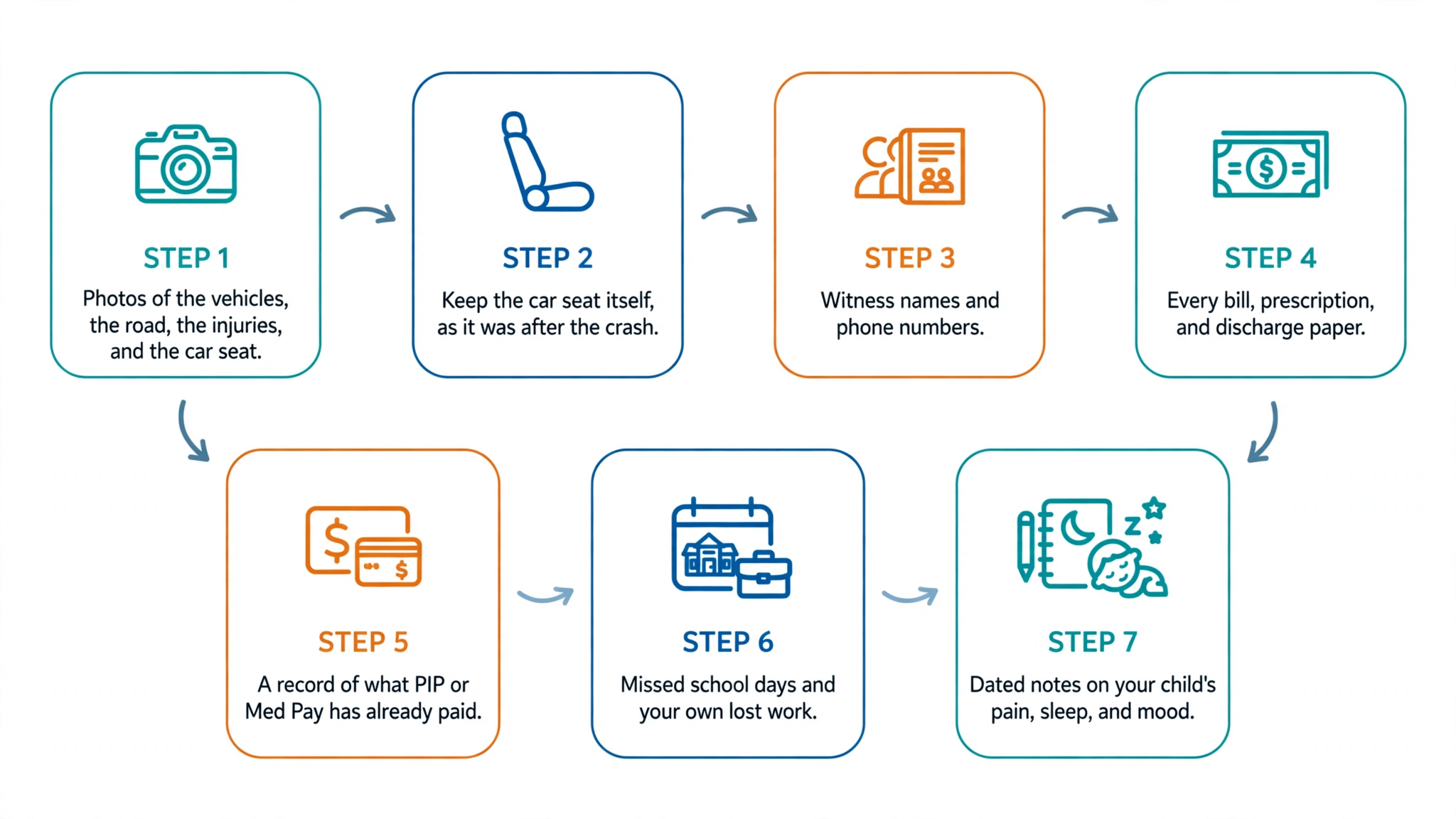
Insurers often dispute claims despite months of medical records, so start the paper trail on day one. Keep everything in one folder, physical or digital, and add to it every week.
- Photos of the vehicles, the road, the injuries, and the car seat.
- The car seat itself, kept as it was after the crash.
- Witness names and phone numbers.
- Every bill, prescription, and discharge paper.
- A record of what PIP or Med Pay has already paid.
- Missed school days and your own lost work.
- Dated notes on your child’s pain, sleep, and mood.
Source: MetaAI
Who Is Liable?
Liability works as it does for adults: someone’s negligence caused the harm. In Texas, that decides whose insurer ultimately pays.
- The other driver, if distracted, speeding, or impaired.
- The vehicle’s owner, in many states.
- A car seat or seat belt maker, if a defect contributed to the injury.
Texas also reduces compensation by a person’s own share of fault.
If the parent driving was partly to blame, a lawyer can explain how that affects the child’s claim. If liability is proven, compensation can cover medical bills, future treatment, pain and suffering, lasting impairment, and a parent’s lost wages.
Insurance Coverage and How to Activate It
Several policies can respond to one crash, and none of them starts on its own. Someone has to open each claim.
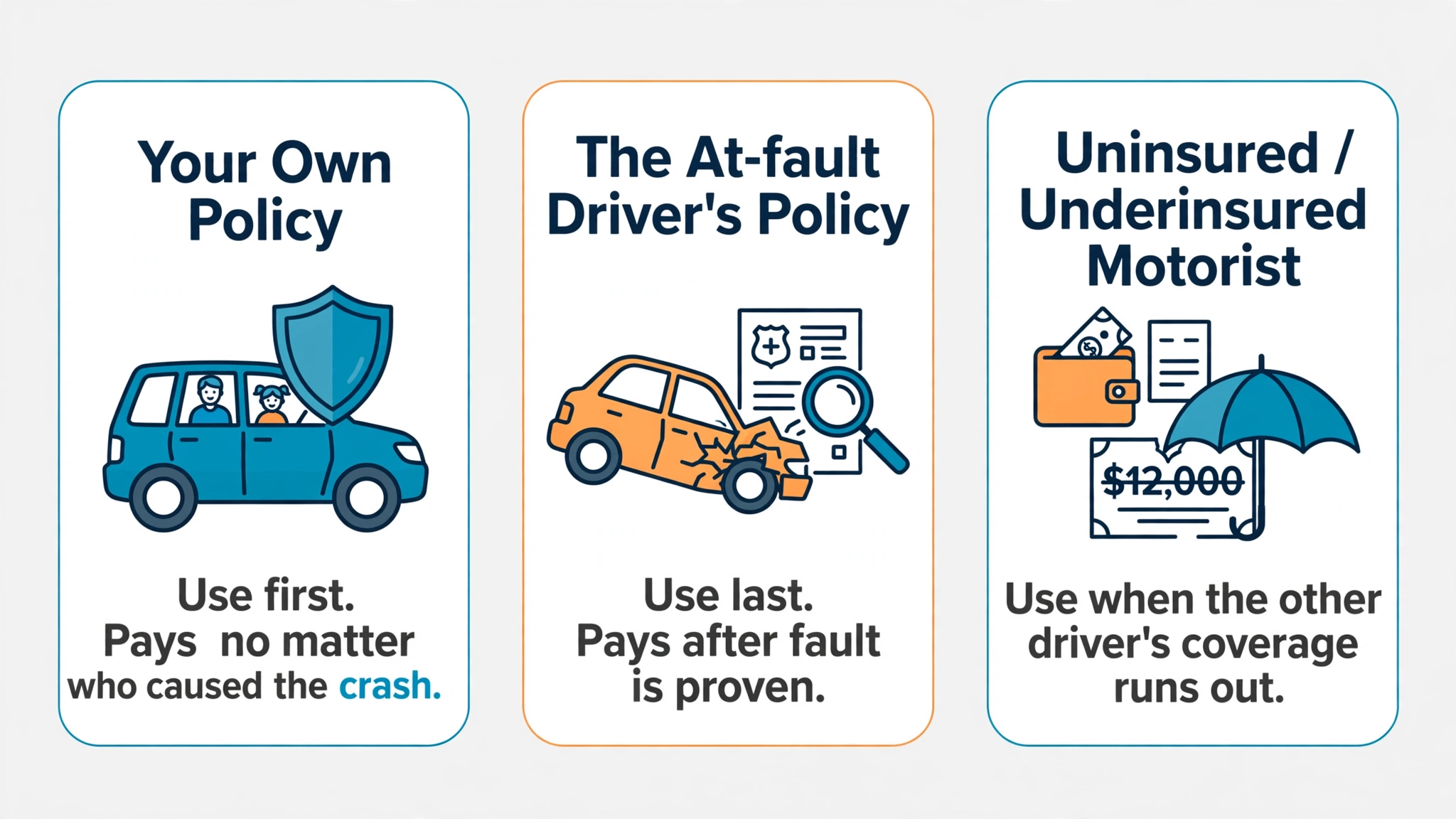
Your Own Policy
PIP pays medical costs regardless of fault, even when the parent driving caused the crash. MedPay, if you carry it, works the same way.
Tell your insurer a child was hurt, get a claim number, and send bills as they arrive.
The At-fault Driver’s Policy
This one pays last, once the fault is clear.
With a $30,000 Texas minimum per injured person, a serious injury can exhaust it fast. Expect the insurer to ask for bills, medical records, the police report, and photos before it makes an offer.
Uninsured and Underinsured Motorist Coverage
Say the other driver carries a $10,000 policy and your child’s bills hit $50,000. UM/UIM can cover the gap.
It can be claimed under your policy, the policy on the vehicle your child was in, or both. Check your declarations page, and get your insurer’s consent before settling with the other side.
Source: MetaAI
Two Deadlines and a Judge
Texas allows two years to sue, but children get a twist.
- Your child’s own claim: the clock is paused until age 18, so they generally have until 20.
- Your claim for medical bills: it usually stays on the two-year clock.
A longer deadline is not a reason to wait. Witnesses forget, and evidence disappears.
Any settlement also needs a judge’s approval. The court appoints a guardian ad litem to confirm the deal serves your child, and the money may go to the court registry, a trust, or a structured settlement that pays out as your child grows.
Open every claim early, keep every record, and speak with a car wreck lawyer before you accept any offer.





Leave a Reply