

For decades, firefighters saw dirty gear as a badge of honor. A soot-covered helmet and a worn leather radio strap showed you had experience on the fireground.
But we now know the risks are much bigger. The soot on your gear isn't just dirt. It's a mix of cancer-causing chemicals that are a serious, long-term health risk.
Because of this, we have to look closely at all our gear. This is especially true for items worn close to the skin that are hard to clean.
Old-style leather straps look classic, but they are porous, meaning they have tiny holes that soak up liquids.
They absorb harmful chemicals like a sponge and can't be safely cleaned in a station's gear washer. This is why new gear has been created for modern cleaning methods.
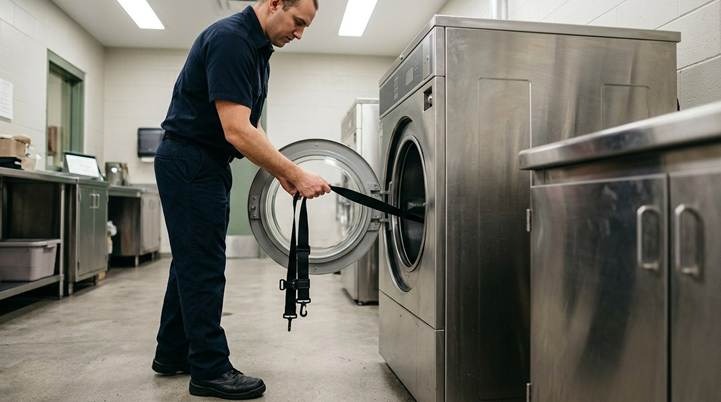
For example, the h6 radio strap uses a special nylon that isn't porous. It can handle the same washing as your turnout gear.
Quick answer: Your radio strap, especially if it's old-style leather, can soak up and hold onto cancer-causing chemicals from fires. The fire service is moving to nylon straps that can be washed in a gear extractor. Cleaning your strap with your turnout gear helps lower how much you're exposed to these dangerous chemicals over time.
Jump to:
What Are the Real Health Stakes of Contaminated Gear?
The main health risk is from being exposed to cancer-causing chemicals over and over again. Your gear soaks up these chemicals at a fire, and they can later get on your skin. These chemicals aren't just dirt you can brush away. They are tiny particles that get stuck inside materials with small holes. The danger isn't from one fire. It's from being exposed hundreds of times over your career, which greatly raises your risk of getting cancer.
This isn't just a theory. A long-term study by the National Institute for Occupational Safety and Health (NIOSH) found that firefighters have a 9 percent higher risk of getting cancer. They also have a 14 percent higher risk of dying from cancer than the average person.
This higher risk is tied to the dangers of the job, especially chemical exposure. The smoke from burning plastics, electronics, and building materials creates a toxic mix that stays on your gear long after the fire is out.
The world's top scientists now agree on this danger. In 2022, the International Agency for Research on Cancer (IARC) reclassified being a firefighter to "Group 1: Carcinogenic to humans." This puts the job in the same risk group as known dangers like asbestos and benzene. It proves that the chemicals at every fire are a real threat to your long-term health.
❝ Talk to your department's safety officer about how easily your skin absorbs chemicals. The skin on your neck, jaw, and groin soaks things in much more easily than other parts of your body. A dirty radio strap resting on these areas creates a direct path for toxins to enter your body, which can happen for hours after you leave the scene.
This is why cleaning rules are now so strict. Every piece of gear that goes into a fire is a possible source of contamination. Items like radio straps are a big problem if they can't be cleaned the right way.
A porous leather strap acts like a sponge, holding cancer-causing particles and pressing them against your skin for your whole shift. This turns a key piece of communication gear into a constant source of dangerous exposure.
What Makes a Radio Strap "Extractor-Ready"?
An "extractor-ready" strap is one made of a material that doesn't soak up liquids. It has strong hardware that won't rust. And it's built tough enough to handle the heat and movement of a gear washer.
The most important factor is the material. Old-style leather just doesn't work with modern cleaning methods. Because it's a natural material with tiny holes, it soaks up water, chemicals, and the tiny soot particles that carry cancer-causing agents. Washing it in a gear extractor would ruin the leather, making it dry and cracked. In contrast, newer straps use a strong, military-grade nylon. This material is not porous, so harmful chemicals sit on the surface instead of soaking in. This allows them to be washed away completely.
Next, look at how the strap is made and the hardware it uses. A strap that falls apart in the wash is a problem. Look for strong stitching, like box or "X" patterns, at points that take a lot of stress. The metal or plastic parts often fail. Ask the seller what the buckles and clips are made of. Cheap, plated metal will quickly rust and get stuck from the heat and soap in a washer. You should look for parts made of stainless steel or tough plastics built for rough use.
❝ A simple test for hardware quality is to check its finish and weight. Real stainless steel parts feel solid and have a smooth finish that doesn't flake. If a metal part feels too light or has a finish that could chip, it may be a cheaper plated metal that won't survive repeated washings.
Finally, think about where the strap was made and what standards it meets. There isn't one single standard for radio straps, but you can look for signs of quality from other fields. For example, some gear is "Berry Compliant." This is a rule that says the U.S. military must use products made 100% in America. For a firefighter, a Berry Compliant strap means you can trust the materials and how it was made.
Here is a direct comparison of the key features:
| Feature | Traditional Leather Strap | Modern Extractor-Ready Strap |
| Material | Porous, organic hide | Non-porous synthetic nylon |
| Decontamination | Can only be wiped; soaks up liquids | Machine washable in gear extractor |
| Contaminant Risk | High; soaks up cancer-causing agents | Low; chemicals wash off the surface |
| Durability | Can dry out, crack, and stretch | Stands up to chemicals, heat, and water |
| Weight | Heavier, especially when wet | Lightweight and consistent |
In the end, an extractor-ready strap is one you can clean just like your turnout coat or pants. It should go straight from the fire into the washer. This makes your cleaning process simpler and means one less dirty item is brought back into the fire station's living areas.
How Should You Properly Clean Your Radio Strap?
You should clean your radio strap the same way you clean your turnout gear, following the rules set by the National Fire Protection Association (NFPA). This means using a special gear washer and a pH-neutral soap. Do not use a regular washing machine. The goal is to remove harmful chemicals without damaging the strap.
The process starts with a basic cleaning at the fire scene. Use a brush and a gentle stream of water to wash off as much soot and dirt as you can before you leave. After this first rinse, put the strap and all other dirty gear into a special bag for the ride back. This step is very important. It stops harmful fumes from spreading in the truck and the station's living areas.
Back at the station, wash the strap in a gear extractor. These machines are very different from the washer you have at home. They are built to handle heavy dirt and use special cycles with the right water temperature and spin speed to keep gear safe. Research on firefighter hoods has found that laundering can reduce some of the contaminants they collect. Even though that research focused on hoods, the same idea applies to any gear that is safe for the extractor.
❝ Never use standard laundry soap, fabric softeners, or bleach on your strap or any other PPE. These products can strip protective coatings, weaken materials like nylon, and may even react with leftover chemicals. Always use a pH-neutral cleaner made for turnout gear. Follow the rules in NFPA 1851, which is the standard for taking care of your protective gear.
After washing, let the strap air-dry completely in a spot away from direct sunlight. UV rays from the sun can weaken nylon over time. A clean and dry strap isn't just about being clean. It's a key part of your safety and long-term health.
FAQ’S
How do I know what size radio strap to get?
The best way to size a strap is to measure yourself while wearing your full turnout gear. Run a tape measure from the top of your shoulder, across your chest, to where you want the radio holster to sit on your other hip. Most companies offer standard and extra-large sizes, and a good strap will have at least 6 to 10 inches of adjustment to get the fit just right.
What makes a radio strap right for firefighting?
Besides being made from a washable material like nylon, the best straps have features that prevent them from failing on the job. Look for hardware made from rust-proof stainless steel or tough polymer, which won't get stuck after repeated washing. Also, make sure it has an anti-sway strap to keep the radio in place during hard work and that the mic loops allow for easy access without looking.
Can a radio holster improve radio transmission?
A holster itself does not make your radio's signal stronger, but how you wear it definitely affects how well it works. The strap and holster work best when the radio sits upright with the antenna pointing up and not blocked by your body or SCBA. A radio in a bad position, especially if the antenna is sideways or blocked, can weaken your signal.
How often should I inspect my radio strap?
You should do a quick check of your strap after every wash and a closer look once a month. Look for any worn or broken threads, especially at high-stress spots where hardware is attached. Check all metal or plastic parts for cracks, rust, or damage. Run your hand along the strap to feel for any deep cuts, scrapes, or damage from chemicals or heat.
Are there different strap designs for different roles, like EMS versus firefighting?
Yes, while the main job is the same, some designs are better for certain roles. A strap for someone who only does EMS might have extra loops for shears or pens. A strap for a structural firefighter often has a simpler design with fewer loops to prevent it from getting caught on things in tight spaces.
The Final Check: Is Your Gear a Tool or a Toxin?
The radio strap has changed. It's no longer just an accessory; it is now a key piece of your protective gear. The main question isn't about looks or tradition anymore. It's about how it works and your long-term safety. A strap that can't handle being washed over and over in a gear extractor does not meet today's fire service health standards. It becomes a weak link in your gear and a source of exposure you carry with you long after a fire is out.
- Parents Are Prioritising Breathable, Sustainable Fabrics For Children's Seasonal Sleepwear
- Our Homemade Christmas Printables, Made With AI: What Worked, What Didn't, and What I'm Saving for Next Year
- At-Home vs. In-Lounge IV Therapy in the Hudson Valley: Which Makes More Sense?
- Can Passengers Pursue Compensation After a Car Accident?




In the end, every item you take to a fire must be judged by whether it can be made safe again. This means you need to change how you think. See the radio strap as part of your turnout gear, not just a personal item. When you choose a strap, the most important thing isn't the color or the metal parts. It's whether it can be cleaned as well as your coat and pants. Your long-term health depends on leaving those dangerous chemicals at the station, not carrying them with you.
About the author
This article is contributed by the team at Homeland Six, a Firefighter and Veteran-owned company founded by Capt. Sean Duncan. Drawing on his experience as a Military Police Army Veteran and a Captain with Hillsborough County Fire Rescue, the company develops equipment for first responders. Homeland Six focuses on creating gear, such as extractor-washable nylon radio straps, that supports modern cleaning methods to lower long-term health risks for firefighters and EMS professionals. All of its products are manufactured in the USA.





Leave a Reply