

Statement lighting is the type of lighting that immediately catches the eye when entering the room.
Statement lighting may take the form of a chandelier, glass pendants, or simply sconces. Each room has different requirements, so some planning is required.
Scale, height, finish, and light output affect a lighting fixture's performance.
Designer collections like Visual Comfort lighting give good guidelines regarding scale and materials.
A few key measurements will help any homeowner choose the right fixture.
Jump to:
Create a Warm Welcome in Your Foyer
The entrance is where guests form their first impression of the house, so a statement light is needed there. Either a lantern or a drum-shaped chandelier can add height to the entrance.
The bottom of a fixture should be placed around seven feet from the floor for easy movement. In a high-ceiling foyer, the light may be hung parallel to an upper window.
This easy formula will help you determine the right dimensions for the fixture. Add the length and width in feet, then multiply the result by 12 to get the perfect diameter in inches.
A 10-foot by 12-foot foyer calls for something approximately 22 inches in diameter. Antique brass or bronze will welcome everyone in a warm way.
Make a Relaxed Centerpiece in the Living Room
The living room is where you have your family movie nights and gatherings, and therefore it needs a relaxing center light.
You may use a wide flush mount, an artistic pendant, or an arching floor light as a centerpiece.
It would be nice to have a ceiling light fixture right above the seating zone.
It looks best when it has some softer accent lights around. Use table lights and wall sconces to make additional layers of light.
The dimmer switch for the center fixture will allow you to change the mood easily. It is recommended to use bulbs with a 2700 Kelvin color temperature in the living room.
Create the Setting Over the Dining Table
Chandeliers work best in the dining room, where the table is the focal point. Its width should range between one-half and two-thirds of the width of the table.
If the table width is 42 inches wide, the width of the chandelier ranges from 21 inches to 28 inches. Mount it 30 to 36 inches above the dining table so it doesn't obstruct guests' view of each other.
A long rectangular table complements a linear chandelier or pendant, while round tables complement globe and tiered chandeliers that mimic the table's shape.
Chandeliers with crystals and polished metals spread light all around the table setting and create a festive ambiance. Candle chandeliers complement dinner parties well.
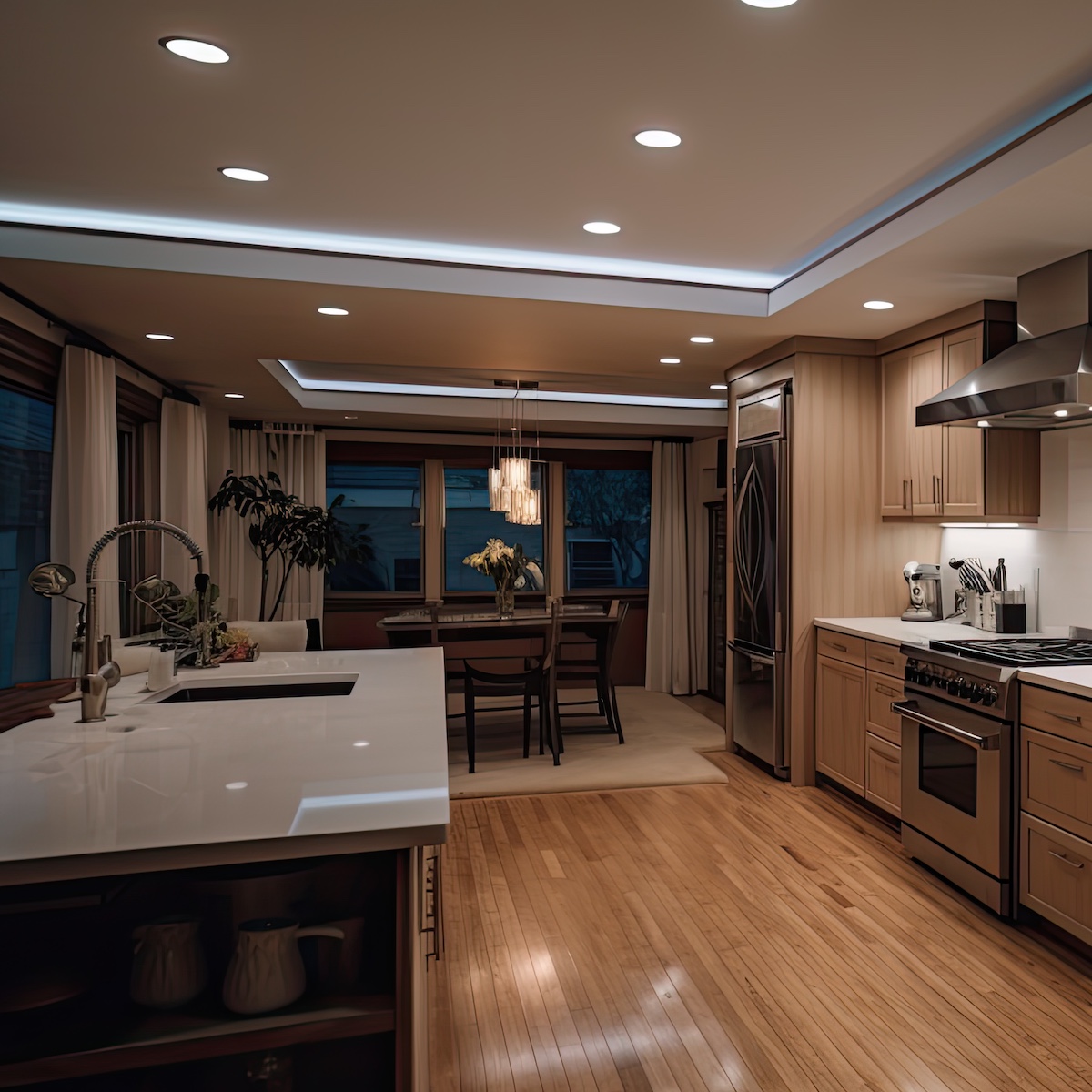
Create the Setting Over the Kitchen Island
Pendants find their natural setting on kitchen islands. Two pendants work for short islands, while three pendants match islands of about eight feet in length.
They should be spaced 30 inches apart from each other, center to center, with six inches separating the outermost pendants from the ends of the countertops.
Kitchen areas encounter moisture, oil, and water regularly, so finishes that can be easily wiped are ideal for easy maintenance. Glass, enamel, and matte black metals are able to withstand these situations.
Glass shades allow the view to extend in an open-plan area. Undercabinet or recessed lights can help to illuminate the food preparation on the kitchen counter.
Add Relaxing Design in the Bedroom
A bedroom should have an accent lighting fixture with a soothing design that illuminates the bedroom.
Fabric drum pendant, chandelier, or flush-mounted lights give the room some flair right at the center of the ceiling. Linen or frosted glass provides even illumination.
Pendant lights or swing arm sconces save nightstand space and allow a good lighting source when reading a book in bed.
Pendants should be installed where the bottom is about 20-24 inches from the nightstand.
Sconces should be mounted at a height of five feet from the floor to create light over the shoulder of an individual sitting in the bed.
Pick Bold and Practical Fixtures for the Bathrooms
The bathroom is a place where a unique fixture could be displayed, even in an average-size room.
Sculptural sconces placed on each side of the mirror light up the person’s face while he or she is preparing.
The fixture should be mounted at about 60 to 66 inches off the floor.
- Parents Are Prioritising Breathable, Sustainable Fabrics For Children's Seasonal Sleepwear
- Our Homemade Christmas Printables, Made With AI: What Worked, What Didn't, and What I'm Saving for Next Year
- At-Home vs. In-Lounge IV Therapy in the Hudson Valley: Which Makes More Sense?
- Can Passengers Pursue Compensation After a Car Accident?




Moisture is a major factor in every bathroom, which is why it makes sense to check the fixture's rating.
A damp rating means a fixture can resist humidity, while a wet rating means it can resist direct water spray.
Damp-rated fixtures are appropriate for the vanity wall, and wet-rated fixtures are suitable for the shower zone.
The distinctive fixture brings individuality to every room, from the entrance to the bedroom.
Homeowners looking for new ideas could consider Visual Comfort lighting fixtures and their analogues.
Easy size and height calculations keep each fixture proportional to its location.





Leave a Reply