

There is a moment that almost every family recognizes. The parent gets up from the chair more slowly.
Forgets to pay the bill. Puts the pan on the stove and goes to the other room. And suddenly, out of pure love and fear, we start doing everything for them.
The problem is that caring can easily turn into taking over. And when we take over, we don't just make everyday life easier; we inadvertently send the message: "You can't do it anymore."

Jump to:
When Professional Help Is Actually an Ally of Independence
Many families delay hiring a caregiver because they perceive it as a "handover". In practice, it is often the other way around.
Quality home care doesn't mean that someone takes over your parent's life; it means that there is a person to help exactly where help is needed, while leaving everything else in their hands.
For families looking for a solution tailored to their member's pace and habits, services like home care Tampa FL offer a model where the care plan is built around the person, not the person around the care plan.
Additional benefits? When the caregiver takes over the most physically demanding tasks, you return to the role of daughter or son. Not the manager. Not the controller. Not the one who constantly "makes noise about medicines".
Why Feeling in Control Is More Important Than We Think
This is not just a matter of pride. Research has confirmed this for decades.
In 1976, psychologists Ellen Langer and Judith Rodin conducted the now-famous study at the "Arden House" nursing home in Connecticut. One group of residents was told that they were responsible for their own daily schedule, movie selection, and care for the plant in the room. Another group was told by the staff that they would take care of everything, including watering the plant.
The results were impressive. The control group was more active, more social and rated as happier. And in the follow-up eighteen months later, the death rate in that group was half that of the group that had "everything fixed."
The message is clear: independence is not a luxury. It is part of health.
Help That Empowers vs. Help That Takes Away
The difference is often subtle, but you can feel it.
| Taking Over | Supporting |
| "I'll do it, it's faster." | "Want me to hold it while you do it?" |
| Dropping off a meal and leaving | Cooking together — they chop the vegetables |
| Booking the appointment without asking | Offering three time slots, they choose |
| "You can't go to the store alone anymore." | "What would make going to the store easier for you?" |
| Managing their medications for them | Setting up a pill organizer they fill themselves |
| Answering for them at the doctor's office | Helping them write down questions beforehand |
Bottom line: don't ask what you can do for them, but what you can remove as an obstacle.
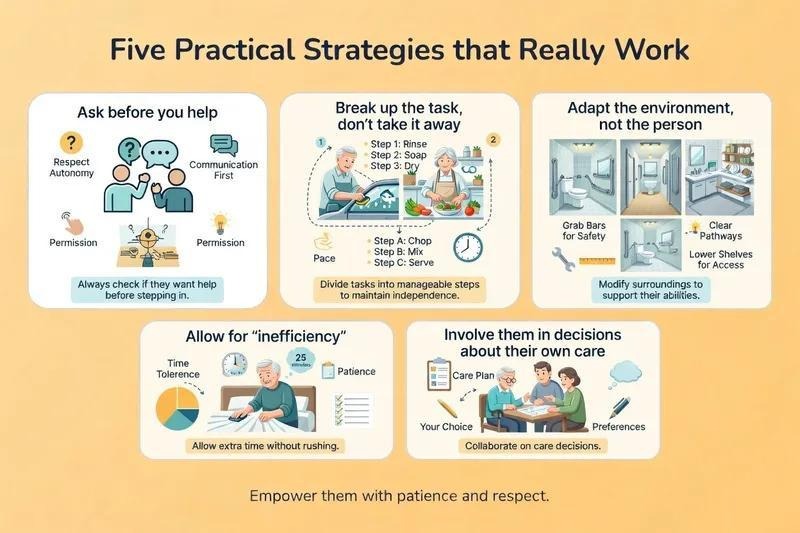
Five Practical Strategies that Really Work
1. Ask before you help
It sounds trite, but it changes everything. Jumping in automatically says you expect failure. A short "Do you need help with that?" puts the decision back where it belongs.
2. Break up the task, don't take it away
If the father can no longer wash the whole car, he can wash the front windows. If the mother can't prepare the whole Sunday kitchen, she can make a salad. Partial participation is still participation—and it maintains both muscle and confidence.
3. Adapt the environment, not the person
Much of the "inability" is actually poorly designed space. Grab bars in the bathroom, stronger light bulbs in the hallway, dishes on lower shelves, non-slip carpets, telephone with large buttons. Small changes often restore weeks and months of independence.
4. Allow for "inefficiency"
Yes, you would change the sheets in 5 minutes. They need 25. If there's no danger, that 21-minute-difference is a worthwhile investment—it's exercise, routine, and a sense of purpose.
5. Involve them in decisions about their own care
The biggest mistake families make is to arrange for care, and then announce it.
The conversation about who comes to the house, when and exactly what they do should be led by the older person themselves, with your support, not instead of them.
A Conversation that Most Put Off
If you're not sure where to start, start with questions, not solutions:
"What is the most difficult thing for you during the day?"
"What is the most important thing for you to continue doing alone?"
"What would you like help to look like if you ever need it?"
"Is there anything I'm bothering you with more than helping?"
That last question takes courage. But the answer to it often removes months of accumulated tension.
At the End
The goal is not to keep your parent safe at all costs. The goal is for them to be safe and still feel that their life is their own.
- Parents Are Prioritising Breathable, Sustainable Fabrics For Children's Seasonal Sleepwear
- Our Homemade Christmas Printables, Made With AI: What Worked, What Didn't, and What I'm Saving for Next Year
- At-Home vs. In-Lounge IV Therapy in the Hudson Valley: Which Makes More Sense?
- Can Passengers Pursue Compensation After a Car Accident?




The best support is the one that goes unnoticed, the one that stands a step behind, ready but quiet. The one that holds, not wears.
Because dignity is not maintained by protecting someone from every risk. It is maintained by allowing the right to continue to choose.





Leave a Reply