

Statement lighting has moved from designer showrooms into mainstream American homes, driven by open floor plans that leave large ceiling areas visually empty.
Here is what is actually selling in 2026, and the practical reasons behind each shift.
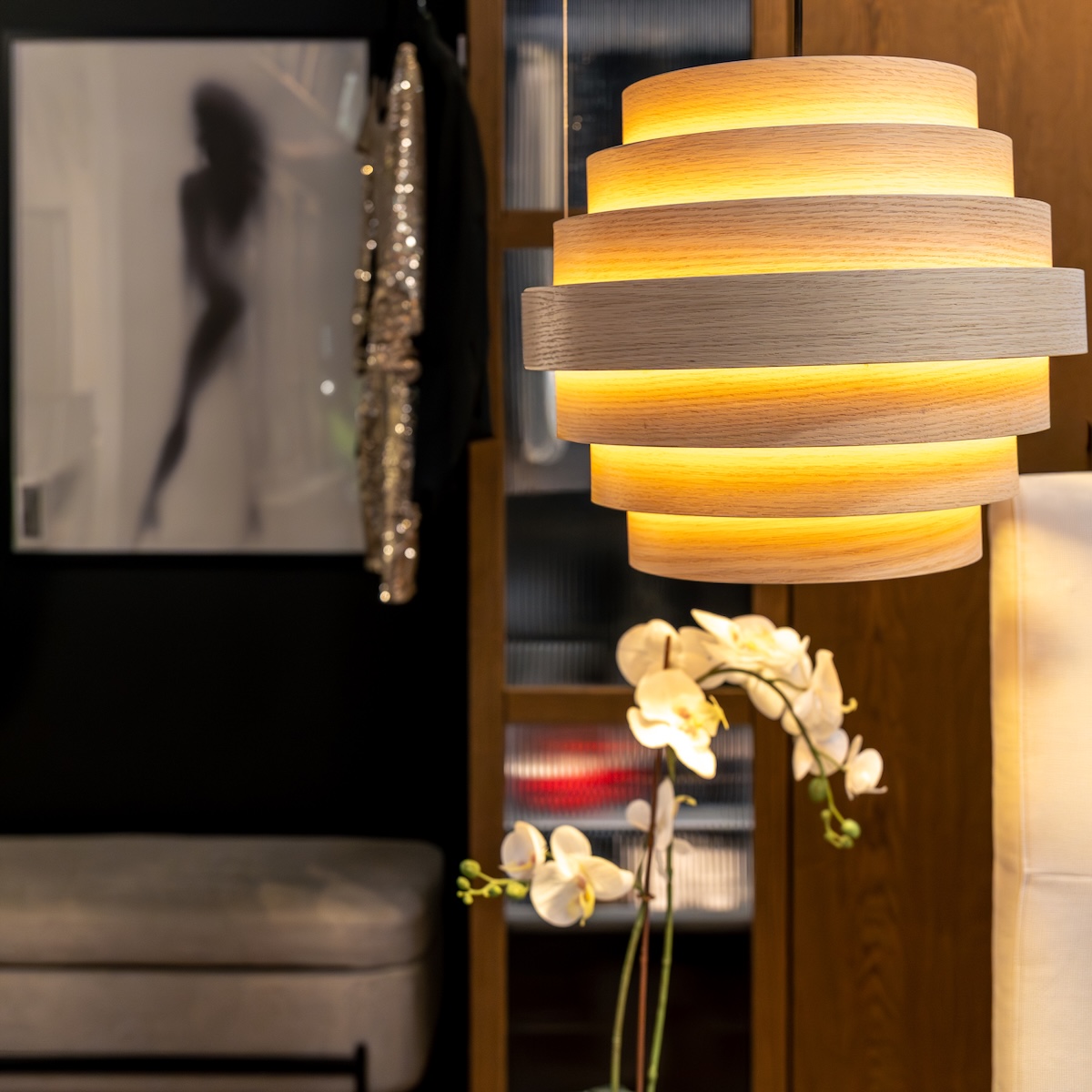
Warm Metals Have Replaced Chrome
Brushed brass, aged gold, and copper finishes now dominate new fixture releases, ending a decade of polished chrome and nickel. The driver is color temperature compatibility: warm metals reflect 2700K LED light without the greenish cast that chrome can produce. Homeowners pairing fixtures with white oak flooring and cream-toned walls — the prevailing 2026 palette — find warm metals integrate where cold finishes fight the room.
Mixed-metal schemes are also accepted now. The working rule designers use: one dominant metal (roughly 70% of visible hardware) and one accent metal, kept consistent across the sight line of connected open-plan spaces.
Oversized Fixtures in Ordinary Rooms
The old sizing formulas produced conservative results, and buyers are deliberately exceeding them. Where the length-plus-width rule suggests a 26 in (66 cm) fixture, 2026 buyers routinely choose 30–36 in (76–91 cm) for the same room. The look works under two conditions: the fixture has visual transparency (open frames, glass, or thin arms rather than solid mass), and ceiling height is at least 9 ft (2.7 m). In 8 ft rooms, oversizing still fails — flush and semi-flush statement pieces fill that gap instead.
The Five Fixture Categories Defining 2026
- Ring and halo designs: single or stacked LED rings, popular for two-story foyers because they read clearly from both floor levels.
- Bubble and globe clusters: hand-blown glass spheres in staggered arrangements, the leading choice over kitchen islands and stairwells.
- Sculptural linear fixtures: 40–60 in (102–152 cm) horizontal pieces replacing pendant rows over islands and dining tables.
- Organic and branch forms: asymmetrical fixtures that suit rooms where furniture is also curved — a response to the arch and curve movement in 2025–2026 interiors.
- Integrated-LED minimalism: fixtures with no visible bulbs at all, chosen for contemporary builds where the light effect matters more than the object.
What Buyers Check Before Purchasing
Search and retail data show buyers in 2026 filter by constraint first and style second. The most common pre-purchase questions:
| Concern | What Buyers Verify |
|---|---|
| Ceiling height | Fixture height plus 7 ft (2.1 m) clearance, or 30–36 in (76–91 cm) above tables |
| Sloped ceilings | Availability of sloped-ceiling adapter kits |
| Dimming | Compatibility with standard LED dimmers |
| Weight | Whether a fan-rated or reinforced junction box is required above ~50 lb (23 kg) |
| Bulb replacement | Standard sockets vs. integrated LED lifespan (typically 25,000–50,000 hours) |
This constraint-first behavior explains why specialty lighting stores organize inventory by room and ceiling type. Curated catalogs — Modern Chandelier is one example built around this structure — let buyers rule out incompatible fixtures before comparing looks, which cuts return rates that plague generalist marketplaces.
Smart Control Without Smart Bulbs
The 2026 pattern favors smart switches and dimmers over smart bulbs. A statement fixture with six to twelve sockets is expensive to fill with connected bulbs, and firmware-dependent bulbs age poorly. A single smart dimmer controls the whole fixture, preserves standard bulb economics, and survives Wi-Fi changes. Matter-compatible dimmers have become the default recommendation for new installations.
- Parents Are Prioritising Breathable, Sustainable Fabrics For Children's Seasonal Sleepwear
- Our Homemade Christmas Printables, Made With AI: What Worked, What Didn't, and What I'm Saving for Next Year
- At-Home vs. In-Lounge IV Therapy in the Hudson Valley: Which Makes More Sense?
- Can Passengers Pursue Compensation After a Car Accident?




Conclusion
The 2026 statement lighting market rewards buyers who match fixture scale to ceiling height, choose warm finishes that agree with warm LED light, and put control in the switch rather than the bulb.
Trends favor transparency, organic form, and integrated LEDs, but the constraint checklist above outlasts any single style cycle. Measure first, then shop.





Leave a Reply