

The stairwell is the only space in a home where a light fixture is viewed from below, beside, and above, often all three within ten seconds. That single fact changes every standard sizing and hanging rule, and it explains why fixtures chosen with dining-room math so often fail on a staircase.
Jump to:
- Vertical Fixtures for a Vertical Space
- The Three-Angle Test
- Hanging Height and Placement Math
- Installation and Maintenance Realities
- Styles That Currently Lead the Category
- Bringing Form and Function Together
- Choosing the Right Brightness for a Stairwell
- Matching the Fixture to Your Home's Architecture
- Energy Efficiency and Long-Term Running Costs
- Safety Should Never Be Overlooked
- Creating a Lasting Focal Point
Vertical Fixtures for a Vertical Space
Rooms are horizontal problems; stairwells are vertical ones. A two-story stairwell typically offers 17–20 ft (5.2–6.1 m) of clear height, and a standard wide-and-shallow chandelier leaves most of it visually empty.
The category built for this is the vertical or cascading fixture: pieces whose height equals or exceeds their diameter. Working proportions:
| Stairwell Type | Clear Height | Fixture Height | Fixture Diameter |
| Single-story stair, 9–10 ft (2.7–3 m) | Limited | 12–20 in (30–51 cm) | 16–24 in (41–61 cm) |
| Two-story open stairwell | 17–20 ft (5.2–6.1 m) | 40–72 in (102–183 cm) | 20–32 in (51–81 cm) |
| Grand / curved double-height | 20 ft+ (6.1 m+) | 60–100 in (152–254 cm) | 28–40 in (71–102 cm) |
A useful target: the fixture should occupy roughly one-quarter to one-third of the stairwell's clear vertical height. Below that, it reads as an afterthought; a 24 in (61 cm) tall fixture in an 18 ft void is the most repeated staircase lighting mistake in American two-story homes.
The Three-Angle Test
Before buying, evaluate the fixture from all three viewing positions, because each exposes different things:
- From below (entering the foyer): the underside is the first impression. Cascading crystal, tiered glass, and spiral designs are built to be read from beneath; flat-bottomed drum shades show a blank disc.
- From beside (mid-flight): this is the closest anyone ever gets to the fixture, sometimes within arm's reach. Finish quality, wiring tidiness, and bulb glare are all inspected at eye level here. Choose designs with shielded or diffused sources; exposed high-output bulbs at eye height are the second most common staircase error.
- From above (upstairs landing): the top of the fixture and its canopy are fully visible, unlike in any other room. Open-top designs and clean chain or cable work matter; a dusty upper surface or bundled cords are on permanent display.
Hanging Height and Placement Math
Two clearances govern the drop. Over walkable treads or landings, maintain a minimum clearance of 7 ft (2.1 m) below the fixture's lowest point.
In the open well between flights, where nobody walks, the fixture can and should drop much lower: the standard is to centre the fixture's visual mass at or slightly below the second-floor line, so it is seen at eye level from the upstairs hall and overhead from the entry.
Horizontally, center on the open well, not the foyer floor plan; when the well is narrow, maintain at least 24 in (61 cm) between the fixture's widest point and the railing so it is never touched in passing.
Installation and Maintenance Realities
Staircase fixtures carry the most demanding logistics in residential lighting, and the costs belong in the budget from day one:
- Structure: cascading crystal pieces commonly weigh 50–150 lb (23–68 kg), requiring a reinforced or fan-rated box lagged to framing, not a standard plastic junction box.
- Labor: two-story installation runs $300–$800 because it needs scaffolding, a tall platform ladder, or two technicians; simple foyer swaps this is not.
- Cleaning access: the fixture will need dusting from the same scaffolding. Practical mitigations at purchase: designs with fewer, larger elements instead of hundreds of small crystals, or a motorized light lift ($400–$900 installed) that lowers the fixture to floor level for cleaning and bulb changes.
- Bulbs: 2700K, dimmable, all one batch, and favor 25,000+ hour LEDs specifically because every replacement repeats the access problem.
Styles That Currently Lead the Category
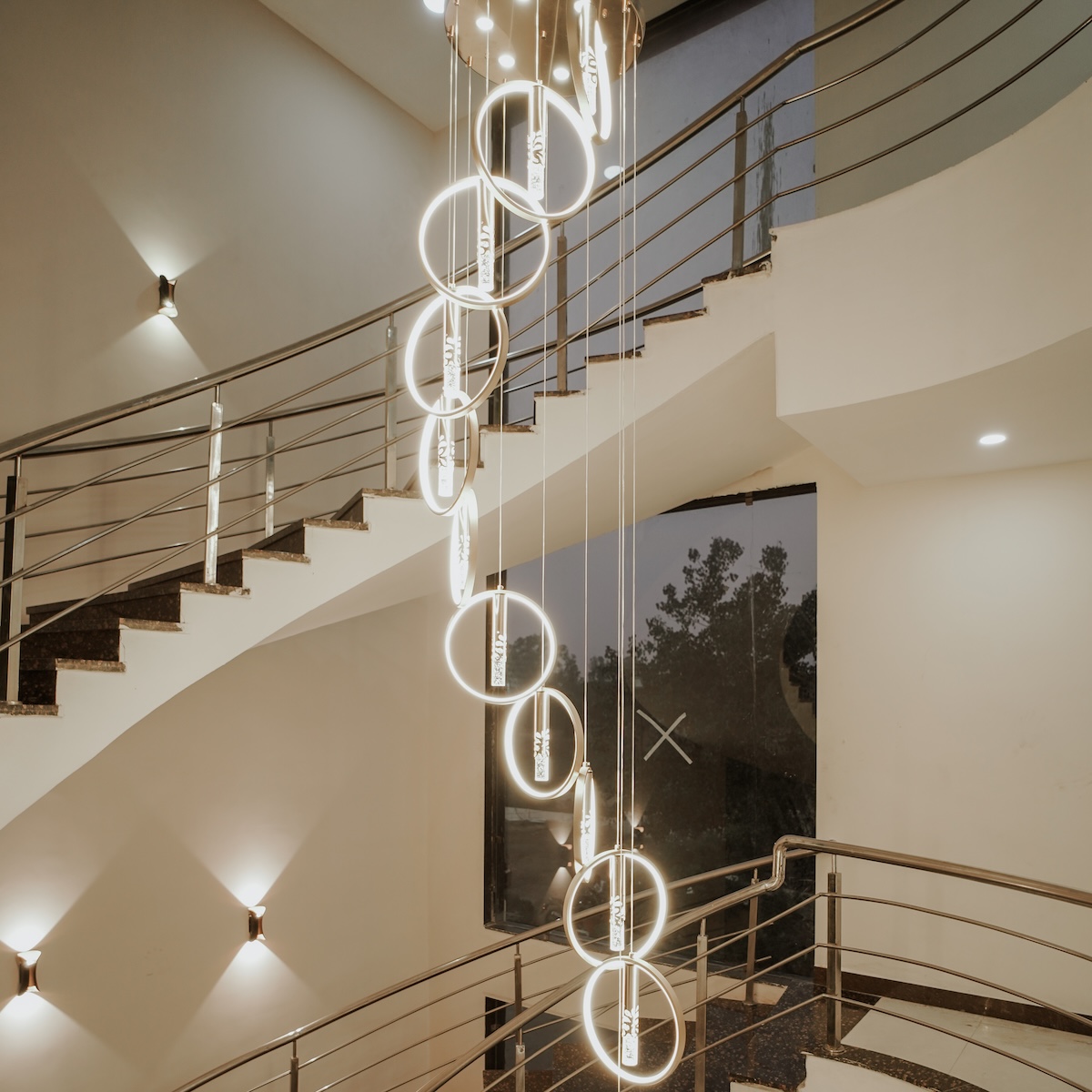
The 2026 stairwell market focuses on four families: cascading crystal rain designs (the traditional flagship), stacked or spiral LED rings (the contemporary flagship, which reads equally well from all three angles), staggered glass-globe clusters at varying drop lengths, and linear waterfall fixtures for straight-run stairs.
Ranges assembled specifically for vertical spaces, this staircase-focused selection is a representative example; list fixture height and adjustable cable ranges first, because in this category the vertical dimension, not the diameter, is the purchase decision.
Bringing Form and Function Together
Staircase lighting inverts normal fixture logic: height matters more than width, the side view matters more than the bottom view, and installation access belongs in the price.
Size to a quarter or third of the stairwell's clear height, pass the three-angle test, keep 7 ft over treads while dropping the mass to the second-floor line, and plan the cleaning method before checkout.
The stairwell rewards this rigor more than any room, it is the one fixture visible from nearly everywhere in the house.
Choosing the Right Brightness for a Stairwell
Brightness is just as important as the fixture itself. A staircase should feel comfortably illuminated without creating harsh glare or deep shadows that make navigating the stairs more difficult.
Layering light with dimmable fixtures allows homeowners to adjust the atmosphere throughout the day, providing brighter illumination when needed and a softer ambience in the evening.
Light output should also be considered alongside the finish and materials of the fixture.
Crystal and polished metal naturally reflect more light throughout the stairwell, whereas darker finishes and frosted glass tend to produce a softer, more diffused effect.
Matching the Fixture to Your Home's Architecture
The most successful staircase chandeliers complement the architectural style of the home rather than competing with it.
A traditional property may suit cascading crystal or ornate metalwork, while contemporary homes often benefit from minimalist ring lights or sculptural linear designs.
Scale also plays a role beyond simple measurements. A dramatic chandelier can become a defining architectural feature in a grand entrance hall, whereas a more understated fixture may better suit compact stairwells where the goal is elegance rather than visual impact.
Energy Efficiency and Long-Term Running Costs
Modern LED technology has made large staircase chandeliers significantly more economical to operate than older incandescent or halogen fixtures.
High-quality LED lamps consume less electricity, generate less heat, and often provide tens of thousands of hours of operation before replacement becomes necessary.
Given the difficulty of accessing fixtures installed in double-height spaces, selecting long-life LED bulbs from the outset can reduce future maintenance costs and minimise the inconvenience of replacing lamps at height.
Safety Should Never Be Overlooked
A staircase chandelier is both a decorative feature and a permanent structural installation.
Professional installation helps ensure the fixture is correctly supported, properly wired, and positioned safely within the available space.
This is particularly important for larger fittings that place considerable weight on the ceiling structure.
Homeowners should also consider ongoing safety when planning maintenance.
If regular cleaning or bulb replacement requires specialist access equipment, factoring these future requirements into the purchase decision can help avoid unnecessary expense later.
- Parents Are Prioritising Breathable, Sustainable Fabrics For Children's Seasonal Sleepwear
- Our Homemade Christmas Printables, Made With AI: What Worked, What Didn't, and What I'm Saving for Next Year
- At-Home vs. In-Lounge IV Therapy in the Hudson Valley: Which Makes More Sense?
- Can Passengers Pursue Compensation After a Car Accident?




Creating a Lasting Focal Point
Unlike many other light fittings in the home, a staircase chandelier becomes part of the architecture itself.
It draws the eye from multiple levels, connects different floors visually, and often creates the first impression when entering the property.
Choosing the right fixture therefore involves balancing aesthetics, proportion, lighting performance, and practical maintenance rather than focusing on appearance alone.
When these factors are considered together, a well-chosen staircase chandelier can enhance both the function and character of the space for many years.
Investing time in selecting the correct size, style, and installation approach ensures the finished result complements the home while providing reliable illumination and lasting visual appeal.





Leave a Reply