

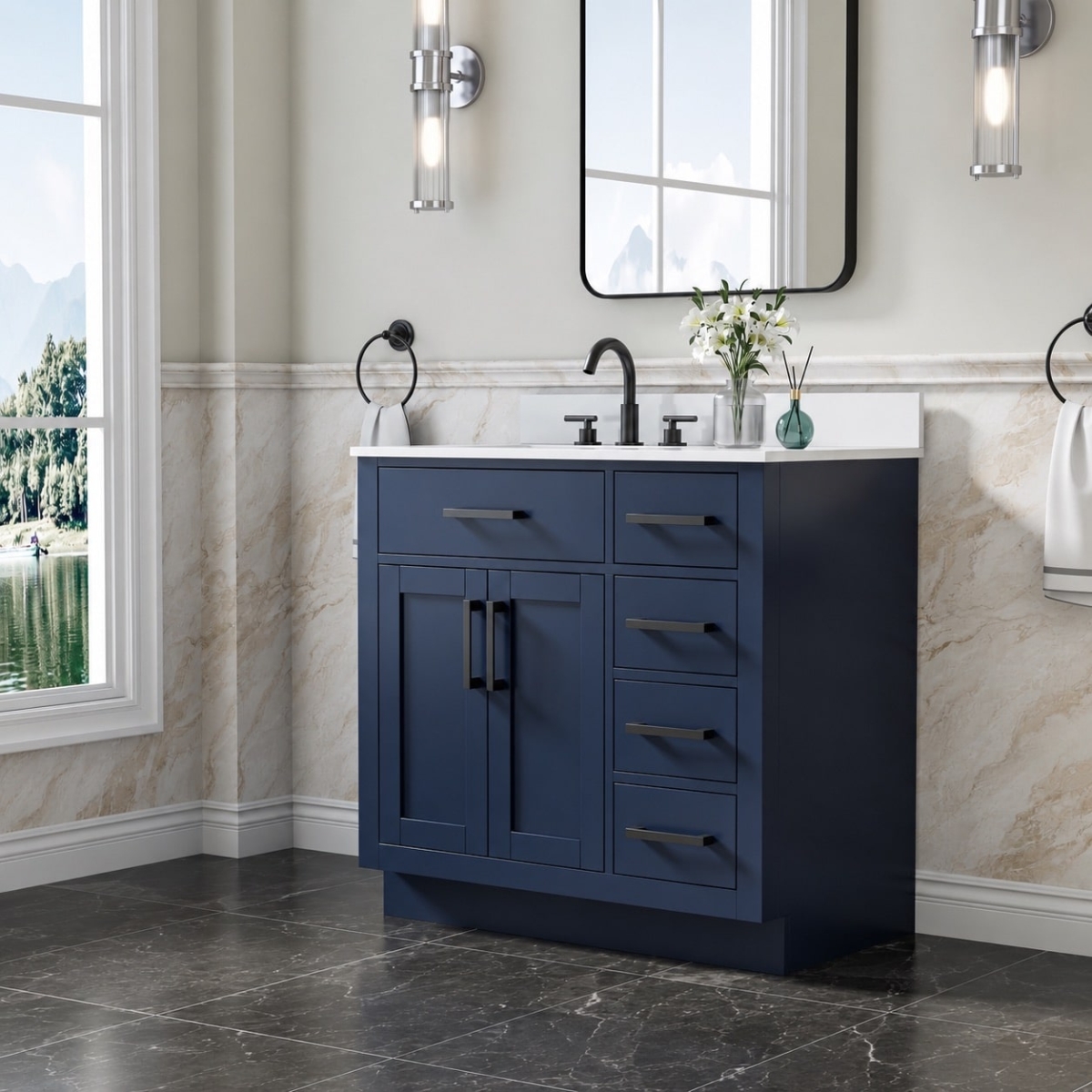
A 36 inch bathroom vanity with drawers can make a modest bathroom feel far more organized without asking for the floor space of a double vanity. The real advantage is not simply “more storage.”
Drawers divide the cabinet into visible, reachable layers, so everyday items do not disappear behind plumbing or pile up at the back.
For a guest bath, small primary bath, or busy family bathroom, that change can save time every morning while keeping the countertop calmer.
Jump to:
- Drawers Turn One Deep Box Into Useful Zones
- A 36-Inch Width Hits A Practical Middle Ground
- Smart Drawer Layouts Work Around The Sink
- Better Organization Protects The Countertop
- Moisture Resistance Still Matters
- Measure The Room And The Drawer Swing
- Inspect The Hardware, Not Just The Drawer Count
- Use A Simple Storage Test Before Buying
- Final Takeaway
Drawers Turn One Deep Box Into Useful Zones
A traditional two-door vanity often provides one large cavity. It may hold tall bottles, but smaller products tend to collect in baskets or form a second row behind the first. A drawer-based layout separates that same interior volume by height and purpose.
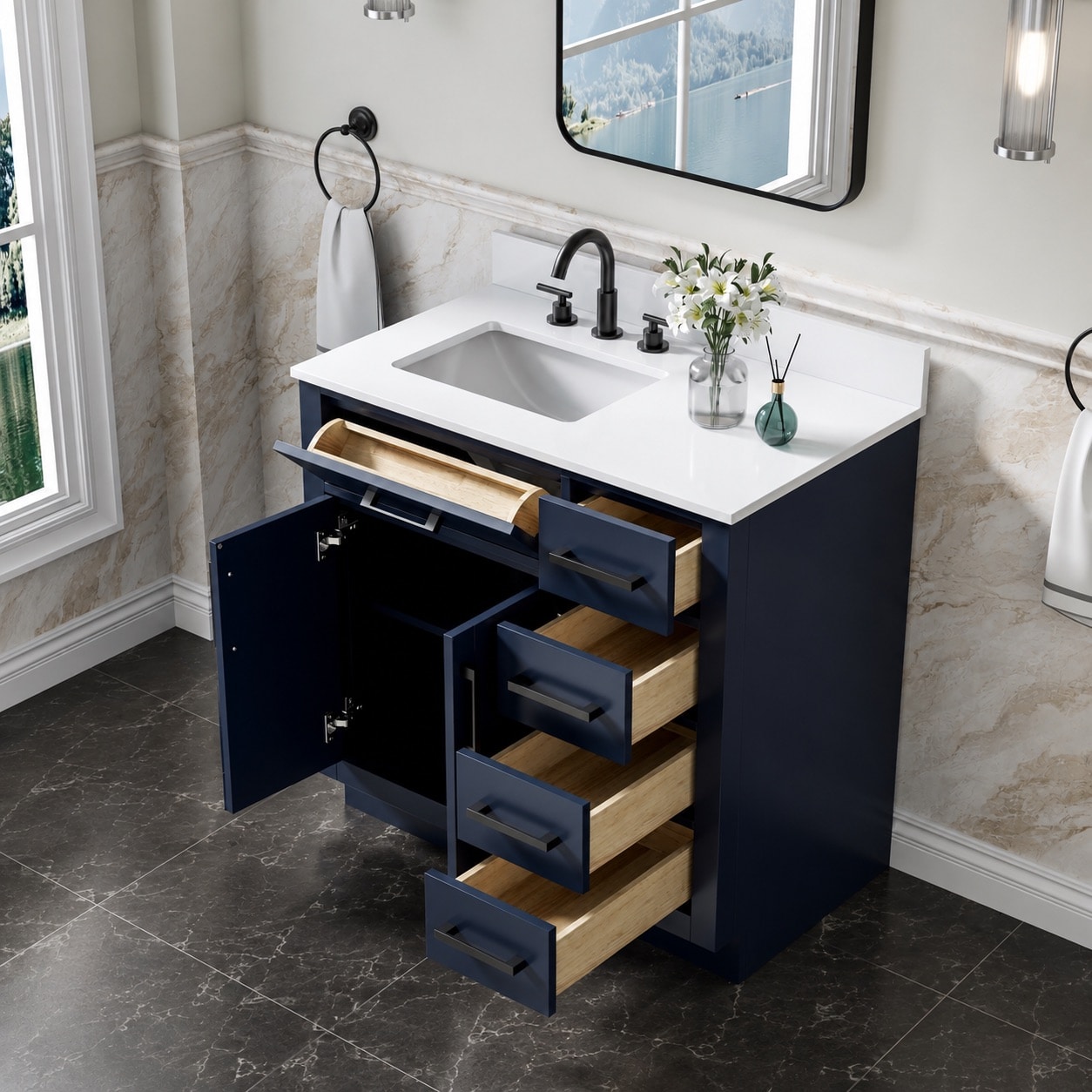
Shallow drawers can hold toothbrushes, cosmetics, combs, and first-aid items. Deeper drawers can take folded hand towels, extra toilet paper, or a hair dryer.
The benefit is access. When a full-extension drawer opens, most contents come toward the user. There is less crouching and unloading. Assign the top drawer to daily items, the middle to grooming tools, and the bottom to refills.
A 36-Inch Width Hits A Practical Middle Ground
At 36 in. wide, a vanity is broad enough to support a comfortable single sink and still leave room for meaningful drawer banks. Yet it remains easier to fit than a 48-in. or 60-in. model.
That balance matters in bathrooms where the vanity shares a wall with a toilet, tub, door casing, or heating register.
Width alone does not reveal capacity. Compare usable interior drawer dimensions, because side panels, slides, the sink, and plumbing consume space. Two 36-in. vanities can have very different drawer depth and height.
Smart Drawer Layouts Work Around The Sink
The sink and drain are the main obstacles inside any vanity. Manufacturers solve the conflict in several ways. A U-shaped top drawer wraps around the plumbing.
An offset sink leaves a full-height drawer bank on one side. Some models use a tilt-out tray at the false drawer front for toothpaste or small grooming tools.
An offset sink may create excellent storage but look asymmetrical. A U-shaped drawer uses space near the basin, although it may need small organizers. Before ordering, confirm the drain location, supply-line path, drawer dimensions, and wall clearance on the specification drawing.
Better Organization Protects The Countertop
Countertop clutter is often a storage-design problem rather than a housekeeping problem. If opening a door means moving several bottles, people naturally leave frequently used items beside the sink. Drawers make a one-motion routine possible: open, take, use, return.
Choose dividers after measuring the drawer, and leave some open space for changing routines. Reserve a heat-safe location for styling tools; never close a hot appliance inside. Store medicines according to their labels, including any temperature or humidity instructions.
Moisture Resistance Still Matters
Extra organization does not compensate for a cabinet that handles moisture poorly. The U.S. Environmental Protection Agency recommends controlling bathroom moisture and using ventilation because damp conditions can encourage mold growth.
(Source: U.S. EPA, “A Brief Guide to Mold, Moisture and Your Home.”) Run the exhaust fan during bathing, wipe standing water, and repair leaks promptly.
Wood and wood-based materials can also respond to changes in moisture. The USDA Forest Products Laboratory explains that wood can swell as it gains moisture and shrink as it loses moisture below the fiber-saturation range. (
Source: USDA Forest Products Laboratory, Wood Handbook: Wood as an Engineering Material, Chapter 4.) Look for sealed edges, a durable finish, protected drawer bottoms, and smooth slides.
If the vanity uses composite wood, check whether the product information addresses EPA’s TSCA Title VI formaldehyde-emission requirements. (Source: U.S. EPA, “Formaldehyde Emission Standards for Composite Wood Products.”)
Measure The Room And The Drawer Swing
Measure available width at the floor, countertop, and backsplash because walls may not be square. Confirm vanity depth, countertop overhang, faucet clearance, and baseboards. Mark the footprint with painter’s tape.
Next, simulate an open drawer. Check whether it conflicts with the bathroom door, shower door, toilet, towel bar, or a person standing at the sink.
Drawer handles add projection, too. If the room must meet accessibility requirements, do not assume a standard vanity is compliant; accessible lavatories can require specific height, clear-floor-space, and knee-clearance conditions. (Source: U.S. Access Board, “Guide to the ADA Accessibility Standards: Toilet Rooms.”) Verify the applicable local code and project requirements with a qualified professional.
Inspect The Hardware, Not Just The Drawer Count
Six small drawers are not necessarily better than three well-sized ones. Look for full-extension slides, a suitable weight rating, removable boxes, and consistent soft-close action.
Good joinery, alignment, and moisture-resistant finishing matter more than one feature name.
Read reviews for repeated reports of sagging bottoms, loose fronts, or rubbing drawers.
Confirm whether handles are installed, packed separately, or sold separately. Listed width may exclude protruding hardware.
Use A Simple Storage Test Before Buying
Inventory what the vanity must hold: daily care, grooming tools, towels, paper goods, cleaning products, and backups.
Measure the tallest bottle and widest appliance, then compare them with the manufacturer’s interior drawer dimensions. Ask the seller if measurements are missing.
Also decide what belongs elsewhere. Household chemicals may require child-resistant storage, while bulky bath towels may fit better in a linen closet.
The goal is not to force every bathroom item into 36 in. of cabinetry. It is to give the most frequently used items a clear, safe, and reachable home.
- Parents Are Prioritising Breathable, Sustainable Fabrics For Children's Seasonal Sleepwear
- Our Homemade Christmas Printables, Made With AI: What Worked, What Didn't, and What I'm Saving for Next Year
- At-Home vs. In-Lounge IV Therapy in the Hudson Valley: Which Makes More Sense?
- Can Passengers Pursue Compensation After a Car Accident?




Final Takeaway
The best 36-in. drawer vanity improves storage through access, separation, and plumbing-aware design.
Choose it by usable drawer dimensions, construction quality, moisture protection, and real clearance, not by drawer count alone.
When the layout matches your routine, a compact vanity can keep necessities close at hand while making the entire bathroom feel more spacious.





Leave a Reply