

According to a peer-reviewed study published in Frontiers in Veterinary Science, July 2024, surveying 1,211 cat owners across France, personality traits, activity levels, and environmental stress are the three most significant predictors of undesired furniture scratching, with aggressiveness, disruptiveness, high playfulness, and nocturnal activity all strongly correlated with increased scratching behaviour.
That finding reframes a question most prospective cat owners get wrong. All cats scratch as a biological necessity to maintain claw health and mark territory.
The question is which breeds scratch furniture least, and why their specific temperament and energy profile make them less likely to redirect that instinct destructively.
Cats that rarely scratch furniture are not cats with a suppressed natural instinct.
They are cats whose calm temperament, low frustration threshold, and moderate activity levels make them far less likely to scratch in response to stress, boredom, or territorial anxiety.
Jump to:
Do All Cats Scratch Furniture? What the Science Says
Scratching is physiologically non-negotiable for every domestic cat, it maintains claw condition, stretches the spine, and deposits scent markers from interdigital glands.
According to Dr Yasemin Salgirli Demirbas, veterinary researcher at Ankara University and lead author of the Frontiers in Veterinary Science study, scratching "is not a behaviour that's displayed to punish the owners"; it becomes problematic only when environmental and personality factors drive it toward furniture rather than appropriate surfaces.
What Makes Some Cats Scratch More Than Others
The study identified five key risk factors for increased furniture scratching:
- High play duration and strong playfulness
- Nocturnal activity levels
- Aggressiveness or disruptiveness as personality traits
- Presence of children in the household (elevated environmental stress)
- Scratching posts placed away from areas the cat frequents
The inverse holds directly: calm, low-aggression, moderate-energy cats with well-placed scratching surfaces scratch furniture significantly less.
This is why breed temperament, not training alone, determines how much of a scratching problem a cat owner is likely to face.
4 Cat Breeds That Rarely Scratch Furniture
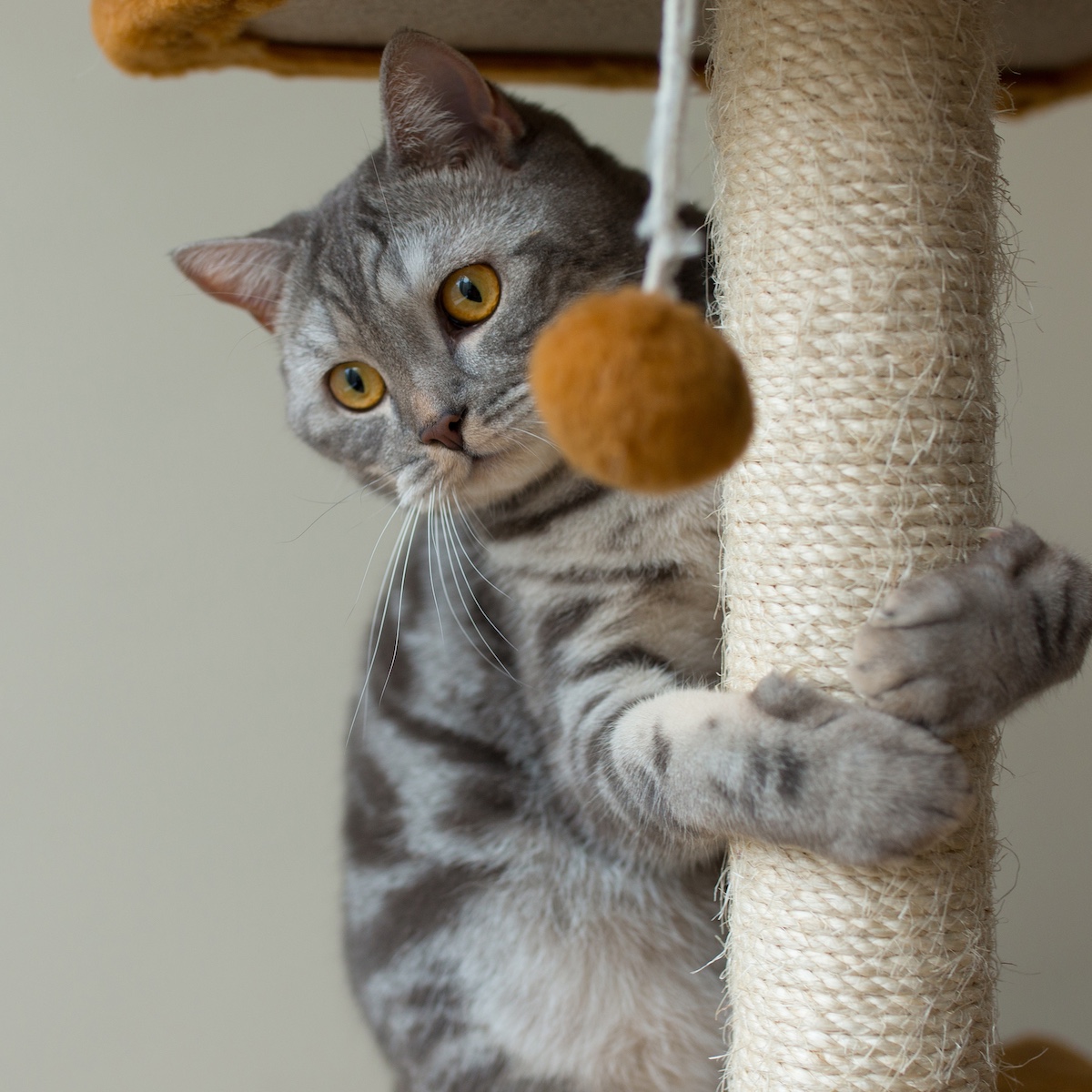
1. British Shorthair
The British Shorthair is the benchmark low-scratching breed, and the science explains why. Its defining temperament traits, calm, low-frustration, non-reactive, and content with independent activity, map directly onto the Frontiers study's risk factor profile in reverse.
British Shorthair cats are neither aggressive nor disruptive, have moderate rather than high play energy, and rarely engage in nocturnal bursts of activity that drive stress-related scratching.
Their placid nature extends to how they manage territory. Rather than scratching to communicate anxiety or frustration, British Shorthairs tend toward quiet observation.
They accept standard scratching posts readily when placed in their preferred resting areas, redirecting the behavior naturally rather than requiring management.
For owners whose primary concern is furniture integrity, the British Shorthair is consistently the most reliable choice available.
2. Ragdoll
Ragdolls share the British Shorthair's low-frustration temperament and add an even stronger tendency toward physical passivity.
Their famously docile nature, the tendency to go limp when held, the preference for ground-level activity over climbing, means they engage with furniture as soft surfaces to rest on rather than surfaces to scratch and mark.
Ragdolls' social orientation also reduces territorial anxiety, one of the primary drivers of stress-based scratching.
3. Persian
The Persian's low activity level and preference for calm, routine-based environments make it one of the least destructive breeds with furniture.
Persian cats are unhurried, undemanding, and largely indifferent to territorial signaling, the motivation behind the most persistent furniture scratching in high-energy breeds.
A Persian with a sisal post near its favorite resting spot will use it consistently and reliably, with minimal redirection effort from the owner.
4. Russian Blue
The Russian Blue's low tendency to scratch comes from a different angle: emotional sensitivity rather than passivity.
Russian Blues are highly attuned to household atmosphere and actively avoid behaviors that generate negative responses from their owners.
They are also notably low in aggression and disruptiveness, the two personality traits the Frontiers study identified as most strongly associated with increased furniture scratching.
In a calm, stable household, a Russian Blue's scratching behavior is among the most contained of any shorthair breed.
How Do These Breeds Compare?
| Breed | Energy Level | Aggression/Disruption | Scratching Tendency | Best Redirected With |
| British Shorthair | Low-Moderate | Very Low | Very Low | Sisal post near resting area |
| Ragdoll | Low | Very Low | Very Low | Floor-level sisal or carpet post |
| Persian | Low | Very Low | Low | Post near favored sleeping spot |
| Russian Blue | Low-Moderate | Very Low | Low | Post in high-traffic household areas |
What Every Low-Scratching Cat Still Needs
Even the calmest breed will scratch furniture when its scratching needs go unmet.
The Frontiers study found that post placement is a statistically significant factor: posts located in areas the cat frequently uses are measurably more effective at redirecting scratching than posts placed in corners or utility areas the cat rarely visits.
Three practical rules apply regardless of breed:
- Place posts adjacent to furniture that the cat currently targets: proximity to the preferred surface matters more than post quality
- Use sisal rather than carpet: sisal texture satisfies the claw-dragging motion most effectively for most cats
Never punish scratching: the Frontiers study confirms that owner frustration increases environmental stress, which directly increases scratching frequency in a self-reinforcing cycle
FAQ'S
All cats scratch as a biological necessity – it maintains claw health and marks territory. The difference between breeds is how strongly personality and activity level drive that scratching toward furniture versus appropriate surfaces. Calm, low-aggression breeds like the British Shorthair and Ragdoll redirect to provided scratching posts with minimal management effort, while high-energy, high-frustration breeds scratch furniture more persistently regardless of available alternatives.
Post placement and post texture are the two most evidence-based factors. A post placed away from the cat's preferred resting and activity areas will be ignored in favor of furniture. The Frontiers in Veterinary Science study also identified personality traits, specifically aggressiveness, disruptiveness, and high play intensity, as significant drivers of furniture-directed scratching beyond what post-availability can solve alone.
Redirecting scratching to appropriate surfaces is achievable in most cats with consistent management: well-placed sisal posts, positive reinforcement when the post is used, and avoidance of punishment. However, high-energy breeds with strong territorial instincts require significantly more sustained effort than naturally calm breeds. Breed selection is the most impactful single variable before any training approach begins.
No. Declawing is a surgical amputation that removes the last bone of each digit and is associated with chronic pain, behavioral changes, and increased biting. It is banned or heavily restricted in the UK, most of Europe, and many U.S. states. The American Association of Feline Practitioners opposes it explicitly. Breed selection and post placement resolve furniture scratching without welfare consequences.
At minimum, one post per cat placed in the areas where the cat spends the most time. Multiple posts in different rooms are more effective than a single post in an isolated location. The Frontiers study confirmed statistically that post location in high-frequency cat areas is a significant predictor of successful redirection.
Why Breed Temperament Determines Scratching Risk
The cats that rarely scratch furniture are breeds whose baseline temperament places them at the low end of every risk factor the research identifies: low aggression, low nocturnal activity, low frustration response, and low territorial anxiety.
- Parents Are Prioritising Breathable, Sustainable Fabrics For Children's Seasonal Sleepwear
- Our Homemade Christmas Printables, Made With AI: What Worked, What Didn't, and What I'm Saving for Next Year
- At-Home vs. In-Lounge IV Therapy in the Hudson Valley: Which Makes More Sense?
- Can Passengers Pursue Compensation After a Car Accident?




Choosing a British Shorthair, Ragdoll, Persian, or Russian Blue does not guarantee zero furniture scratching.
It does mean starting with a cat whose natural behavioral profile produces the least friction between its instincts and its owner's home, which is the most reliable foundation any scratching management strategy can build on.





Leave a Reply