

The 2026 Atlantic hurricane season starts June 1. Colorado State University forecasts 13 named storms and 6 hurricanes this year.
AccuWeather expects 3 to 5 direct U.S. impacts. Whether the season ends up average or above, the math hasn't changed: a single hurricane can knock your power out for days, and everything in your household, food safety, medical devices, and communication, depends on electricity.
The 2024 season proved this in devastating fashion. Hurricanes Helene and Milton knocked out power to 9.5 million homes across the Southeast, with some communities in western North Carolina waiting over two weeks for restoration.
The average family loses over $1,500 per multi-day outage from spoiled food, emergency lodging, and missed work alone.
A portable power station is the fastest, safest way to keep your home's essentials running through a blackout.
his guide covers how to calculate your power needs, choose the right capacity, and execute a 72-hour strategy to get your family through the storm.
Jump to:
- Portable Power Station vs. Gas Generator: A Quick Comparison
- Step 1: Conduct a Home Energy Audit
- Step 2: Choose the Right Capacity
- Step 3: The 72-Hour Hurricane Power Plan
- Solar Panels: How to Extend Your Backup from Days to Weeks
- Quick-Reference: Complete Hurricane Prep Checklist
- Start Now, Not When the Warning Comes
Portable Power Station vs. Gas Generator: A Quick Comparison
If you're debating between a traditional generator and a portable power station, here's what matters most:
| Gas Generator | Portable Power Station | |
| Indoor Use | Never, produces carbon monoxide | Yes, zero emissions, safe indoors |
| Noise | 65–80 dB (vacuum cleaner level) | Under 30 dB (whisper quiet) |
| Fuel | Requires gasoline; stations often close after storms | Recharges via wall outlet, car, or solar panels |
| Startup | Pull-start, may fail when wet | One-button or automatic UPS switchover |
| Maintenance | Oil changes, fuel stabilizer, seasonal upkeep | Virtually none |
| Best For | Heavy loads: central AC, well pumps | Essential devices: fridge, medical, comms, lighting |
The two aren't mutually exclusive. A generator handles heavy loads outdoors; a portable power station handles essentials safely indoors. Modern stations use LiFePO4 (LFP) batteries rated for 3,000+ charge cycles, that's over 10 years of daily use, with built-in battery management systems that monitor safety around the clock. For most households without a whole-home standby system, a mid- to large-capacity power station (1,000–4,000Wh) can cover 1 to 3 days of critical needs on its own.
Step 1: Conduct a Home Energy Audit
Before buying anything, answer one question: how much power does my household actually need during an outage?
Categorize Your Devices by Priority
Walk through your home and sort every device into three tiers:
Priority 1, Life Safety: CPAP/BiPAP machines (30–60W), oxygen concentrators, medication fridges, cell phones for 911 and emergency alerts, NOAA weather radio, basic LED lighting.
Priority 2, Essential Living: Kitchen refrigerator (100–200W running, 800–1,200W startup surge), Wi-Fi router (10–20W), a fan for sleeping in summer heat (40–60W).
Priority 3, Comfort: Laptop (60–100W), TV (110W), coffee maker (1,000W). Nice to have; first to cut when battery gets low.
Calculate Your Daily Watt-Hours
For each device, multiply its wattage by the hours you'd run it per day. Here's a realistic scenario for a family of four:
| Device | Watts | Hours/Day | Daily Wh |
| Refrigerator | 150 (avg.) | 8 (compressor cycles) | 1,200 |
| Wi-Fi Router | 15 | 24 | 360 |
| LED Lighting (3 lamps) | 30 | 6 | 180 |
| Phone Charging (4 phones) | 80 | 3 | 240 |
| Fan | 45 | 10 | 450 |
| CPAP Machine | 50 | 8 | 400 |
| Laptop | 65 | 4 | 260 |
| Total | 3,090 Wh |
This household needs roughly 3,000 Wh per day. Over a 72-hour outage, that's about 9,000 Wh, achievable with a large station plus solar recharging, or a mid-range station with strict conservation.
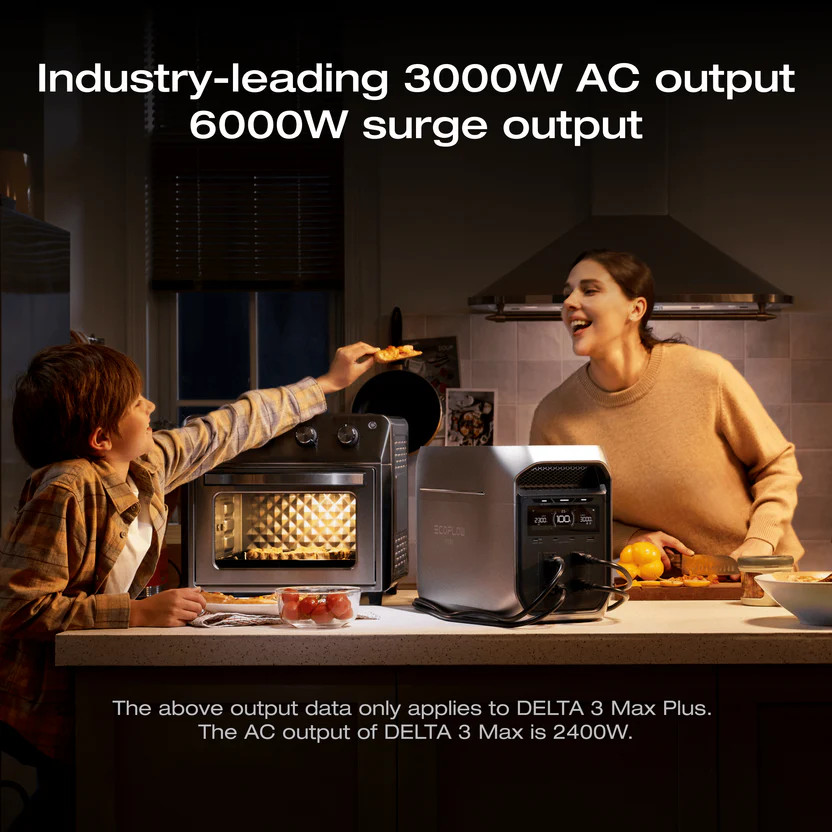
Don't forget surge power. A fridge might run at 150W but spike to 1,200W when the compressor kicks in. Make sure your power station's surge rating exceeds the highest startup spike among your devices. If your station is rated at 1,800W continuous with a 3,600W surge, you're comfortably covered for virtually all standard household appliances.
Pro tip: Your actual daily consumption will likely be lower than this table suggests. During an outage, you'll naturally cut comfort devices and reduce screen time. The table gives you a worst-case planning number, build your capacity around it, and the real-world runtime will pleasantly surprise you.
Step 2: Choose the Right Capacity
Light-Duty: 256–512Wh
Best for: Solo adults or couples, apartment dwellers, or a secondary backup unit.
Keeps phones charged, runs LED lights and a Wi-Fi router for a day or two. Won't sustain a refrigerator for long, but keeps you connected, informed, and lit. Under 15 lbs, easy to grab if you need to evacuate. At this size, you can charge four smartphones roughly 15–20 times, run a Wi-Fi router for about 20 hours, or power LED lamps for 40+ hours.
Mid-Range: 1,000–2,048Wh
Best for: Families of 2–4 who need a refrigerator, communications, and lighting for 1–2 days.
This is the sweet spot for most hurricane-prone households. A 1,000Wh station gives you roughly 8–10 hours of refrigerator runtime (with compressor cycling) plus phone charging and lights. A 2,000Wh station stretches that to 1.5–2 days with moderate conservation. Look for 1,800–3,000W AC output, fast charging (0–80% in under an hour), and expandable capacity through add-on battery packs. Many stations at this tier also offer UPS functionality with a switchover time under 20ms, fast enough to keep your desktop computer and router running without a flicker when the power drops.
Heavy-Duty: 3,000–4,096Wh+
Best for: Large families, households with medical equipment dependencies, or regions where week-long outages are common (coastal Louisiana, the Carolina Outer Banks, South Florida).
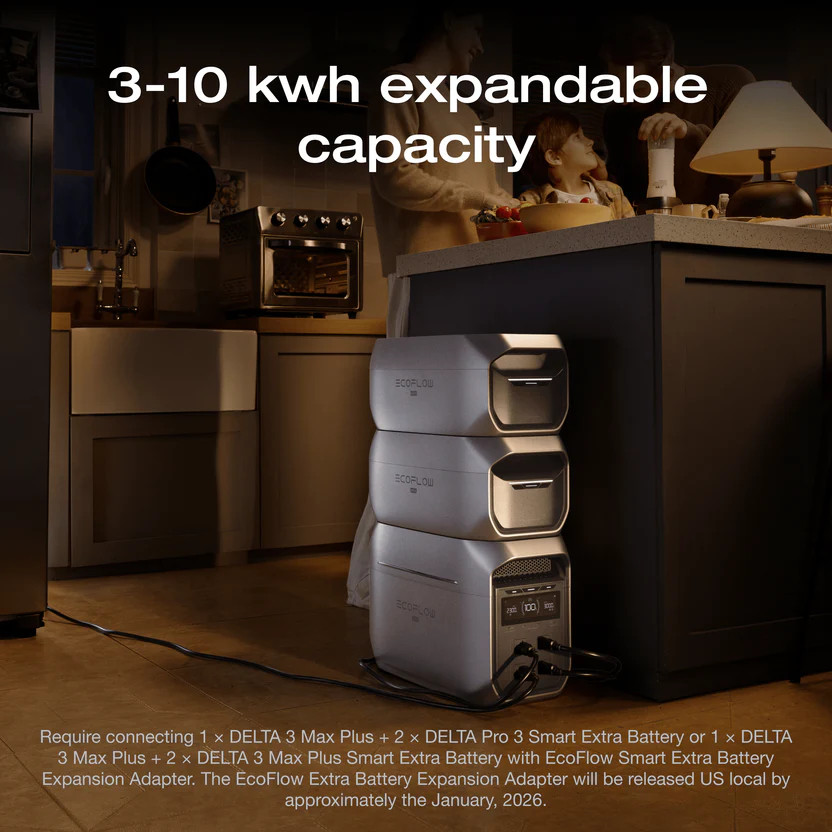
Runs a fridge, CPAP, lighting, fans, and full comms for 2–3 days per charge, and significantly longer when paired with solar panels. Some models offer 120V/240V split-phase output for well pumps and heavy appliances that smaller units simply can't handle. Many support expansion batteries; a 4,000Wh base unit can scale to 12,000–48,000Wh, enough for a full week of household power. This modular approach lets you invest gradually: buy the base this season, add batteries next year as budget allows.
Five Specs That Actually Matter
- Battery Capacity (Wh): Determines total runtime.
- Continuous AC Output (W): Must exceed your highest-draw device.
- Surge Rating (W): Handles motor startups. Should be 2× your continuous needs.
- Charging Speed: The best stations reach 80% in 45–60 minutes via AC.
- Solar Input (W): Higher wattage = faster post-storm recharging.
Step 3: The 72-Hour Hurricane Power Plan
Having the right station is half the battle. How you manage your power across three phases determines whether you cruise through a blackout or burn your reserves in 12 hours.
Phase 1: Pre-Storm (24–48 Hours Out), Maximize Everything
Charge your power station to 100%. This is job number one. If you have expansion batteries, charge those too. Most modern stations reach full in 1–2 hours via AC.
Charge every portable device in the house. Phones, tablets, laptops, rechargeable flashlights, lanterns, portable fans, power banks. Each fully charged device is a small energy reserve that reduces the load on your main station later.
Prepare your refrigerator. Turn the fridge and freezer to their coldest settings. This builds a "thermal reserve", a fully loaded freezer can maintain safe temperatures for up to 48 hours if the door stays shut. Fill empty space with water bottles or ice bags.
Run a dry test. Flip your main breaker off for 2–3 hours and run your household on the power station alone. You'll discover problems you never anticipated: the fridge compressor trips the station's protection, you're missing an adapter cable, or you forgot about the fish tank pump. Better to find these now than at 2 AM during a Category 3 hurricane.
Stage your solar panels indoors. If you own solar panels, don't leave them outside during the storm, high winds will destroy them. Have them accessible with cables pre-organized so you can deploy them immediately once the storm passes. Know exactly where you'll set them up (south-facing driveway, backyard, clear patio).
Phase 2: Active Outage, Conserve Ruthlessly
Cut phantom loads. Unplug everything not actively needed. TVs, game consoles, and chargers with nothing connected can silently drain 50–100W around the clock.
Practice light discipline. One LED headlamp for tasks, one lantern in the main room. Save the station's AC outlets for devices that actually need them.
Manage the fridge strategically. Plan meals in advance, open the door briefly, grab everything at once, close it. A well-sealed, full fridge holds safe temperatures for 4–6 hours without power. Running it intermittently, 2 hours on, 2 hours off, stretches battery reserves significantly.
Schedule power in blocks. Create two daily windows instead of running everything continuously:
- Morning (7–8 AM): Run the fridge, charge phones, check news and weather.
- Evening (6–7:30 PM): Run the fridge again, heat a meal, top off devices.
- In between and overnight: Low-draw only, single LED light, Wi-Fi router, medical devices.
This scheduling approach can effectively double your station's usable runtime.
Keep phones on airplane mode when not actively in use. Switch off airplane mode a few times daily for emergency alerts, then switch it back. This stretches a phone charge from 1 day to 3–4.
Phase 3: Post-Storm, Recharge and Rebuild
The storm has passed, but the grid may stay down for days or weeks. This is where your recharging strategy determines whether you're comfortable or counting hours.
Deploy solar panels immediately. If you have solar panels, get them set up as soon as conditions are safe. Even partial sunlight on a cloudy post-storm day generates meaningful power. A full sunny day with a 400W setup can push 1,000–1,500Wh back into your station, nearly enough to cover a full day of essential use. (More on solar strategy below.)
Use your car as a backup charger. Most portable power stations charge from a 12V car outlet. Running your car for 30–60 minutes pushes several hundred watt-hours into the station. Less efficient than AC or solar, but reliable when nothing else is available. Keep your gas tank above half full throughout hurricane season for exactly this reason.
Monitor battery levels through the app. Most modern stations offer smartphone apps showing real-time input/output wattage, remaining capacity, and estimated runtime. If you're at 40% with 6 hours until sundown, you know exactly how aggressive your conservation needs to be.
Prioritize what gets power first. Resume running the refrigerator, keep phones charged for insurance calls, FEMA contact, and family coordination. If you're able to charge from solar during the day, save stored battery capacity for overnight medical devices and lighting. Non-essentials stay off until the grid returns or your panels are generating consistent surplus.
Solar Panels: How to Extend Your Backup from Days to Weeks
After a major hurricane, the average power outage lasts 3–7 days. In hard-hit areas, it can stretch to weeks. During prolonged outages, gas stations close, roads get blocked, and fuel deliveries become impossible.
Families with solar panels and portable power stations are consistently the ones who keep their food cold, phones charged, and medical devices running through it all.
Solar panels can't help during the storm itself, heavy rain and dangerous winds make them useless and vulnerable.
But the moment the weather clears, they become your single most valuable recovery asset. Here's how to make the most of them.
Choosing the Right Panels
Foldable panels with built-in kickstands are easiest to deploy and store. Look for IP67/IP68 weatherproofing so post-storm moisture won't cause problems. Higher wattage (200–400W per panel) recharges faster but adds weight.
A pair of 200W panels is a good balance of portability and power. Make sure connectors are compatible with your station (most use MC4 or proprietary).
Realistic Charging Math
A 400W solar panel produces roughly 400W under ideal conditions. Over 5–6 hours of usable sunlight, that's approximately 2,000–2,400Wh generated per day. After real-world losses (clouds, angle, heat), expect 1,000–1,500Wh daily, enough to keep a refrigerator cycling, phones charged, lights on, and a CPAP running every night. Indefinitely, as long as the sun comes out.
A practical strategy: run your refrigerator and charge devices during peak solar hours (10 AM – 4 PM) when panel input roughly matches output.
This effectively runs those devices on "free" solar power while preserving your stored battery capacity for overnight use, medical devices, lighting, and anything else that can't wait for sunrise.
This is the difference between counting down the hours until your battery dies and knowing that tomorrow's sunshine refills your reserves. A power station alone is a finite backup. A power station plus solar panels is a renewable energy system.
Quick-Reference: Complete Hurricane Prep Checklist
Your power station is the hub that keeps the rest of your emergency plan functional. Here's everything else you need alongside it:
- Water: 1 gallon per person per day, minimum 3-day supply
- Food: 3–7 days of non-perishables (canned goods, peanut butter, granola bars, dried fruit)
- Communication: NOAA weather radio (battery or hand-crank), fully charged phones
- Lighting: Rechargeable LED lanterns and headlamps, no candles (fire risk from gas leaks)
- Medical: 7+ day supply of prescriptions, first aid kit, charged medical devices
- Documents: Insurance policies, IDs, medical records in a waterproof bag; digital copies on a USB drive
- Cash: $200–500 in small bills (ATMs and card readers need power too)
- Vehicle: Gas tank above half full throughout hurricane season, it's your evacuation vehicle and backup charging source
Notice the thread running through this entire list: almost every item depends on electricity to stay useful. Your phone needs charging. Your medical devices need power.
Your fridge keeps food safe. Your LED lights need periodic recharging. The portable power station isn't just another item on this checklist; it's the hub that makes everything else functional when the grid goes dark.
Start Now, Not When the Warning Comes
The 2026 hurricane season begins June 1. Every year, the pattern repeats: a storm enters the forecast cone, and portable power stations sell out overnight. Prices spike. Shipping delays stack up. Families scramble.
The average household loses over $1,500 during a multi-day outage, spoiled food, emergency hotel stays, damaged electronics, missed work.
- Parents Are Prioritising Breathable, Sustainable Fabrics For Children's Seasonal Sleepwear
- Our Homemade Christmas Printables, Made With AI: What Worked, What Didn't, and What I'm Saving for Next Year
- At-Home vs. In-Lounge IV Therapy in the Hudson Valley: Which Makes More Sense?
- Can Passengers Pursue Compensation After a Car Accident?




A quality power station costs roughly the same but serves you for a decade of hurricane seasons, camping trips, and everyday backup.
With LFP batteries lasting 3,000+ cycles, it's a one-time investment that pays for itself the first time the lights go out.
Assess your family's needs. Pick the right capacity. Charge it up. Pair it with solar if the budget allows. Run a test. Then put it away and hope you never need it, knowing that if you do, you're ready.





Leave a Reply