

Kids don't just "use" their rooms; they live entire mini-lives in there, reading, building forts, doing homework, negotiating with sleep like tiny lawyers. Good children's room lighting quietly supports it all.
Good lighting in your child's bedroom isn't just about picking a cute fixture. It affects how well they sleep, how safely they play, and whether bedtime turns into a 45-minute negotiation.
The good news? Getting it right doesn't require an interior designer or an electrician, just a few smart decisions made in the right order.
Jump to:
- Why the Lights in Your Kid's Room Actually Matter
- How Much Light Does a Kid's Room Actually Need?
- Warm Light vs. Cool Light: The One Rule to Remember
- Building the Room: Think Zones, Not Just One Light
- Are LED Lights Actually Safe for Kids?
- Custom LED Neon Signs: The Fun Part (With a Few Honest Notes)
- Screens, Tablets, and the Thing No Product Page Mentions
- Key Takeaways: Here's What You Actually Need to Remember
Why the Lights in Your Kid's Room Actually Matter
Most parents focus on furniture, colors, and storage when setting up a child's bedroom. Lighting usually gets whatever was on sale at the hardware store. But that matters more than you'd think.
Children's eyes are more sensitive to bright and blue-toned light than adults' eyes, especially in the evening.
The Sleep Foundation explains that exposure to bright or screen-heavy light before bedtime can suppress melatonin, the hormone that helps your child feel sleepy at roughly twice the rate it does in adults.
A University of Colorado study found that even relatively low levels of light in the hour before bed can significantly reduce melatonin levels in young children.
What that means in plain terms: if your kid's bedroom is bright and cool-toned right before sleep, their brain thinks it's still daytime. No amount of "just go to sleep" is going to fix that.
Good kids' bedroom lighting is really about giving your child two modes: bright and energizing for play and homework, soft and warm for winding down. One overhead bulb on a single switch can't do both. That's the whole secret, honestly.
How Much Light Does a Kid's Room Actually Need?
You don't need to get technical here. A few practical numbers help, though.
Think about it in layers rather than one big bright light:
- Main ceiling light: This is your everyday brightness, bright enough to play LEGO or read a book on the floor. For an average kid's bedroom, something in the range of 1,000 to 1,500 lumens works well. (Lumens are just the number on the bulb box; higher means brighter.)
- Bedside or reading lamp: Much softer. Around 300 to 400 lumens is enough to read by without straining one's little eyes.
- Night light: Barely bright enough to make the room feel safe and find the door. That's it.
The fix most parents don't think of: put the main ceiling light on a dimmer switch. It's usually a $15–$20 upgrade, and it lets you dial from "let's build a fort" brightness down to "time to sleep" without buying a second fixture. Genuinely one of the highest-value lighting decisions in a kids' room.
Warm Light vs. Cool Light: The One Rule to Remember
Here's the one thing worth remembering from this entire guide: warm light for evening, cooler light only where focus matters.
Bulbs come in different "shades" of white, ranging from warm yellow-white (like a cozy lamp) to crisp blue-white (like a hospital waiting room). The cooler and brighter the light, the more it tells your child's brain to stay alert.
For bedrooms, especially the hour before sleep, stick with warm white bulbs. On the bulb box, look for 2700K, which is the warm, relaxed end of the scale. Cleveland Clinic's sleep specialists specifically flag bright, cool-toned nightlights as a common reason kids struggle to fall asleep.
If your child has a desk in their room, that's the one place where slightly brighter, neutral light (around 3500–4000K) makes sense; it genuinely helps with focus during homework.
But keep that on a separate lamp with its own switch, so it's not bathing the whole room in "study mode" at 8 pm. The fast rule: if a bulb looks bluish-white, it doesn't belong near your child's bed.
Building the Room: Think Zones, Not Just One Light
One ceiling light doing everything is the most common mistake in kids' bedrooms. Real rooms, real kids need more than that.
A good kids' bedroom lighting setup has three zones:
1. The main light (for the whole room)
A ceiling fixture with a shade or diffuser (something that softens the light rather than pointing a bare bulb downward) gives even, gentle brightness across the room. Add a dimmer if you can.
2. The focused light (for reading or homework)
A bedside lamp or a desk lamp, wherever your child does their focused work. Wall-mounted reading lights are brilliant for kids who have a habit of knocking table lamps onto the floor, which is most of them.
3. The accent light (for personality)
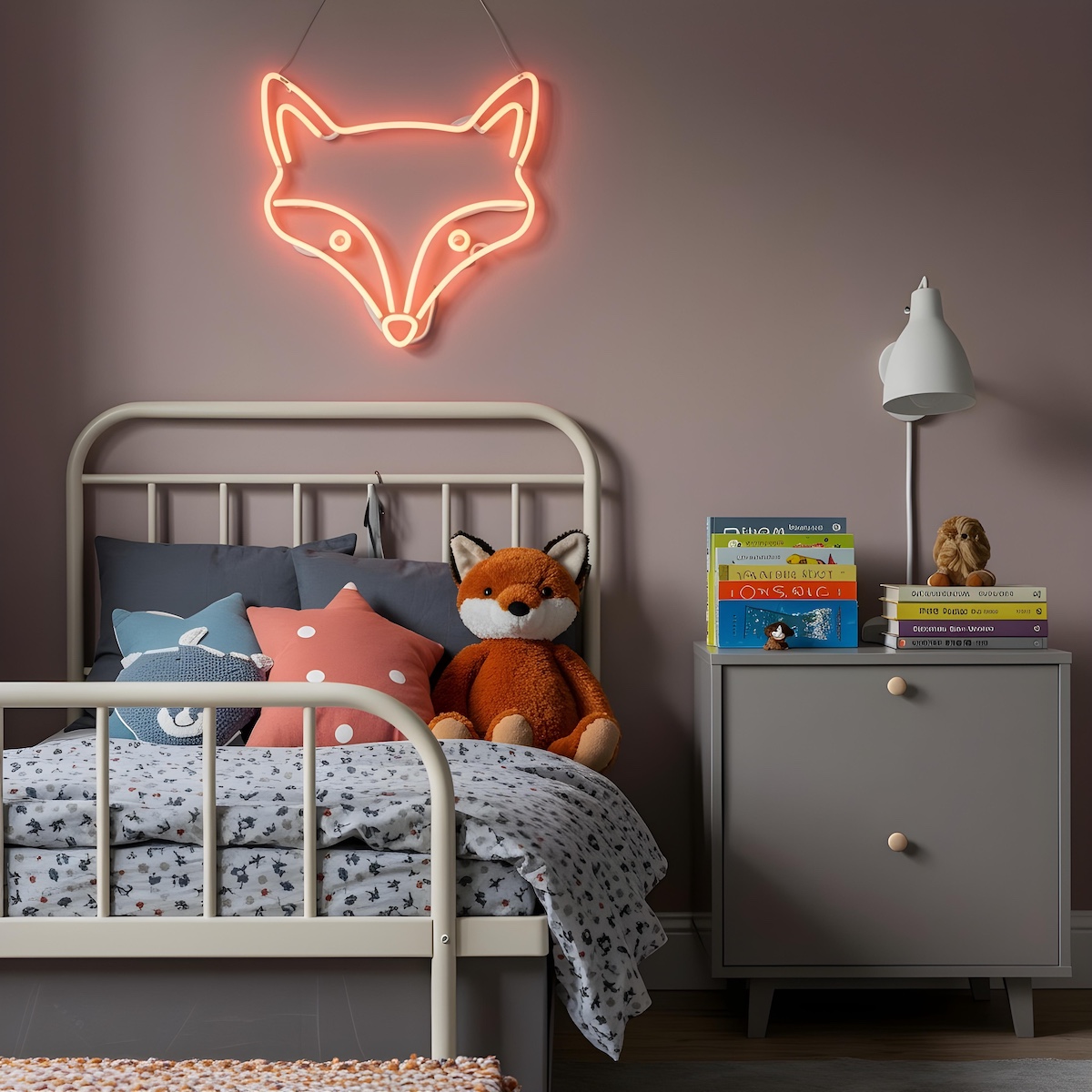
This is where neon signs for kids' bedrooms, fairy string lights, or soft LED strips come in. These aren't your main light sources; they're the bits that make a room feel like your child's room rather than just a generic bedroom.
A soft glow over a reading nook or a custom LED neon sign above a desk corner adds warmth and character without blinding anyone.
Getting these three layers right means you can have a room that's genuinely bright during play and genuinely calm at bedtime without swapping fixtures out twice a day.
Are LED Lights Actually Safe for Kids?
Short answer: yes, and they're a better choice than older-style bulbs for a kids' room specifically.
Here's why parents often worry that some older LED bulbs flicker or have a slightly harsh quality, raising questions.
Modern LEDs have improved significantly, and lighting guides now point to two clear advantages for kids' rooms:
- They don't get hot. Old incandescent bulbs could get dangerously warm. LEDs stay cool, which matters in a room where a child might touch a lamp shade, drag a blanket against a light, or knock a fixture out of alignment.
- They use far less energy, meaning even if they're left on for hours (and they will be), you're not running up your electricity bill or heating the room.
A few things to watch for when buying:
- Look for "warm white" on the box (or 2700K) for any bedroom fixture.
- Avoid very cheap, unbranded bulbs, as some can have a noticeable flicker that's visually uncomfortable over time.
- For lampshades and fixtures in younger kids' rooms, skip glass; there are plenty of fabric, plastic, and silicone options that do the job safely.
For nightlights specifically: keep them dim and warm. Studies consistently show that even low-level bright light before sleep can delay melatonin in young children, so the "just in case it's too dark" nightlight that doubles as a small sun is working against you every night.
Custom LED Neon Signs: The Fun Part (With a Few Honest Notes)
Custom LED neon signs have become the feature kids actually ask for, and unlike a lot of trendy decor, they're not a bad idea when used correctly.
Modern custom LED signs use flexible LED tubing rather than glass, which means they run at low voltage, stay cool, and don't shatter.
They're much safer for kids' rooms than traditional glass neon, and many come with dimmers and remote controls so you can adjust brightness based on time of day.
Where they work well:
- As a gentle accent over a reading nook, above a dresser, or in a "chill corner" of the room.
- As a low-brightness warm nightlight alternative, a soft neon sign can create a calming glow that kids find reassuring without being bright enough to disrupt sleep.
- As the personalisation piece that makes your child feel like the room was designed for them. A name, a favourite phrase, a little cloud shape, kids love it, and it doubles as decoration that actually does something useful.
One honest take: don't go too blue or too cool-white on the color. Those tones look great on social media but are harsher on sleep in the evening, and we know kids are particularly sensitive to cool, blue-leaning light at night.
Stick to warmer tones, pinks, oranges, soft whites, or yellows if the sign is going to be on in the evening.
Also, buy from an LED neon sign company that actually lists the specs (voltage, dimming options, materials) rather than just posting aesthetic photos.
The cheap ones can have color inconsistencies and buzzing annoying enough that you'll want to replace them in six months.
Screens, Tablets, and the Thing No Product Page Mentions
You can have the most perfectly planned kids' bedroom lighting and still destroy your child's sleep with two hours of tablet time before bed. Worth saying plainly.
Screens emit exactly the kind of bright, blue-toned light that delays sleep in children. Research consistently links evening screen use among kids and teens to lower melatonin levels, later sleep onset, and shorter overall sleep duration.
For preschoolers, studies show that light before bed can reduce melatonin by around 90%, and the room doesn't even have to be that bright for it to happen.
Sleep researchers and medical groups broadly suggest:
- No screens in the hour before bed, especially for younger children.
- Shift to warm, soft lighting in that wind-down window, a low bedside lamp, or a dim warm nightlight, not full overhead brightness.
- Keep nightlights just bright enough to provide comfort and nothing more.
If your child genuinely has trouble sleeping without some light, that's completely normal, and a warm, dim nightlight is the right answer.
The goal isn't total darkness; it's just making sure the light that is on isn't actively telling their brain to stay awake.
- Parents Are Prioritising Breathable, Sustainable Fabrics For Children's Seasonal Sleepwear
- Our Homemade Christmas Printables, Made With AI: What Worked, What Didn't, and What I'm Saving for Next Year
- At-Home vs. In-Lounge IV Therapy in the Hudson Valley: Which Makes More Sense?
- Can Passengers Pursue Compensation After a Car Accident?




Key Takeaways: Here's What You Actually Need to Remember
Here's what all the research, all the guidance, and all the practical experience point to for kids' bedroom lighting in 2026:
1. Layer the light. One ceiling light on a dimmer, a focused reading lamp, and a small accent piece covers 90% of what a child's bedroom needs.
2. Go warm in the evenings. Warm white bulbs (around 2700K), dim nightlights, and switching off screen glow an hour before sleep make a real difference to how quickly and how well your child sleeps.
3. Choose LEDs, but choose them wisely. Modern LED lighting for kids' rooms is genuinely safe, cool to the touch, and energy-efficient. Just pick warm-toned options and decent quality over the cheapest thing available.
4. Add the fun piece intentionally. A custom LED neon sign, fairy lights, or a soft LED strip in a corner gives a kids' room personality without compromising on safety or sleep, as long as it's warm-toned, dimmable, and not doing the heavy lifting as a main light source.
Get those four things right, and the room works for your child at every hour, bright and lively for Saturday morning cartoons, soft and calm for Sunday night wind-down. That's really the whole goal.





Leave a Reply