

In recent years, interest in the Easter nativity depicting the Passion and Resurrection of Christ has grown, offering a visual way to reflect on the central mystery of Easter.
Where once our mantelpieces were the exclusive preserve of shepherds and swaddling clothes in December, many families are now discovering that the drama of Holy Week, too, can be contemplated through carefully crafted figures and scenes.
This revival isn't a novelty born of seasonal décor trends. It's a devotional instinct, the desire to see what we profess in the Creed: that Christ suffered, died, was buried, and rose again on the third day.
Jump to:
What Is an Easter Nativity?
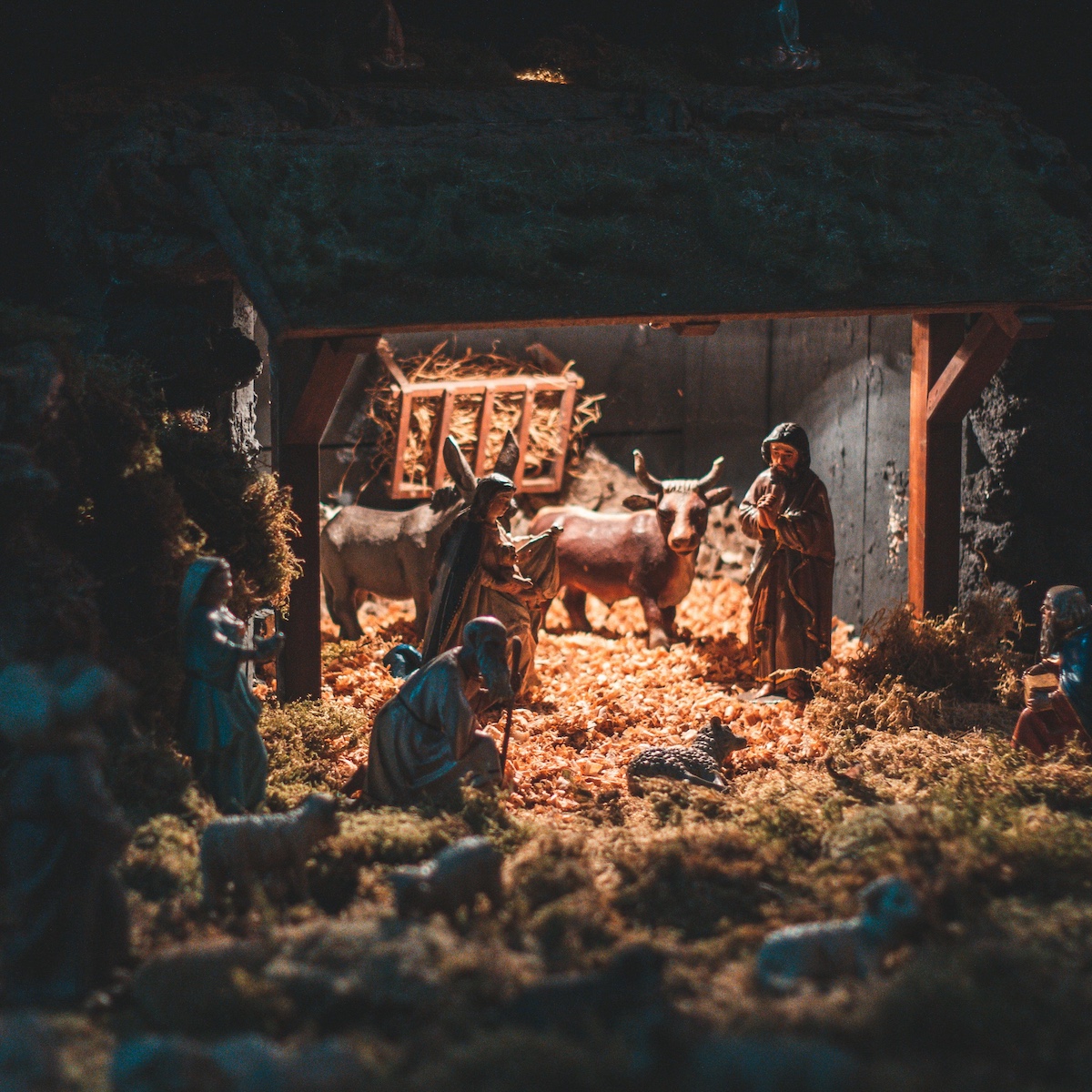
An Easter nativity is a sculptural or figurative display representing the key events of Holy Week and the Resurrection. Instead of Bethlehem's stable, we encounter the Upper Room, Gethsemane, Calvary and the empty tomb.
I find it rather beautiful that the same instinct which moves us to set out a crib at Christmas, the need to make the mystery visible, is now finding expression at Easter too.
Because if the Incarnation deserves a stable full of painted ceramic figures, surely the Passion and Resurrection deserve no less.
Unlike static seasonal ornaments, Easter nativity sets often unfold progressively throughout Lent and the Triduum, allowing families and parishes to walk with Christ from Palm Sunday to Easter morning. One scene at a time. One day at a time. Each figure placed with intention.
The Theological Heart of It, Visual Catechesis in Action
At the centre of the Easter nativity lies the Paschal Mystery, Christ's Passion, Death and Resurrection. The Church has always understood the value of sacred images as aids to contemplation.
From medieval mystery plays to Renaissance altarpieces, visual storytelling has helped the faithful enter more deeply into salvation history.
An Easter nativity functions in much the same way. It becomes a domestic catechism, a silent homily in wood or resin.
Children can see the sorrow of Good Friday and the triumph of Easter Sunday. Adults are invited to linger, reflect and pray before the scenes.
Think of it like this: a child who has watched their parents reverently place the figure of the Risen Christ outside the empty tomb on Easter morning carries that image for a lifetime. No textbook manages that quite so well.
In a world saturated with fleeting images, a devotional display rooted in the Gospel offers something genuinely countercultural: stillness, reverence and theological depth.
Is There Historical Precedent for the Easter Nativity?
While the Christmas crib is famously associated with St Francis of Assisi and his living Nativity at Greccio in 1223, the impulse to depict Christ's Passion visually is far older.
Medieval churches across Europe featured Passion cycles in fresco, sculpture and stained glass, entire visual narratives painted across walls and windows for congregations who could not read.
The Stations of the Cross, in particular, became a structured way for the faithful to meditate visually on Christ's suffering. Each station a scene. Each scene an invitation to pause and pray.
The Easter nativity can be seen as a domestic continuation of this tradition, bringing what was once primarily a parish-based devotion into the heart of the home.
So while the format may feel new, the instinct behind it is deeply rooted in Catholic spirituality. We are not inventing something; we are remembering something.
Why Is This Devotion Growing Now?
Several cultural and spiritual factors help explain the renewed interest, and none of them are particularly complicated.
First, there is a genuine hunger for tangible faith practices. In an increasingly digital age, where so much of our devotional life risks becoming abstract, scrollable and forgettable, physical symbols and sacred objects anchor prayer in reality. You cannot swipe past a figure of Christ crucified on your kitchen shelf.
Second, families are seeking meaningful ways to mark the liturgical year beyond Christmas. Lent and Easter, rich though they are, often lack the visible domestic customs that Advent enjoys. An Easter nativity fills that gap rather beautifully.
Finally, there is a renewed appreciation for catechesis within the home. Parents and grandparents are rediscovering their role as the first teachers of the faith, and visual aids have a way of sparking conversations that no amount of formal instruction can replicate. A child pointing at a figure and asking "why is he carrying a cross?" is already doing theology.
How to Use an Easter Nativity in the Home
An Easter nativity need not be elaborate to be fruitful. What matters is intentionality. Here are a few simple ways families bring it to life:
- Introduce one scene at a time during Holy Week, the Last Supper on Holy Thursday, the Crucifixion on Good Friday, the empty tomb revealed on Easter morning
- Read the corresponding Gospel passage together before placing each figure
- Invite children to place the figures reverently as part of a short prayer
- Position the display somewhere visible, near a prayer corner, on a side table, or even the dining room, so it becomes a natural focal point throughout the week
The empty tomb, left bare until Easter Sunday, creates a quiet dramatic tension that children feel instinctively. And when the Risen Christ finally appears? That moment lands.
A Devotion Rooted in the Heart of the Faith
The Christmas crib invites us to kneel at the mystery of the Incarnation. The Easter nativity invites us to stand at the foot of the Cross, and then to run, breathless and astonished, toward the empty tomb.
In contemplating the Passion and Resurrection through sacred imagery, believers are not indulging in sentimentality.
They are entering more fully into the drama that defines Christianity itself. The same drama that early Christians painted onto catacomb walls.
- Parents Are Prioritising Breathable, Sustainable Fabrics For Children's Seasonal Sleepwear
- Our Homemade Christmas Printables, Made With AI: What Worked, What Didn't, and What I'm Saving for Next Year
- At-Home vs. In-Lounge IV Therapy in the Hudson Valley: Which Makes More Sense?
- Can Passengers Pursue Compensation After a Car Accident?




The same drama that sent medieval stonemasons up scaffolding to carve scenes no one on the ground could easily see, because it still needed to be there, carved into stone, as an act of devotion rather than display.
And perhaps that is precisely why the Easter nativity depicting the Passion and Resurrection of Christ is quietly finding its place in homes once more: because Easter is not merely remembered, it is lived, seen and celebrated, year after year.





Leave a Reply