

Preparing for your child's educational future is an important cornerstone of sound family financial planning. With so many options available, understanding how to select the right Registered Education Savings Plan (RESP) is essential. Many Canadian families have wondered about the best approach, and the family vs individual RESP comparison is a crucial starting point for determining what fits their needs. The right choice can significantly impact the money available when your child starts post-secondary studies.
RESPs offer more than tax-deferred growth; they unlock access to valuable government grants. However, choosing between Individual and Family RESP plans depends on factors like family structure, children’s potential education paths, and how you want to manage your contributions. Getting the basics right can mean maximizing your education savings and leaving money on the table.
Understanding RESPs
A Registered Education Savings Plan (RESP) is a unique Canadian account designed to help families save for a child’s post-secondary education. One of the biggest advantages is that RESP contributions grow tax-free until withdrawn. Families can benefit from government grants, like the Canada Education Savings Grant (CESG) and the Canada Learning Bond (CLB), which boost total savings. While the beneficiary will pay income tax on the educational assistance payments they receive, students typically pay little or no tax due to their lower income during school.
RESPs are regulated by the federal government and offered through various financial institutions. Deciding on the appropriate plan type at the outset can help avoid headaches as family dynamics and education goals evolve.
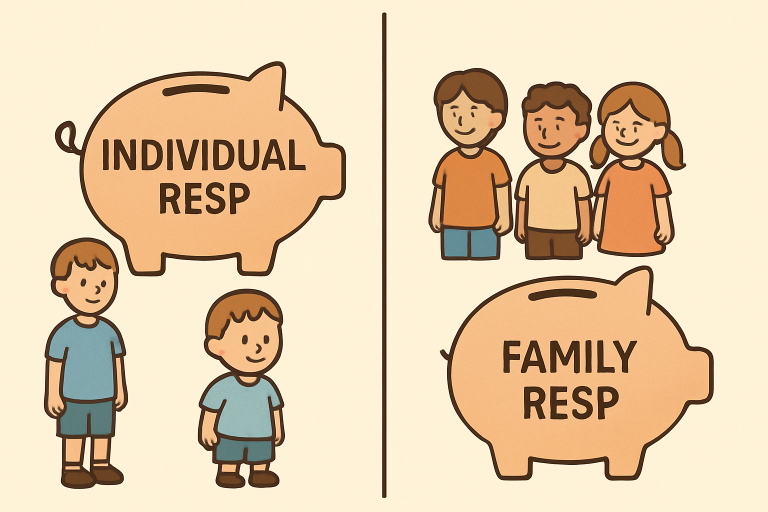
Individual RESPs
An Individual RESP is set up for a single beneficiary, making it a straightforward option for families with one child or when they want to tailor investments individually. Flexibility is a key feature: the beneficiary has no age restrictions, and anyone can open the account regardless of family relationships. This can be useful for grandparents, godparents, or close family friends who want to contribute. Each Individual RESP can be managed according to the particular goals, risk tolerance, and timeframe suitable to the beneficiary's needs.
Who Should Consider an Individual RESP?
- Families with only one child.
- Those wanting customized investments for each child.
- Account holders who might not be closely related to the child.
Family RESPs
A Family RESP allows savings for multiple children in one plan, as long as all beneficiaries are related by blood or adoption to the subscriber (e.g., parents, grandparents, or siblings). The added flexibility of a Family RESP is beneficial for parents with several kids. If one child chooses not to pursue post-secondary education, their share of grants and investment income can be allocated to the other sibling beneficiaries, subject to specific grant rules.
Who Should Consider a Family RESP?
- Families with two or more children or expecting to grow their family.
- Subscribers who want to simplify management with one account.
- Situations where it’s important to ensure any unused grant room can benefit another sibling.
🤖 Looking For An Answer?
Ask AI to summarise this post to see if the article answers your questions:
Contribution Limits and Government Grants
Individual and Family RESPs adhere to the same contribution cap: a lifetime maximum of $50,000 in contributions per beneficiary, with no annual limit set. The Canada Education Savings Grant (CESG) adds 20% to the first $2,500 contributed annually, up to $500 annually, and a $7,200 lifetime maximum per child. The Additional CESG offers extra grants for lower-income families, and the CLB is available to children from modest-income families. However, only siblings under 21 can share the Additional CESG and CLB grants in a Family RESP, so understanding grant eligibility is important when managing multiple beneficiaries.
Flexibility and Restrictions
Choosing between Individual and Family RESPs centers on the flexibility you need. Individual RESPs are great for providing tailored investment options on an account-by-account basis. Family RESPs, on the other hand, excel for families who want to streamline their savings and ensure no grant money is wasted if one sibling doesn’t enroll in post-secondary studies.
- Individual RESP: Personalized investment strategies and wide eligibility for those who can open and contribute to the account.
- Family RESP: Hassle-free management of savings for multiple kids; grants and funds can be shared among siblings as long as government regulations are followed.
Crucially, if one child doesn’t pursue post-secondary studies in a Family RESP, their contribution room and grants may be transferred among eligible siblings, within the government-imposed limits. This makes maximizing your family’s available government benefits easier while maintaining control.
Making the Right Choice
As you evaluate which plan best aligns with your long-term savings strategy, consider:
- Your family’s current size and the likelihood of future children.
- The relationship between yourself (the subscriber) and your beneficiary/beneficiaries.
- How much flexibility and simplicity do you want when managing contributions and grants?
Ultimately, personalizing your approach—possibly with guidance from a financial advisor—can help you maximize your RESP contributions and available grants.
Final Thoughts
Making an informed choice about your RESP means more than just opening an account. By weighing the specific features, limits, and benefits of Individual and Family RESPs, and keeping abreast of government grant opportunities and plan-management strategies, you can set your children up for educational success. Careful planning today ensures your RESP delivers maximum value tomorrow.





Leave a Reply